
Key takeaways
- A maglock has no mechanical latch: power holds the door, and removing power is the only way it releases.
- Every maglock opening should prove five release paths: normal egress, valid access, fire and life-safety release, power loss, and free mechanical movement.
- The approved release sequence is part of the locking system, not an optional accessory.
- A maglock is fail safe by nature, so a power outage is a designed release and the secure side should be planned around it.
- Delayed egress and sensor-release arrangements are special locking systems allowed only where adopted code, approved plans, and the authority having jurisdiction permit them.
- When the release sequence is undocumented, the correct move is to stop and verify, not to improvise or bypass.
How it works
Power holds the door; removing power releases it.
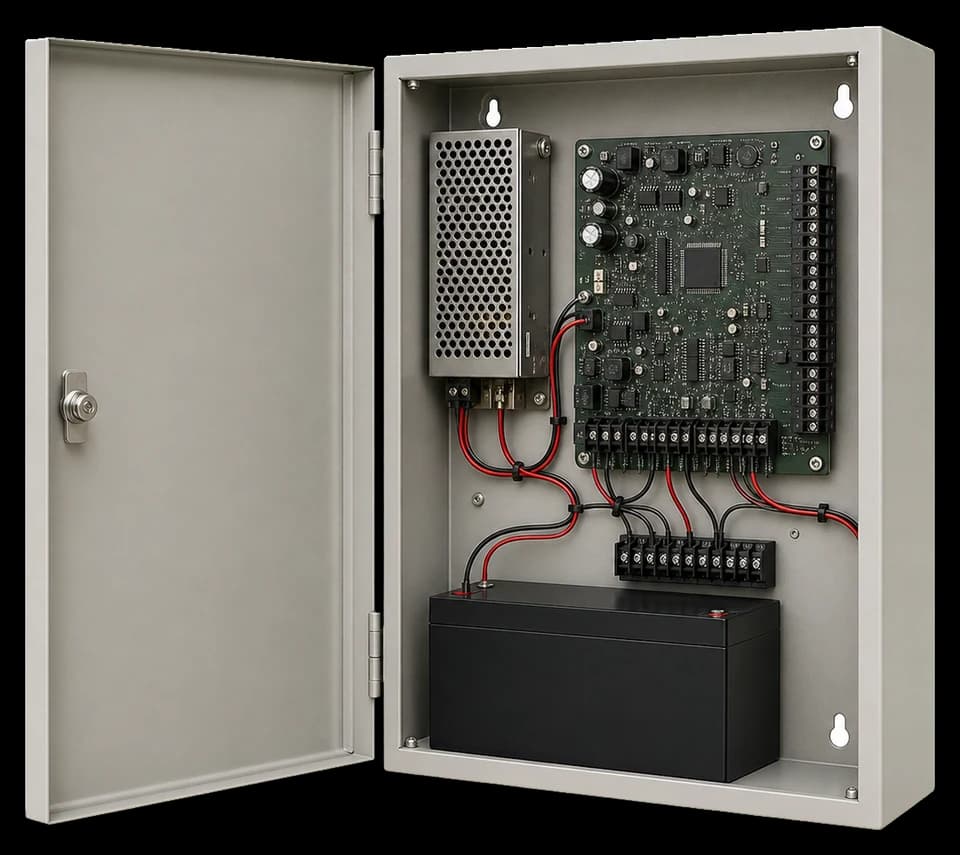
A magnetic lock is a two-piece assembly. An electromagnet mounts to the frame, usually at the header, and a steel armature plate mounts to the door. While the magnet is powered, it grips the armature and holds the door closed. There is no latch, no bolt, and no mechanical retraction anywhere in the assembly — continuous electrical power is the only thing securing the door.
That single fact drives everything else about the opening. Removing power is the only way a maglock releases, which makes the hardware fail safe by nature, and it means the safety of the opening lives in the circuits and devices that remove power rather than in the lock body itself.
A maglock also never works alone. The door, frame, hinges, closer, and the access control system that commands the magnet behave as one system, and the release logic — what can cut power, and under which conditions — is the part of that system property teams most often inherit without documentation.
The release map
What are the five release paths a maglock opening must prove?
Five separate paths must either remove the magnet's power or prove the door physically moves. A healthy opening demonstrates all five, not just the one that prompted the service call.
| Release path | What releases the door | What proves it works |
|---|---|---|
| 1. Normal egress | A request-to-exit (REX) sensor or button, or approved egress-side hardware, removes power | A person leaves through normal use without a key, credential, special knowledge, or special effort |
| 2. Access granted | The controller interrupts power for the set unlock time | A valid credential releases the door promptly, and the opening re-secures after the set time |
| 3. Fire and life safety | The approved fire and life-safety interface removes power as designed | The documented release sequence operates the way the approved plans describe |
| 4. Power loss | Loss of power releases the magnet; a maglock is fail safe | With power removed, the door is no longer held from either side |
| 5. Mechanical movement | Nothing electrical — the door itself must move | After release, the door swings freely with no residual grip or binding |
Path one
How does normal egress work at a maglocked door?
A maglocked door has no latch for egress hardware to retract, so leaving depends entirely on a device that removes power. In most designs that device is a request-to-exit sensor that detects a person approaching the door, a push button at the opening, or egress-side hardware approved to interrupt the circuit as part of the release arrangement.
The standard to hold the opening to is simple: a person should be able to leave through normal use without a key, a credential, special knowledge, or special effort. If leaving requires badging out, waiting, or knowing which device to touch, the opening deserves review against its approved documents.
REX devices are inputs to the release logic, not accessories. A failed sensor or a repositioned button changes how the opening behaves in exactly the situations that matter most, so treat them as part of the lock when scheduling service, and expect them to be tested whenever the opening is worked on.
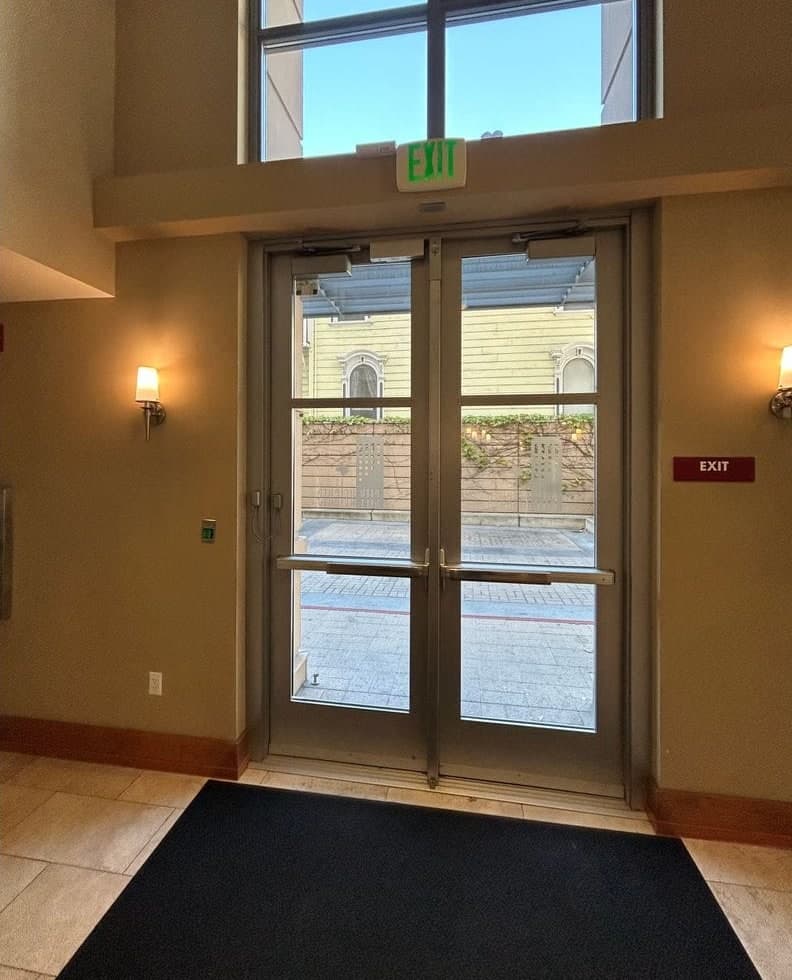
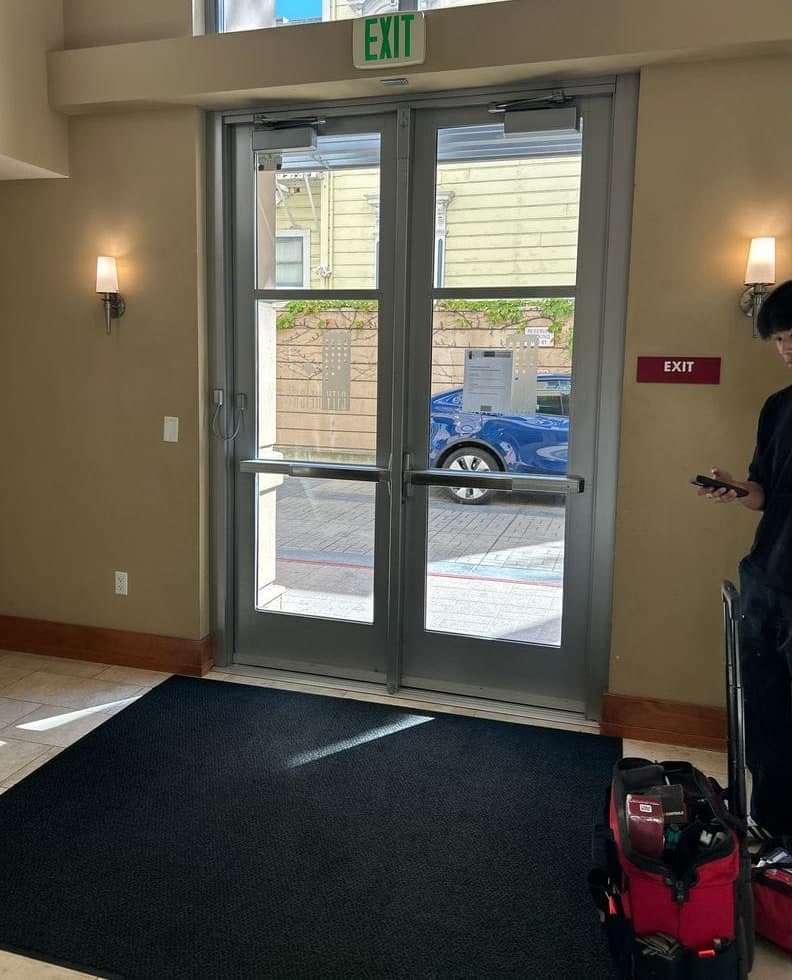
See all before and after photos
Path two
What should a valid credential actually do?
On a valid credential, the controller interrupts the maglock's power for a set unlock time, the door opens, and the magnet re-engages once power returns. There is no motor or latch in the sequence — the grant is a timed removal of power and nothing more.
Three things are worth confirming from the property side. The release should be prompt when the credential is accepted, with no tugging or second attempt. The unlock time should match how the opening is used — long enough for carts, deliveries, and slower users, short enough that the door is not left effectively unsecured. And the opening should reliably re-secure after each grant, which is easy to observe by letting the door close and checking that it holds.
Path three
How does the fire and life-safety release work?
Where a maglock is part of a required exit, the approved design connects it to the building's fire and life-safety systems, and that interface must release the door as designed. The sequence — which conditions release which doors, and in what order — is engineered into approved plans, not improvised at the opening.
Because the release involves the life-safety system, verifying it is coordinated work: testing is scheduled with the responsible alarm contractor and building management, follows the approved documents, and gets recorded. What a property team should never accept is a field change to the interface — disconnecting it, wiring around it, or temporarily feeding the magnet from a different supply alters a life-safety sequence without authorization.
If the interface's behavior is unknown because the building changed alarm vendors, drawings are missing, or the panel has been altered, treat the sequence as unverified until qualified review confirms it.
Path four
Power loss is a designed release, not a malfunction.
When power drops, a maglock releases. That is the intended behavior — the hardware is fail safe — and it should be planned for rather than discovered during the first outage.
For a property team, the planning question sits on the secure side: during an outage the opening is no longer held, so decide in advance what protects the space, whether that is staffing, patrol coverage, or other secured openings along the path. Any backup power for the magnet belongs in the approved design, because a supply that keeps the magnet holding must still honor every release path.
Two follow-ups matter after any outage. Confirm the opening re-secured when power returned — a tripped breaker or failed supply leaves the door released indefinitely — and never respond to outage behavior by rigging the magnet to stay powered from an unapproved source.
Path five
Why is a freely swinging door its own release path?
Every other path lives in wiring and logic; the fifth is physical. After power is removed, the door must actually swing freely — no residual grip at the armature, no binding at the hinges or threshold, and no condition at the closer that keeps the leaf from moving.
The distinction matters because a release can look complete everywhere except at the door. A controller can log the grant, the interface can operate, and the circuit can be verifiably dead while the leaf still resists because the opening is out of alignment. The people the release paths exist to protect only experience the door, so the proof is movement, not an indicator.
This is where treating the opening as one system earns its keep: the maglock, door, frame, hinges, and closer are evaluated together, because any one of them can hold a released door shut.
Special locking
When are delayed egress or sensor-release arrangements allowed?
Some maglocked openings are designed to do more than release instantly. Delayed egress and sensor-release arrangements are special locking systems, and they are permitted only where the adopted code, the approved plans, and the authority having jurisdiction allow them for that occupancy and that opening. They are not features to enable simply because the hardware supports them.
The broader principle is worth stating plainly: the lock does not define egress — the egress-side hardware and the approved release arrangement do. Two openings can carry the same magnet and be entirely different systems, one an ordinary access-controlled door and one a special locking arrangement with its own conditions attached.
In California, the requirements for these arrangements live in the 2025 California Building Code's means-of-egress chapter, and local amendments and the AHJ's determinations control. A guide like this one gives general planning information; whether a specific opening may hold, delay, or release on a sensor is a question for the approved documents and the authority having jurisdiction.
Documentation
An undocumented release sequence is a stop condition.
When no one can say how a maglocked door is supposed to release, the answer is to stop: protect the opening, keep egress available, and verify before anyone modifies, disconnects, or experiments at the door. Keep the following on file for every maglock opening.
- The approved plans or permit records that cover the opening, including any special locking arrangement
- A plain-language description of the release sequence: what removes power, in what order, under which conditions
- Fire and life-safety interface documentation, including which conditions release the door
- Dates and results of release testing across all five paths, with who performed and witnessed them
- The current service contact responsible for the access control system and the release hardware
Common questions
Questions about maglock release and egress
Are maglocks legal on exit doors?
They can be, when installed as part of an approved release arrangement. The maglock itself is neutral; what matters is that egress-side devices, the fire and life-safety interface, and power-loss behavior release the door as the adopted code, approved plans, and authority having jurisdiction require. An opening that cannot demonstrate its release paths is the problem, not the magnet on the header.
Does a maglock unlock when the power goes out?
Yes. A maglock holds only while powered, so power loss releases it — the hardware is fail safe by nature. Treat that as designed behavior and plan the secure side accordingly: during an outage the opening is not held, and any backup power belongs in the approved design because it must still honor every release path.
What is a REX device, and does every maglock need one?
REX stands for request to exit: a sensor or button on the egress side that removes the maglock's power so people can leave through normal use. Whether a specific opening uses a sensor, a button, approved hardware, or a combination comes from its approved design — but some device must provide free egress, because nothing mechanical retracts at a maglocked door.
Can we add delayed egress to an existing maglock opening?
Only where the adopted code, approved plans, and the authority having jurisdiction permit a special locking arrangement for that occupancy and opening. Delayed egress is a regulated arrangement with its own conditions, not a controller setting to switch on. Start with the code path and the AHJ, then design the opening around what is actually approved.
How do we verify a maglock opening is healthy?
Prove the five release paths: normal egress through the REX or approved hardware, a valid access grant with reliable re-securing, the documented fire and life-safety release, release on power loss, and a door that swings freely afterward. Coordinate anything involving the life-safety interface with the responsible parties, and record the results. If the sequence is undocumented, verify before modifying.
Sources and further reading
These sources back up the general guidance. Your building and the people who approve the work decide the details for your doors.
- Allegion: Door Hardware 101
- Allegion: Decoded: Fail Safe vs. Fail Secure
- Schlage: M450/M452 Electromagnetic Locks
- Securitron (ASSA ABLOY): XMS Exit Motion Sensor
- California Building Standards Commission: 2025 California Building Standards Code
- International Code Council: 2025 California Building Code, Chapter 10: Means of Egress