
Key takeaways
- Inspect the door, frame, lock, exit hardware, closer, and latch behavior before selecting release hardware.
- Electric strikes work with compatible latching hardware and demand consistent frame and latch alignment.
- Maglocks release when power at the magnet is removed and require a complete, approved egress design.
- Electrified levers or locksets place the controlled function in the door and need the exact lock function, power path, and preparation verified.
- Fail safe and fail secure describe the secure-side state during loss of lock power; they do not define egress by themselves.
- The specific product, listing, compatibility, power-loss behavior, and authority requirements must be confirmed for each opening.
Decision table
Compare how each option secures and releases the opening.
This is a planning comparison, not a hardware schedule. The exact product, function, listing, and opening conditions must be verified before selection.
| Option | Controlled hardware location | Release method | Power-loss behavior | Main planning questions |
|---|---|---|---|---|
| Electric strike | Primarily in the frame | The strike keeper releases a compatible latchbolt | Fail-safe or fail-secure functions may be available, depending on the product and application | Frame preparation, latch alignment, preload, fire-rating conditions, power, and compatibility |
| Magnetic lock | Magnet at the frame or header and armature on the door | Power is removed from the magnet to release the magnetic bond | Fail safe at the magnet; a backup supply may keep the magnet powered during a utility outage | Mounting, continuous power, egress release, alarm interfaces, door position, and authority review |
| Electrified lever or lockset | In the door as part of the lockset | The secure-side lever or lock function is electrically controlled | Fail-safe or fail-secure options may be available, depending on the exact product and function | Door preparation, lock function, wired or wireless path, egress, compatibility, and serviceability |
Before comparison
Start with the complete opening.
The reader authorizes access; the locking hardware physically secures and releases the door. The opening conditions decide which hardware can do that reliably.
- Door and frame construction
- Single door, paired door, storefront, gate, or other opening type
- Existing lock, latch, deadlatch, exit device, closer, and strike
- Door swing, secure side, daily traffic, and closing behavior
- Reader, controller, credential, request-to-exit, and door-position plan
- Power supply, cable route, and equipment locations
- Fire-rating, egress, accessibility, and other code-sensitive conditions
- Intercom, gate, elevator, alarm, network, or automatic-operator connections
Option 1
How an electric strike works
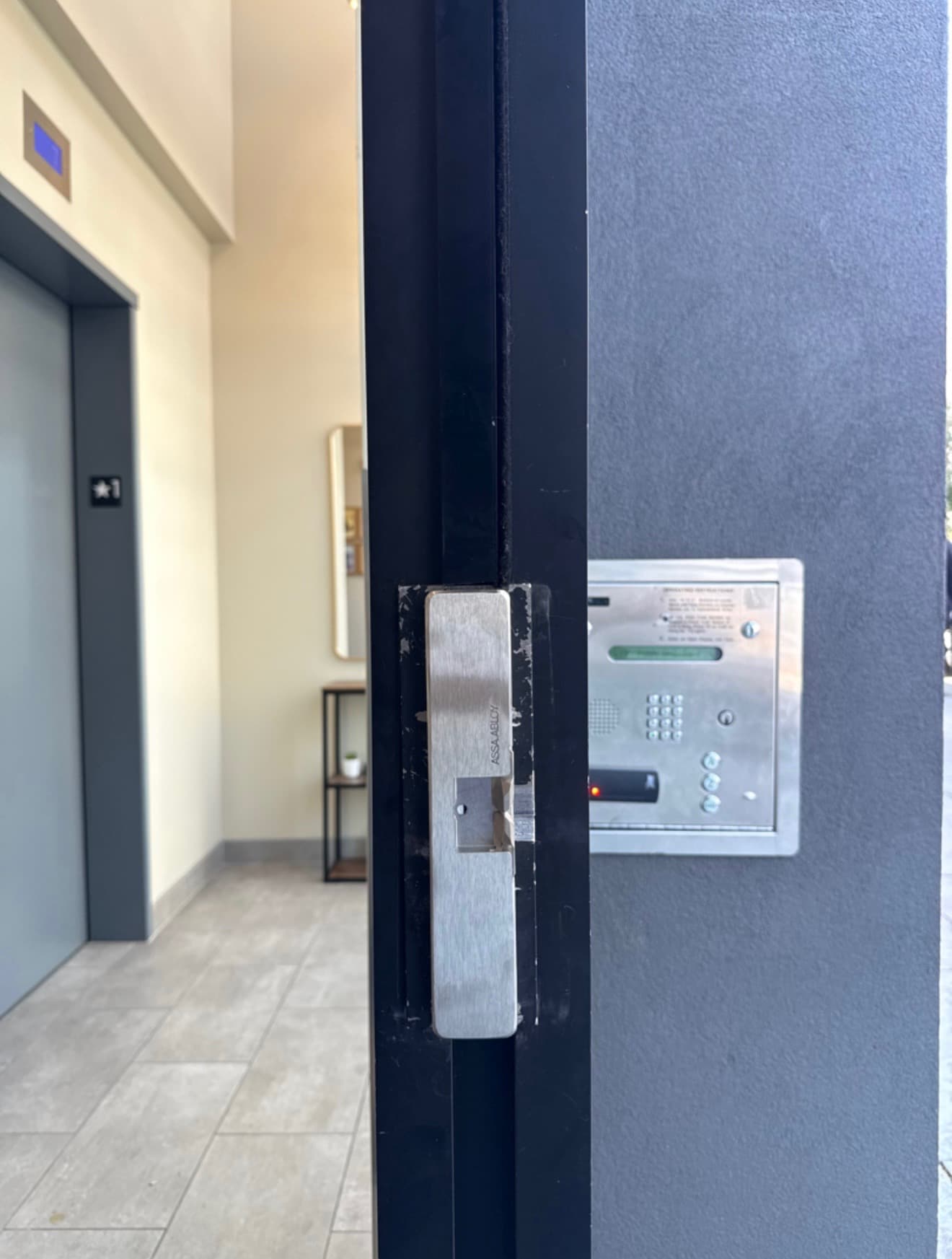
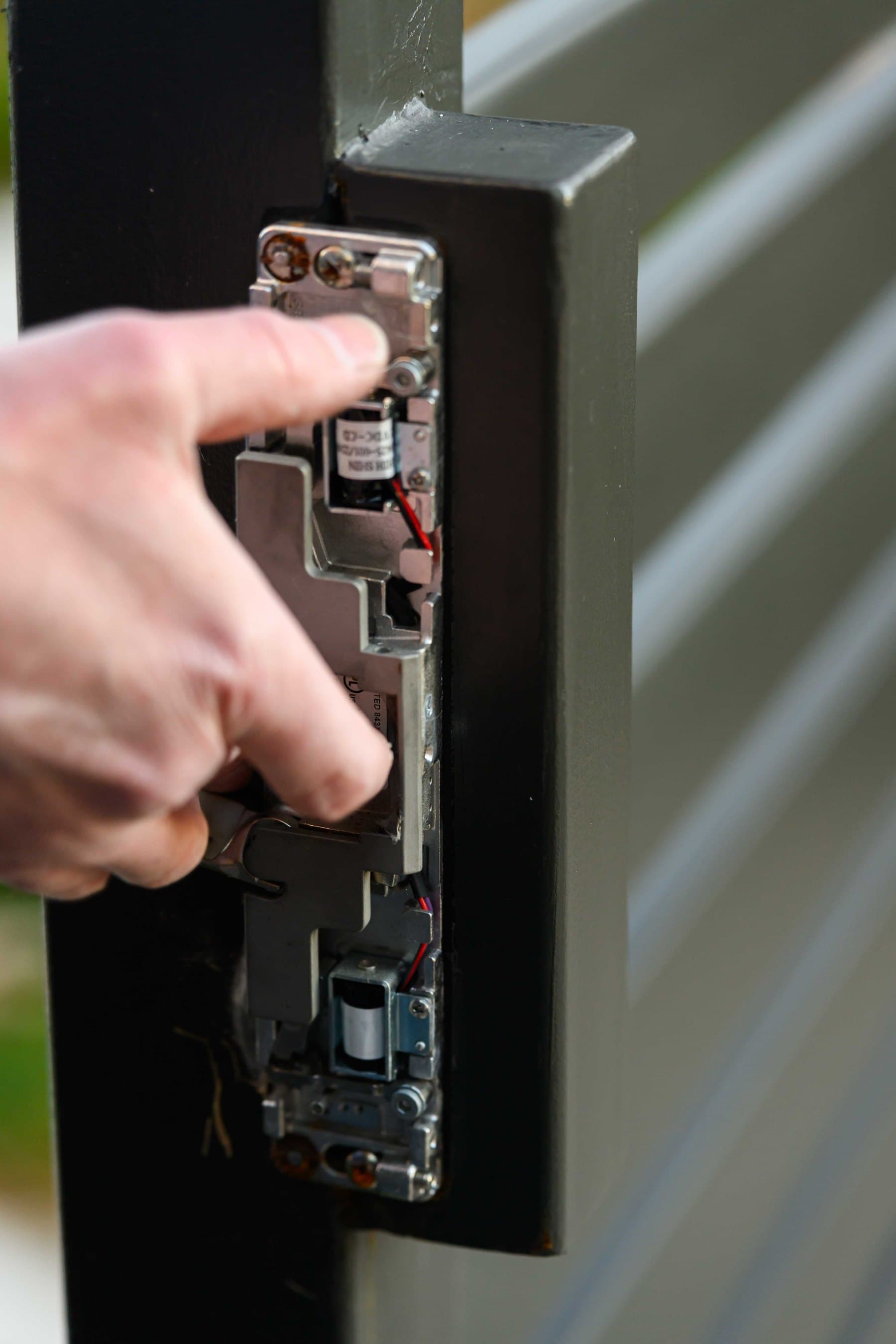
An electric strike replaces or modifies the strike-side hardware that receives a compatible latchbolt. When access is authorized, the strike keeper can release the latch so the door may be opened without operating the secure-side lever in the usual way.
The lockset or exit device still matters. The strike must match the latch, door, frame, intended function, power, and required opening behavior.
Where it can fit
A strike deserves closer review when the opening has compatible latching hardware, the frame can accept the preparation, preserving the mechanical lock function is useful, and the latch and closer can maintain consistent alignment.
What can limit it
Frame preparation, door pairs, narrow-stile conditions, exit devices, fire-rated assemblies, latch pressure, alignment, power, and the exact hardware pairing can all change the selection.
Option 2
How a magnetic lock works
A magnetic lock uses an electromagnet mounted at the frame or header and a steel armature attached to the door. With power applied at the magnet, the magnetic bond holds the opening. Removing power at the magnet releases that bond.
That makes the magnet fail safe at the locking device. A loss of utility power does not necessarily remove lock power when a backup supply remains active, so the complete power and emergency-release design must be understood.
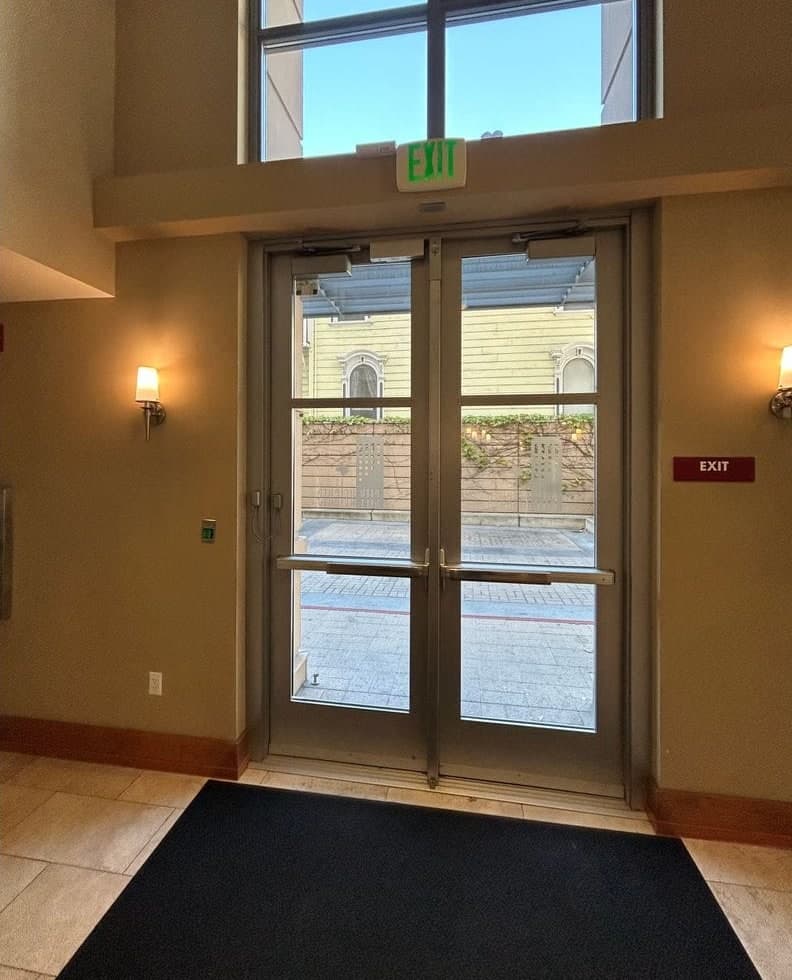
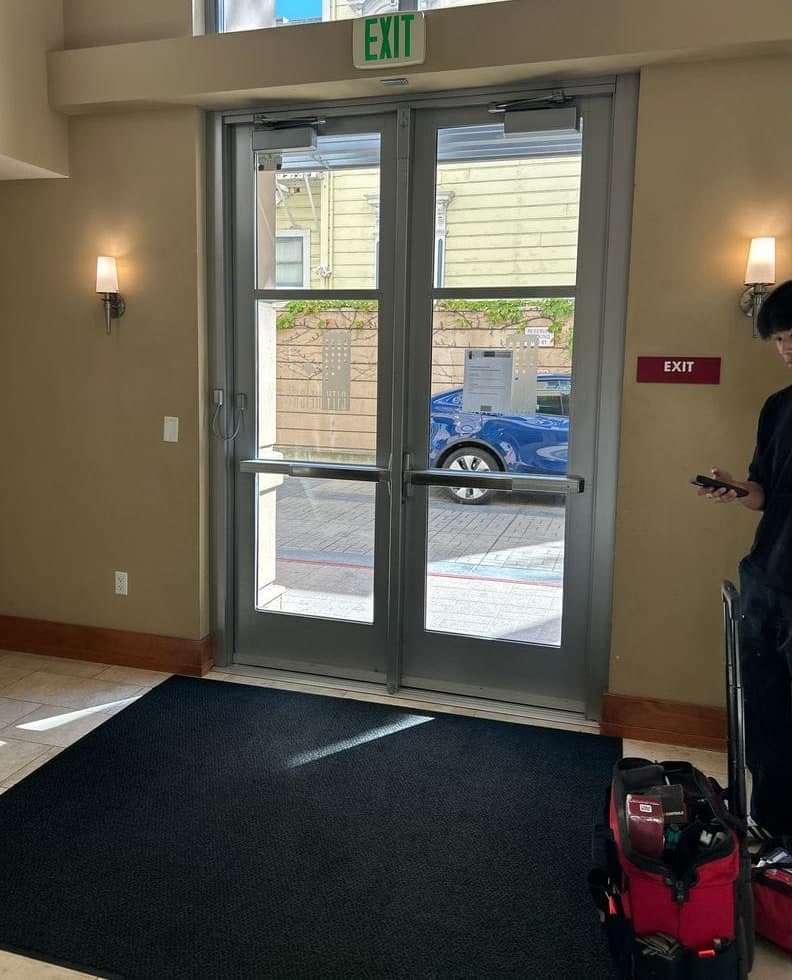
See all before and after photos
Where it can fit
A maglock deserves closer review when an electromagnetic locking arrangement is appropriate, the door and frame support correct mounting, continuous power is available, and every required release path can be provided and reviewed.
What can limit it
Alignment, armature movement, mounting, clearances, appearance, request-to-exit, manual release, alarm interfaces, emergency conditions, and authority requirements all belong in the design.
Option 3
How an electrified lever or lockset works
An electrified lever or lockset places the electrically controlled function in the door hardware. Depending on the product and function, the secure-side lever may be locked or unlocked electrically while the required egress-side operation remains mechanically available.
The category can include electrified cylindrical locks, mortise locks, and other commercial locksets. Exact functions differ and must be reviewed as a specific product and opening combination.
Where it can fit
An electrified lockset deserves closer review when the door can accept the preparation, integrated control provides the desired user experience, the exact lock function supports the opening, and a supported wired or wireless design is practical.
What can limit it
Wired products need an appropriate door-to-frame power path. Wireless or intelligent products have their own battery, communication, compatibility, and management requirements. Door preparation and replacement planning must match the hardware.
Power behavior
Fail safe and fail secure describe the secure side.
Fail safe means the secure side becomes unlocked when lock power is removed. Fail secure means the secure side remains locked when lock power is removed.
These terms do not automatically describe whether a person can exit. Egress-side operation is a separate part of the hardware and opening design.
An electric strike or electrified lock may be available in either function, depending on the product and application. A maglock releases its magnetic bond when power at the magnet is removed. The required function depends on the opening, occupancy, security need, fire and life-safety conditions, and adopted requirements.
Opening fit
Let property conditions narrow the hardware choice.
| Condition | Questions that influence the choice |
|---|---|
| Existing commercial interior door | Is the lock compatible? Can the frame accept a strike? Would an electrified lockset fit the preparation more cleanly? |
| Aluminum storefront opening | What narrow-stile hardware is present? Can the frame accept compatible hardware? How will power and wiring reach each device? |
| Door with panic or fire exit hardware | Which listed hardware and release method fit the exact exit device and opening? What does the authority having jurisdiction require? |
| Paired doors | Where is the latch received? Is there a mullion or inactive leaf? How do coordinators, vertical rods, and other hardware affect the scope? |
| Exterior or high-traffic door | How do weather, traffic, wear, door movement, closer performance, and service access affect the hardware? |
| Gate | Is it a pedestrian or vehicle gate? What release hardware, operator interface, weather protection, and cable path are required? |
| Fire-rated opening | Which listed, compatible components and modifications are permitted for the assembly? The fire marshal or AHJ determines compliance. |
Life safety
Review egress and emergency release as a complete arrangement.
Electrified locks on doors used for egress are governed by more than the device fail mode. Depending on the approved arrangement, the design may need to address door-hardware release, request-to-exit sensing, direct power interruption, manual release, fire-alarm or sprinkler activation, emergency lighting, panic or fire exit hardware, and other conditions.
Applicable requirements depend on the occupancy, opening, current California code, local amendments, and authority having jurisdiction. Listed, compatible components should be used where required. The fire marshal or AHJ determines compliance.
Infrastructure
Make the power and wiring design visible in the proposal.
- Required power supply and equipment location
- Device load, cable distance, and power-loss behavior
- Cable and conduit route
- Supported power or communication path into hardware located in the door
- Controller and relay connections
- Request-to-exit and door-position inputs
- Alarm or other building-system interfaces where applicable
- Commissioning, testing, labeling, and documentation
Buyer checklist
Ask the installer to defend the opening-level decision.
- Why does this locking method fit this specific door and frame?
- Which existing lock, exit device, closer, or frame conditions affect the recommendation?
- What are the secure-side and egress-side behaviors during normal operation?
- What happens when lock power is removed, and can backup power change that result?
- Which request-to-exit, manual-release, door-position, alarm, or other devices are included?
- Which product listings and compatibility conditions apply?
- What preparation, power, controller, and cable work is included?
- How will the complete opening be commissioned and tested?
- Which design reviews, permits, inspections, or other trades are part of the scope?
Common questions
Strike, maglock, and electrified-lock questions
Is an electric strike better than a maglock?
Not universally. A strike may fit a compatible latching opening, while a maglock uses a different holding and release arrangement. The door, frame, existing hardware, egress, power, wiring, and approval conditions decide which approach fits.
Can an electric strike be fail safe or fail secure?
Many electric-strike product families offer both functions, but availability and suitability depend on the exact model and opening. Select the function through project-specific hardware and life-safety review.
Does a maglock unlock when utility power is lost?
A maglock releases when power at the magnet is removed. A backup power supply may keep the magnet energized during a utility outage, so the approved power and emergency-release design must be reviewed as a complete system.
Does fail secure mean people cannot exit?
No. Fail secure describes the secure-side state when lock power is removed. Egress-side operation is separate and must be confirmed for the exact hardware and opening.
Sources and further reading
These sources back up the general guidance. Your building and the people who approve the work decide the details for your doors.
- Security Industry Association: The Basics of Physical Access Control
- Allegion: Door Hardware 101: Mechanical and Electrified Hardware
- Allegion: Fail Safe vs. Fail Secure
- Allegion: Electric-Strike Electrical and Mechanical Troubleshooting
- California Building Standards Commission: 2025 California Code Changes: Chapters 9 and 10
- California Building Standards Commission: Current California Building Standards Codes