
Key takeaways
- Narrow-stile aluminum doors need hardware that fits the available stile, backset, door thickness, and existing preparation.
- A deadlock throws a bolt for locking; a deadlatch provides latching and is commonly paired with a paddle, lever, or compatible electric strike arrangement.
- A paddle is operating trim, not the complete lock. Its push/pull orientation and compatible latch matter.
- Worn pivots or a failing concealed closer can shift the door enough to create repeated lock and strike symptoms.
- Storefront pairs, exit devices, labeled openings, and electrified release need opening-specific compatibility, listing, and authority review.
- Request service for an active failure; use a site walk when several openings need standardization, access-control changes, or entrance renovation planning.
Opening anatomy
A storefront entrance concentrates many functions into a slim assembly.
| Component | Job | Common condition to verify |
|---|---|---|
| Aluminum door and frame | Supports glazing and provides the narrow rails and stiles for hardware | Twist, damage, loose glass stops, frame movement, existing cutouts, reinforcement, and clearances |
| Deadlock or deadlatch | Secures or latches the door at the frame | Exact lock family, backset, bolt or latch, cylinder cam, strike, and intended egress behavior |
| Paddle, lever, or pull | Provides inside operation or a grip, depending on the hardware | Compatible latch, push/pull orientation, mounting, accessibility, and whether it actually retracts a latch |
| Pivot set | Carries and locates the door at the top and bottom | Wear, looseness, vertical drop, offset or center-hung geometry, floor condition, and door/frame preparation |
| Concealed or surface closer | Controls opening and returns the door toward closed | Closer type, arm or spindle, pivots, leakage, speed, force, wind exposure, door size, and latch engagement |
| Exit device | Provides push-side egress and latches at a rim, mortise, or vertical-rod point | Device series, trim, strikes, pairs, labels, dogging, and required panic or fire-exit function |
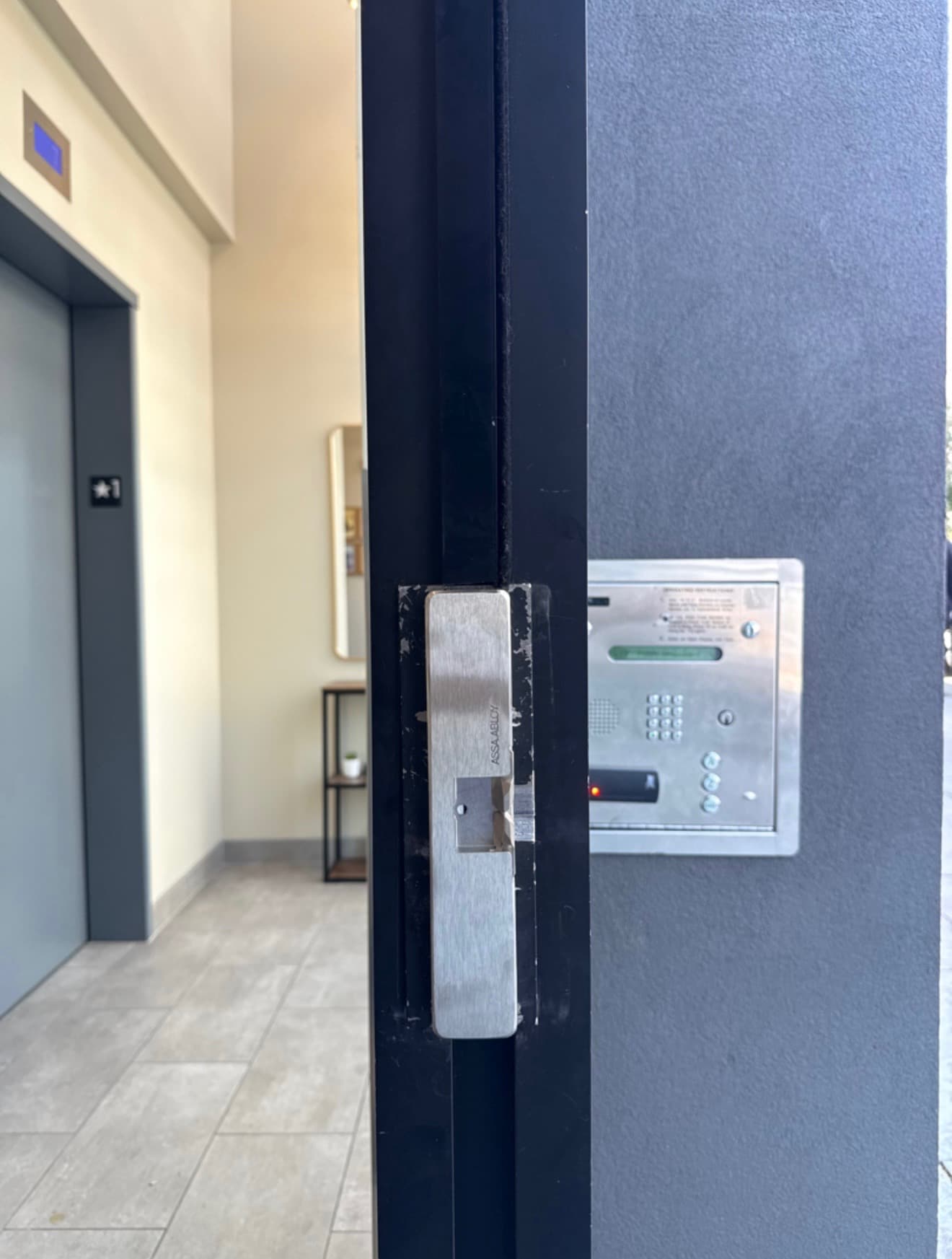
| Electric strike or electrified lock | Releases a compatible latch when authorized | Frame preparation, latch compatibility, preload, power, wiring, access command, egress, and listing conditions |
Why fit matters
Narrow-stile hardware is not a reduced-size version of every commercial lock.
The vertical aluminum member at the lock edge may provide limited width and depth for a lock body, cylinder, fasteners, and wiring. Manufacturers offer hardware with specific faceplates, backsets, cams, strikes, and trim for these preparations. A standard cylindrical or mortise lock intended for a different door construction may not fit or preserve the opening correctly.
Before ordering, identify the door and frame series if available, stile width, door thickness, existing cutout, lock body, faceplate dimensions, backset, handing, cylinder and cam, strike, pivots, closer, and desired operation. Existing holes alone are not a complete specification.
See all before and after photos
Locking hardware
Deadlocks and deadlatches support different daily behavior.
A deadlock and deadlatch may fit similar-looking aluminum preparations but do not perform the same job. Do not assume an electric strike can release a deadbolt; strike and latch compatibility must be verified for the exact products and approved opening behavior.
| Hardware | Typical behavior | Common trim or release | Planning questions |
|---|---|---|---|
| Narrow-stile deadlock | A key or thumbturn projects and retracts a deadbolt or hook bolt; the bolt does not normally latch automatically as the door closes | Mortise cylinder, thumbturn, or compatible lever/turn depending on the product | When may it be locked, how is egress maintained, what strike receives the bolt, and does the opening need automatic relatching? |
| Narrow-stile deadlatch | A spring latch engages the strike when the door closes and can be operated by compatible inside trim | Paddle, lever, cylinder, compatible electric strike, or other listed arrangement | Does the door close and align consistently, which trim function is required, and how should authorized entry work? |
| Narrow-stile exit device | A door-spanning push pad or crossbar retracts rim, mortise, or vertical-rod latching for egress | Exit-only, lever, pull, thumbpiece, cylinder, or electrified trim depending on the device | Is panic or fire exit hardware required, what door pair and latching arrangement exists, and which listed components fit? |
Customer vocabulary
A paddle, lever, and pull each tell a different story.
Paddle
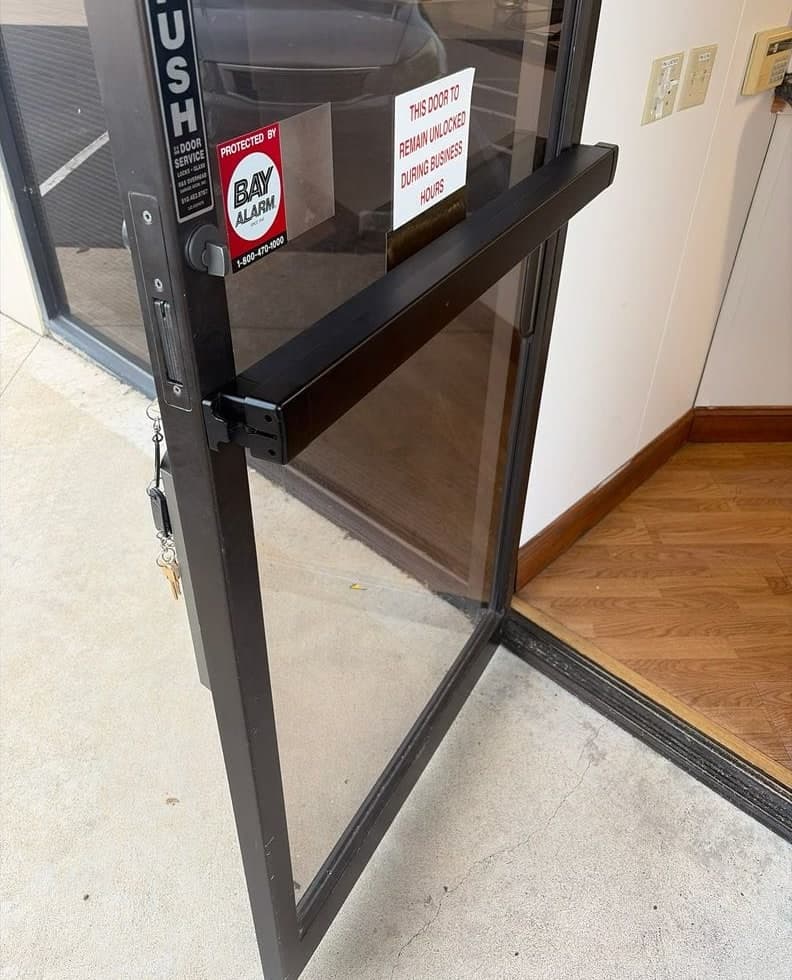
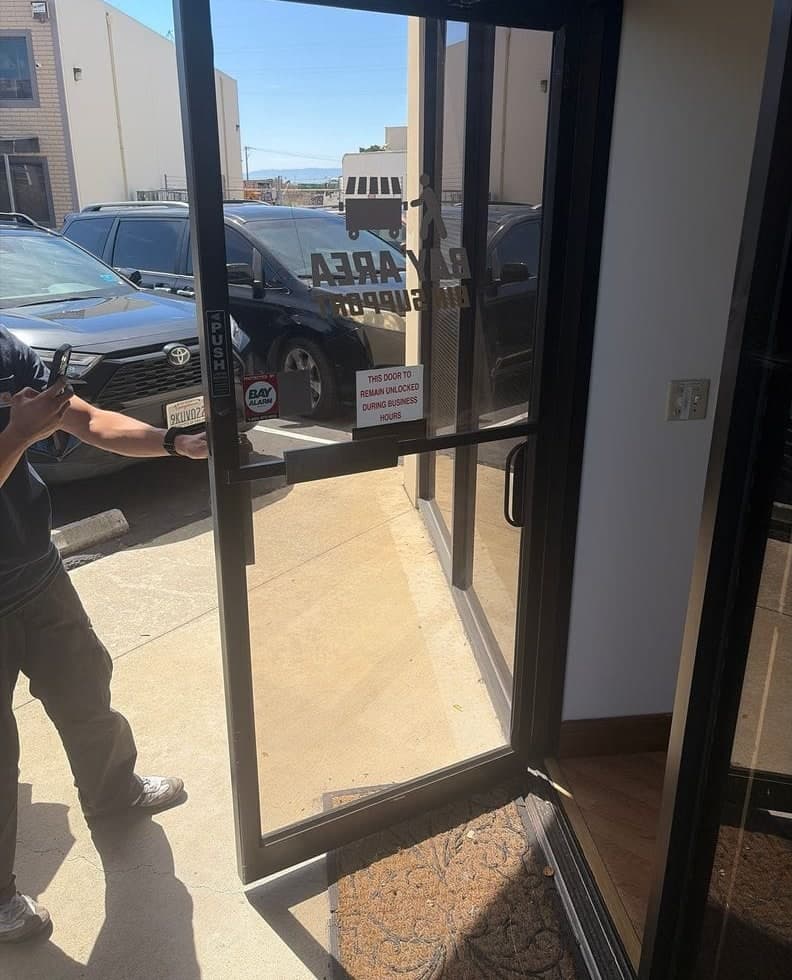
A storefront paddle commonly operates a compatible deadlatch through a push or pull motion. Orientation, handing, linkage, latch model, mounting, and accessibility conditions must be confirmed. Some paddle-shaped products operate switches rather than mechanical latches.
Lever
A narrow-stile lever can operate a deadlatch, deadlock function, or exit-device trim depending on the product family. Specify the required inside and outside behavior rather than requesting a generic locking lever.
Pull handle
A pull provides a grip and usually does not retract a latch by itself. The door may rely on a separate deadlock, deadlatch, electric strike, magnetic lock, roller latch, or exit device. Loose pulls require mounting and door-material inspection.
Push bar
The phrase may mean non-latching architectural trim or an exit device. If pushing it retracts latches, identify the exact device and any life-safety conditions before service or replacement.
Door support
Pivots set the geometry that the lock and closer depend on.
Many storefront doors rotate on top and bottom pivots rather than conventional butt hinges. Center-hung and offset arrangements locate the pivot point differently and use different components. A floor closer can also provide the lower pivot and closing control as one coordinated assembly.
Wear, loose fasteners, damaged pivot components, corrosion, floor movement, or a poorly supported door can let the leaf drop or shift. The first symptom may appear at the latch: scraping, a key that binds, a strike that needs repeated adjustment, or a door that only locks when lifted.
Door control
A storefront closer may be hidden overhead or below the floor.
Closing speed is only one part of closer selection and setup. Door size and weight, wind or stack pressure, pivot friction, opening force, backcheck, latch engagement, accessible operation, hold-open conditions, and fire or smoke requirements can all affect the approved arrangement.
| Closer type | Where it is | What to inspect |
|---|---|---|
| Overhead concealed closer | Concealed in the frame header or transom and connected to the door through an arm or channel | Body and arm condition, leakage, pivots, spindle or connection, door size, opening geometry, speed, and frame preparation |
| Floor concealed closer | In a floor box below the door and often integrated with the bottom pivot function | Closer and spindle, cover and floor condition, water exposure, pivot alignment, leakage, door weight, and service access |
| Surface closer | Visible on the door or frame with an arm or track | Mounting, arm geometry, leakage, adjustments, door/frame reinforcement, wind, stop function, and latch performance |
Field diagnosis
Storefront symptoms often cross more than one hardware category.
| Symptom | Possible conditions | Useful observation |
|---|---|---|
| Door drags at the threshold or header | Worn or loose pivots, door sag, frame or floor movement, glass or rail condition, closer/pivot issue, or debris | Record where contact occurs and whether lifting the door changes it; do not force repeated operation |
| Door closes but latch misses the strike | Pivot wear, closer action, door/frame alignment, loose strike, wrong strike, damaged latch, or pressure | Note whether the gap changes from top to bottom and whether weather or traffic affects it |
| Paddle moves but latch stays engaged | Paddle linkage, incompatible trim, latch condition, cylinder state, preload, or misalignment | Record push or pull direction, lock markings, and whether gentle door-pressure relief changes it |
| Key is hard to turn | Latch or bolt pressure, worn cylinder, wrong key, cam or lock-body condition, strike alignment, or door sag | Stop before the key bends or breaks; note whether the key turns with the door open |
| Door slams or will not close | Closer leakage or failure, arm or spindle issue, pivot friction, obstruction, wind, door damage, or incorrect setup | Report visible fluid, unusual noise, swing direction, and where movement changes |
| Reader accepts a credential but door stays locked | Permissions, controller output, power, wiring, electric strike, latch preload, deadlock/deadlatch mismatch, or door alignment | Record reader response and door behavior without sharing credentials or attempting to bypass the lock |
Electrified entry
The access-control command still depends on a mechanically healthy storefront door.
A reader can accept a credential and the controller can send the correct command while an electric strike, electrified latch, or other release arrangement remains loaded or misaligned. Storefront pivots, closer performance, narrow-stile preparation, latch selection, power, wiring, and frame condition are part of the release path.
Adding controlled entry may involve a compatible electric strike, electrified deadlatch or exit trim, magnetic locking arrangement, door-position monitoring, request-to-exit, power transfer, and other components. The complete egress, power-loss, fire-alarm, accessibility, listing, and authority conditions must be resolved for the specific opening before hardware is ordered.
Adding a reader to a storefront or all-glass door? See keyless entry for commercial glass doors for the usual strike, maglock, and reader options.
Code-sensitive openings
Pairs and egress doors need their exact latching arrangement preserved.
- Identify whether one or both leaves are active during normal use
- Document rim, mortise, surface vertical rod, concealed vertical rod, flush-bolt, astragal, coordinator, and mullion conditions
- Confirm which leaf receives keyed or credential-controlled entry
- Locate door and frame labels and identify listed hardware without altering them
- Distinguish panic hardware from fire exit hardware through the exact product and opening requirements
- Confirm accessible operation, maneuvering, opening force, closing speed, and clear-width conditions for the project
- Route fire-rated, egress, and other code determinations through the adopted requirements, project designer, and authority having jurisdiction
Decision path
Repair an isolated fault; survey recurring or multi-opening conditions.
| Path | Usually fits when | Scope inputs |
|---|---|---|
| Repair | A serviceable opening has an isolated cylinder, paddle, lock, latch, strike, pivot, closer, pull, exit-device, wiring, or adjustment fault | Exact symptom, hardware identification, door condition, cause, compatible parts, and post-repair testing |
| Opening retrofit | Useful door and frame components can remain, but the locking, trim, closer, pivot, or access-control layer needs coordinated improvement | Verified reuse, preparation, function, compatibility, wiring, egress, accessibility, and approval path |
| Entrance replacement | The aluminum door or frame is damaged, heavily modified, unsuitable for the required function, or unable to support a dependable repair path | Glazing and framing scope, complete hardware schedule, interfaces, permits or reviews, sequencing, and temporary security |
Property teams
Bring a door-by-door storefront list to the site walk.
- Opening location, business use, traffic, and secure side
- Single door or pair, swing, aluminum profile, stile width, and door/frame condition
- Lock, latch, bolt, strike, cylinder, paddle, lever, pull, or exit-device identification
- Pivot and closer type, visible leakage, drag, slamming, and latching behavior
- Keys, credential readers, intercom release, schedules, and power-loss expectations
- Door and frame labels and known accessibility, egress, or fire-review conditions
- Photos of the full opening and visible model markings, kept separate from sensitive keys or credential data
- Whether the objective is immediate repair, standardization, tenant improvement, or a larger entrance replacement
Common questions
Commercial storefront door questions
Why does my storefront door only lock when I pull it toward the frame?
That commonly points toward latch or bolt pressure and alignment involving the pivots, closer, door, frame, lock, and strike. Pulling the door into place changes the symptom but does not correct the cause.
Is a storefront paddle the lock?
The paddle is operating trim. It commonly connects to a compatible deadlatch, but the lock or latch body, cylinder, strike, door alignment, and paddle orientation determine the actual behavior.
Can a surface closer replace a concealed storefront closer?
Sometimes a retrofit is possible, but it is not an automatic swap. Door and frame reinforcement, top-rail space, arm geometry, pivots, opening force, wind, swing, appearance, labels, and required operation must be evaluated.
Can access control be added without replacing the aluminum door?
Often, yes, when the door, frame, lock, latch, pivots, closer, preparation, and wiring path can support a compatible release design. A field survey should confirm what can safely remain.
Why does a replaced strike keep going out of alignment?
The strike may be following movement elsewhere. Worn pivots, loose components, door sag, frame or floor movement, closer forces, and high traffic should be checked before another strike adjustment or frame modification.
Sources and further reading
These sources back up the general guidance. Your building and the people who approve the work decide the details for your doors.
- Adams Rite: Deadlocks and deadlatches technical FAQs
- Adams Rite: Narrow-stile turns, levers, paddles, and trim
- Adams Rite: Narrow-stile mortise exit-device technical details
- Builders Hardware Manufacturers Association: ANSI/BHMA A156.4 Door Closers and Pivots overview
- dormakaba: Surface, overhead-concealed, floor, and pivot door controls
- U.S. Department of Justice: 2010 ADA Standards for Accessible Design, Section 404