
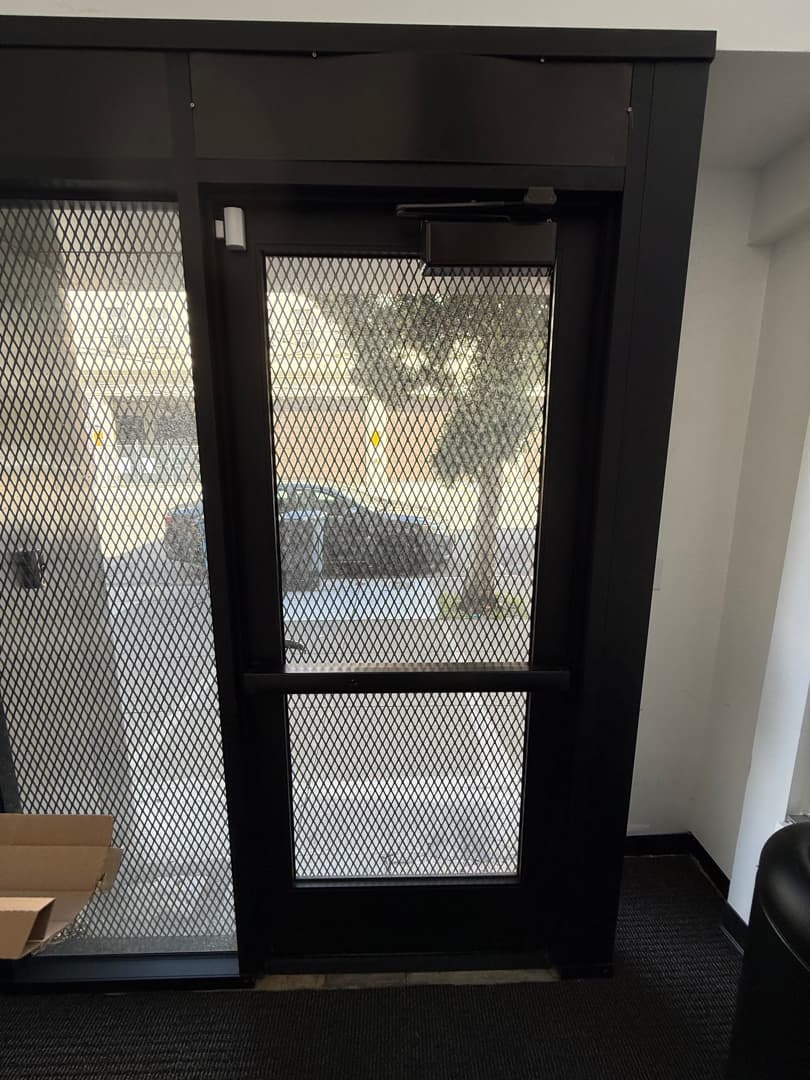
Key takeaways
- Identify whether the opening uses rim, surface vertical rod, concealed vertical rod, or mortise exit hardware before ordering parts.
- A vertical-rod problem may begin at a top latch, bottom latch, rod adjustment, strike, door alignment, hinge, pivot, or closer.
- Exterior lever, pull, thumbpiece, or keyed trim must match the exit device and intended entry function.
- Paired doors introduce mullions, coordinators, inactive-leaf hardware, and sequencing conditions that affect latching.
- Panic hardware and fire exit hardware are not interchangeable terms; labeled openings need listed, compatible components and permitted service methods.
- Do not dog, block, tape, or otherwise defeat an exit device to work around a failure. Route life-safety questions through the adopted requirements and authority having jurisdiction.
Identify the hardware
Four exit-device families solve different opening conditions.
The push pad or crossbar is only the operating surface. The latch arrangement tells you which device family is on the door and which conditions belong in the diagnosis.
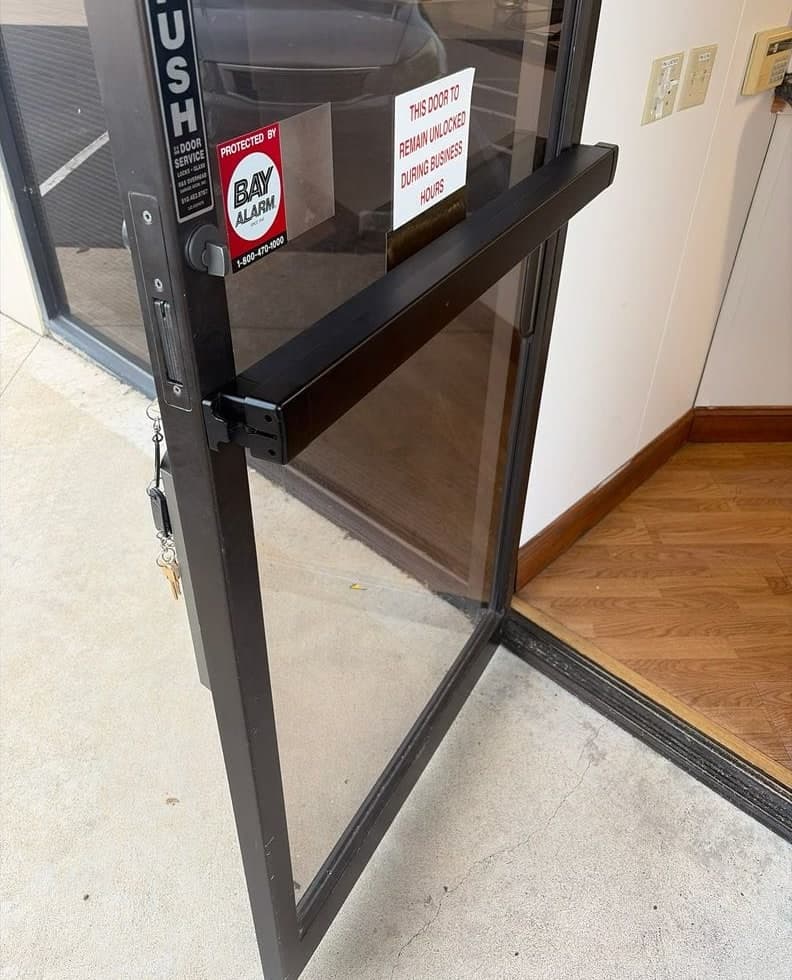
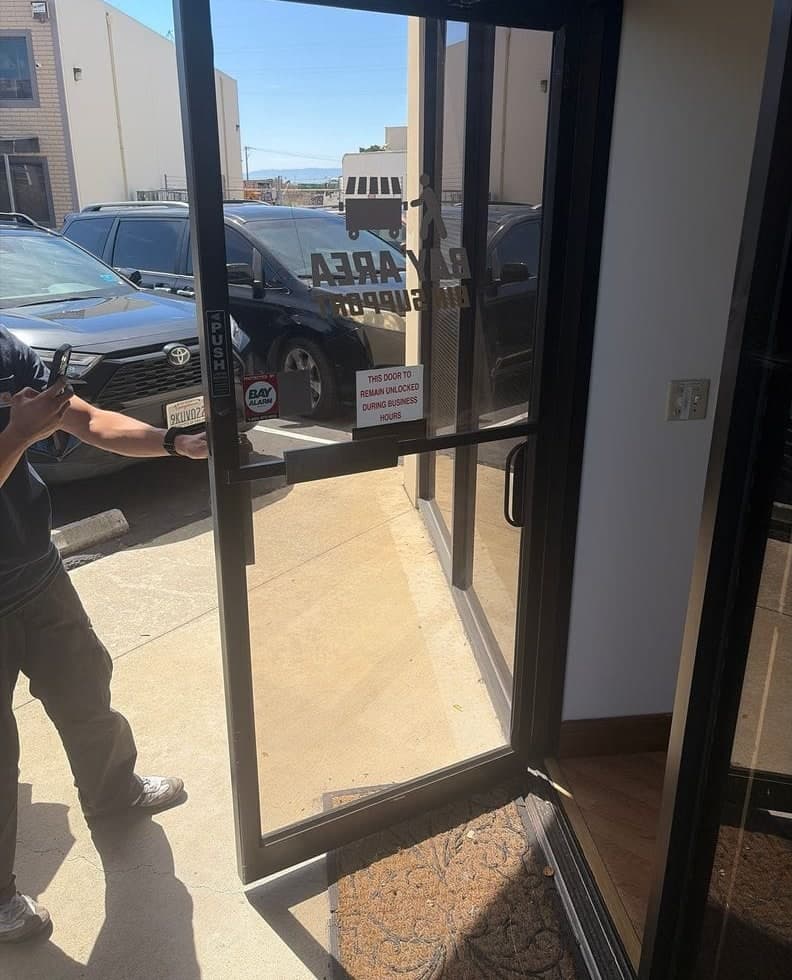
See all before and after photos
| Device family | Where it latches | Typical visual clue | Conditions to verify |
|---|---|---|---|
| Rim exit device | One latch at the door edge engages a strike on the frame or removable mullion | No rods running toward the top or bottom of the door | Latch and strike alignment, mullion condition, device chassis, trim, door sag, and closer performance |
| Surface vertical rod (SVR) | Top and, where present, bottom latches are operated by rods mounted on the door face | Visible rods and latch cases above and below the push pad | Rod guides, latch cases, strikes, floor or threshold condition, fasteners, adjustment, and door alignment |
| Concealed vertical rod (CVR) | Top and, where present, bottom latches are operated through rods or cables inside the door | No exposed rods, with latching at the header and possibly the floor or threshold | Exact device model, internal linkage, access to service points, top and bottom strikes, door construction, and preparation |
| Mortise exit device | A mortise lock case at the door edge latches into the frame | A mortise lock faceplate aligned with the exit-device chassis | Lock case, latch, strike, trim function, handing, door preparation, and device-to-lock connection |
Vocabulary
Panic hardware and fire exit hardware are related, but not identical.
People often use panic bar, crash bar, push bar, and exit device to describe the same visible hardware. In a proposal or parts search, the more useful description includes the manufacturer, device series, rim or vertical-rod configuration, door size, trim function, and whether the opening is labeled.
Panic hardware is evaluated for emergency egress use. Fire exit hardware is exit hardware specifically intended for a fire-door assembly and must maintain the required latching function. The label, product listing, opening configuration, and adopted requirements decide what may be used. A familiar-looking replacement component is not enough evidence of compatibility.
Vertical-rod mechanics
A vertical-rod device has to release and relatch at more than one point.
The touch bar moves a center mechanism, which operates the rods or cables and their latches. A small change at the door, frame, header, threshold, or floor can keep one latch from completing its travel.
Top latch
The top latch and strike deserve review when the device retracts but the door catches at the header, the latch does not reengage, or the top of the door has shifted relative to the frame.
Bottom latch
A bottom latch can be affected by debris, damaged floor or threshold hardware, vertical door movement, loose components, or a strike that no longer meets the latch correctly. Do not disable the bottom latch as a shortcut.
Visible versus concealed linkage
Surface rods make guides, fasteners, and latch cases visible. Concealed rods or cables require the exact device documentation and door preparation to be understood before service access or parts selection.
Less-bottom-rod arrangements
Some listed product families support configurations without a traditional bottom rod, but that does not make field removal of an existing rod acceptable. The complete listed configuration must be verified.
Diagnosis
Use the symptom to narrow the opening—not to guess the part.
| Observed symptom | Possible conditions | Safe property-team note |
|---|---|---|
| Push pad is hard to depress | Preload at the latch, rod or linkage condition, damaged chassis, misaligned strikes, door sag, or binding trim | Record whether it changes when gentle pressure is taken off the door; do not force or disassemble the device |
| Door opens but will not relatch | Closer or hinge condition, latch not resetting, rod travel, door/frame alignment, damaged strike, or an intentionally dogged device | Keep the opening attended if it cannot secure and request service |
| Top latches but bottom does not | Bottom rod, latch, threshold or floor strike, debris, door height, or adjustment condition | Note which latch fails; do not tape or remove hardware |
| Exterior key turns but entry trim does not open the door | Wrong trim function, cylinder or cam condition, disconnected linkage, locked trim, latch preload, or incompatible parts | Preserve the cylinder and device model information for the service visit |
| One leaf of a pair will not latch | Mullion, coordinator, flush bolt, overlapping astragal, vertical-rod, strike, or closing-sequence condition | Report which leaf is active and whether the other leaf changes the symptom |
| Alarm or electrified function behaves unexpectedly | Device option, power, wiring, switch, access-control command, latch condition, or door position | Document normal and power-loss behavior; route electrical diagnosis to qualified service |
Entry side
The outside handle is exit-device trim, not a separate lock choice.
Exterior trim may be a pull, lever, thumbpiece, key cylinder, or electrified control. Customer descriptions such as door handle or outside lock are useful starting points, but the replacement must match the exit-device series, door preparation, handing, function, cylinder, and intended access behavior.
Exit-only trim provides no operating handle outside. Night-latch-style functions commonly require a key or credential for each entry. Other lever functions may be locked, unlocked, or electrically controlled. Names and details vary by product family, so the required behavior should be written plainly instead of inferred from an abbreviation.
Paired openings
Pairs require a leaf-by-leaf latching and sequence review.
- Which leaf is active during normal traffic
- Whether a fixed or removable mullion receives rim-device latches
- Whether either leaf uses surface or concealed vertical rods
- Whether an overlapping astragal or coordinator controls closing order
- How the inactive leaf secures and releases
- Where top and bottom strikes are mounted and whether they remain aligned
- Which exterior trim or access-control function operates each leaf
- What labels, listings, and adopted requirements apply to the complete opening
Before service
Collect observations without defeating the exit hardware.
- Photograph the full push side, pull side, door edge, header, and threshold without sharing key codes or sensitive access details
- Record the manufacturer and model markings visible on the device, latches, and trim
- Note whether the problem affects opening, closing, latching, exterior entry, or more than one function
- Check whether the symptom changes by time of day, weather, power state, or traffic level
- Identify whether the door is single or paired and which leaf is affected
- Look for door and frame labels without painting over, removing, or altering them
- Request prompt service when an egress door cannot open normally or cannot return to a secure, latched condition
Service path
Choose a service call for a fault and a site walk for a broader opening program.
| Path | Usually fits | Useful information |
|---|---|---|
| Service request | One or several identified doors have a hard push pad, failed latch, loose trim, rod problem, door that will not secure, or another active fault | Address, affected opening, urgency, device photos, observed behavior, and access contact |
| Site walk | The property is replacing or standardizing multiple devices, changing key or credential entry, surveying labeled openings, or coordinating doors across a renovation | Door list, plans if available, desired functions, property operations, schedule, and known approval requirements |
Common questions
Exit-device and vertical-rod questions
Is every push bar panic hardware?
No. Appearance alone does not establish a device’s listing or the opening’s requirements. Identify the exact product and whether the door requires panic or fire exit hardware under the adopted requirements.
Can a concealed vertical rod be repaired without replacing the door?
Sometimes. The answer depends on the device, internal linkage, door construction and preparation, access to service points, available compatible parts, strikes, and the condition of the opening.
Why does a vertical-rod door latch at the top but not the bottom?
Possible causes include the bottom rod or latch, debris or damage at the floor strike, door height, worn pivots or hinges, loose hardware, and adjustment. The full opening should be checked before changing rod length or parts.
Can fire exit hardware be left dogged open?
Mechanical dogging is not permitted on fire exit hardware because the opening must restore its required positive-latching function. Any listed electric latch-retraction or release arrangement must return the latches under its approved sequence. Confirm the exact hardware, listing, adopted requirements, and authority expectations rather than using a field workaround.
Sources and further reading
These sources back up the general guidance. Your building and the people who approve the work decide the details for your doors.
- Builders Hardware Manufacturers Association: ANSI/BHMA A156.3 Exit Devices overview
- Steel Door Institute: Basic Fire Door and Frame Requirements
- U.S. Department of Justice: 2010 ADA Standards for Accessible Design, Section 404
- Von Duprin / Allegion: Exit-device technical document library
- Allegion: Falcon 20 Series rim and surface vertical-rod exit devices