
Key takeaways
- HES electric strikes are organized by application: cut-in, shallow-frame, no-cut retrofit, glass-door header, surface exit-device, and Folger Adam heavy-duty families.
- A series number narrows the family; the exact faceplate, keeper, voltage, and fail mode complete an orderable model.
- Latch limits are hard constraints — a 3/4-inch latch does not belong in a strike built for 5/8 inch.
- Compatibility is matched in order: lock, then latch, then frame, then listing.
- Fire-rated openings take only listed strike models, and the label, approved documents, and authority having jurisdiction control what may change.
- The current HES selector guide and installation instructions override any summary, including this one.
Orientation
How is the HES electric strike lineup organized?
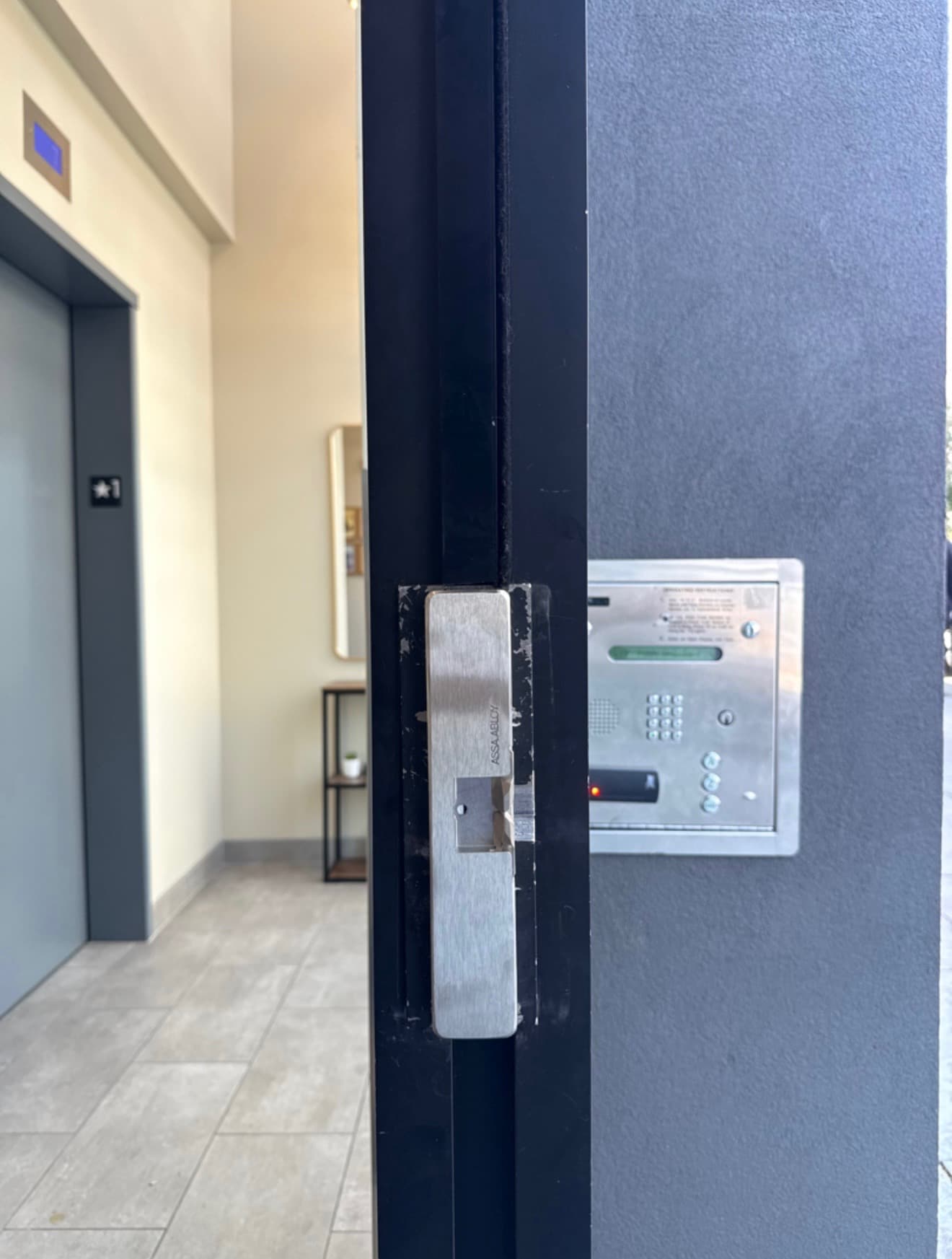
An electric strike is frame-mounted release hardware: on command, its keeper releases a compatible latch that stays in the door. HES, part of ASSA ABLOY, builds its lineup around the application rather than a single universal product. The families divide by how the strike mounts — cut into the frame, concealed with no cut, or mounted on the frame surface — and by what it releases: a cylindrical latchbolt, a mortise latch with or without a deadbolt, or the Pullman latch of a rim or vertical-rod exit device.
The series number only narrows the family. The exact faceplate, keeper, function, options, and finish complete the order, and those choices are controlled by the lock on the door, the measured latch projection, the frame material, and any fire listing. The working order for compatibility is lock, then latch, then frame, then listing.
The opening behaves as one system — door, frame, hinges, latch, strike, closer, and any electrified hardware together. The tables below map the families as a planning aid; the current HES selector guide and installation instructions control the final selection.
Cut-in family
Which HES series are cut into the frame for cylindrical and mortise locks?
These strikes replace the frame's strike prep with a powered keeper sized to the latch. Latch limits and deadbolt support are the first filters; several members of this family carry fire ratings.
| Series | Works with | Latch and deadbolt limits | Selection note |
|---|---|---|---|
| 1006 | Cylindrical or mortise locks | Modular faceplates can support an approved deadbolt | Confirm the faceplate and lock function before ordering |
| 1500 | Cylindrical or mortise latchbolts | Latchbolts up to 3/4 inch; no deadbolt | Confirm the faceplate matches the lock |
| 1600 | Cylindrical or mortise locks | With or without a deadbolt up to 1 inch | The deadbolt option separates it from the 1500 |
| 5000 | Cylindrical latchbolts | 1/2 to 5/8 inch | Compact body; check latch projection and door gap |
| 5200 | Cylindrical latchbolts | Up to 3/4 inch | Horizontally adjustable; check latch projection and door gap |
| 5300 | Cylindrical latches | Up to 5/8 inch | Fire-rated, low-profile; check latch projection and door gap |
| 7000 | Cylindrical latches or rim-exit latches | 5/8 inch cylindrical; 3/4 inch rim exit | Rim-exit use requires the correct faceplate |
| 7501 | Cylindrical latches | Up to 3/4 inch | Fire-rated; preload relief applies in fail-secure operation only |
Retrofit family
Which series handle shallow frames, no-cut retrofits, and wireless openings?
Not every frame can give up material. Shallow storefront-style frames, occupied buildings, and rated frames that should not be cut all push the selection toward these series.
| Series | Application | Limits and conditions to confirm |
|---|---|---|
| 4500C | Shallow 2-inch frames | Built for 2-inch UL 10C frames; supports 3/4-inch latches with a 1/2-inch drywall penetration |
| 8000 | Concealed, no cut in the frame | Cylindrical latches to 5/8 inch; confirm door gap and current availability with HES |
| 8300 | No-cut, fire-rated retrofit | Installs in an existing 4-7/8-inch ANSI strike prep; confirm latch projection and door gap |
| 8500 | Concealed mortise applications | Mortise locks without a deadbolt, latches to 3/4 inch; no cut in the frame face |
| ES100 | Wireless openings | Aperio wireless strike and reader for cylindrical or mortise locks; select the configuration and faceplate |
Surface family
Which strikes serve glass doors and surface-mounted exit devices?
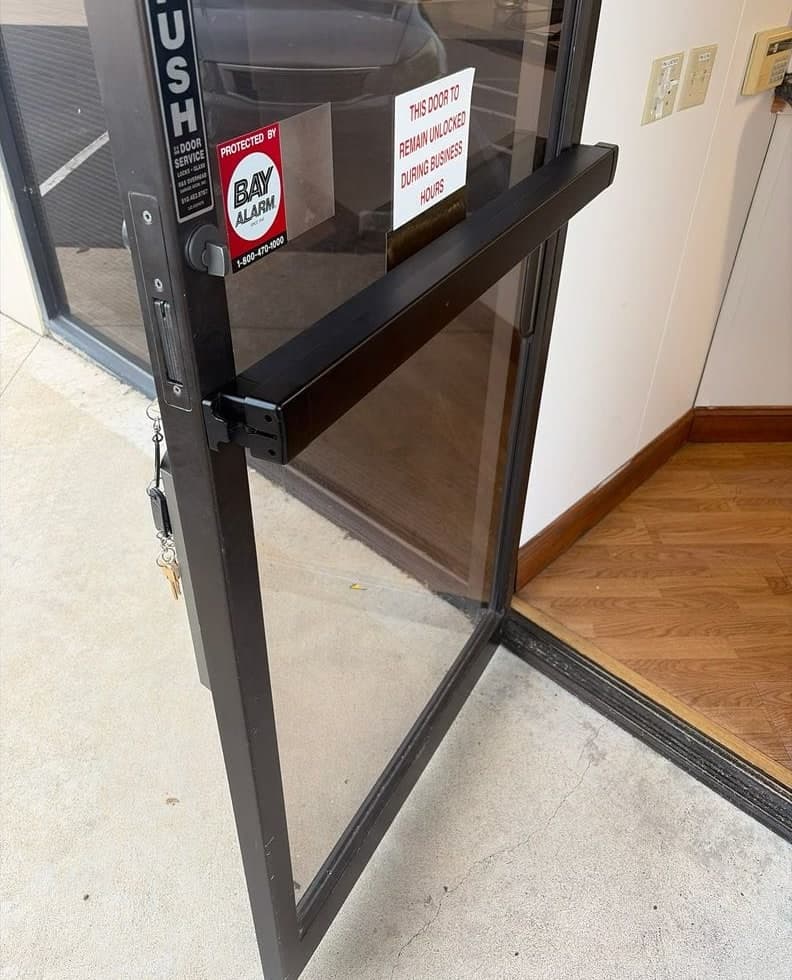
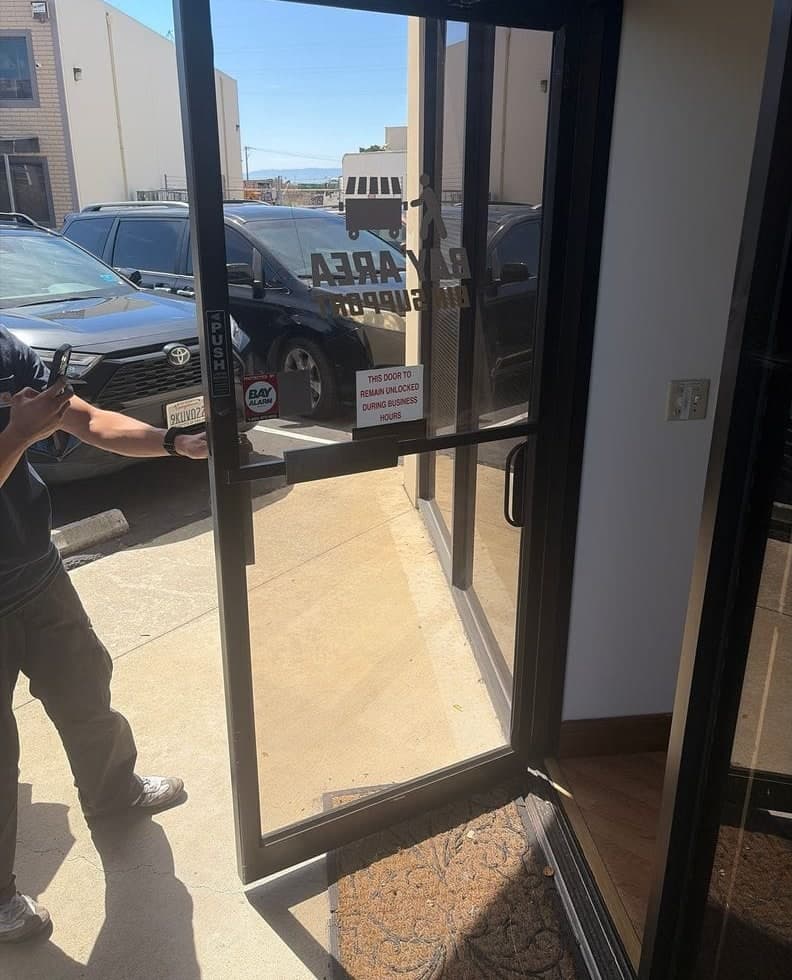
Exit devices latch at the header or at a surface rim strike rather than inside a frame prep, so their release hardware mounts on the surface. Glass doors get header strikes; rim devices get surface rim strikes matched to the latch style.
See all before and after photos
| Series | Door and device | Limits and notes |
|---|---|---|
| 9100 | Single glass doors | Surface header strike for tubular vertical-rod exit devices |
| 9200 | Paired glass doors | Surface header strike for tubular vertical-rod exit devices |
| 9400 | Rim exit devices | Surface rim strike for Pullman latches up to 1/2 inch; confirm reveal and alignment |
| 9500 | Rim exit devices on rated openings | Fire-rated surface rim strike for Pullman latches up to 3/4 inch |
| 9600 | Outdoor and windstorm-exposed openings | Surface strike for Pullman latches up to 3/4 inch |
| 9700 | Listed rim exit devices with square bolts | Confirm the exact device model before ordering |
| 9800 | Adams Rite 8700 and 8800 rim exits | Built for Starwheel or interlocking latches |
Heavy-duty family
Where do the Folger Adam heavy-duty strikes fit?
The Folger Adam line, sold under HES, covers openings that see abuse, weight, or constant traffic. The platform logic is the same — match the latch, the frame, and the exact variant.
One model deserves a specific caution: for the SB:310-1-X, published HES records conflict. Before that strike is ordered or a frame is prepared for it, the exact keeper, faceplate, lock, and exit device should be confirmed directly with HES. Conflicting records are a normal part of a long product line's history; the response is a question to the manufacturer, not a guess at the opening.
| Series | Application | What to match |
|---|---|---|
| FA 310 | Heavy-duty cylindrical or mortise platform | Latch projection, deadbolt condition, faceplate, and exact model |
| FA 700 | Cylindrical or mortise latch-only locks | Keeper depth chosen to match latch projection |
| FA 742 | Metal frames, latch-only locks | Cylindrical or mortise latches up to 3/4 inch |
| FA 310-4 | Rim exit devices | 1/2- or 3/4-inch latch throw; the device and the exact 310-4 variant |
| FA 310-4-X | Pullman-latch exit devices | Vertical surface mount; paired-door geometry and exact model |
| FA 310-6-X | Pullman-latch exit devices, single or paired doors | Heavy-duty vertical mount; confirm the variant |
Selection workflow
The series narrows the family; the selector completes the order.
A series name is not an orderable part. Before approving a strike purchase or any frame modification, expect the installer to work through this sequence and to show the evidence behind it.
- Identify the lock or exit device: manufacturer, series, and function.
- Measure the latch or bolt projection, the reveal, and the jamb depth.
- Confirm the frame material, any fire labels, glass or paired-door conditions, and the environment.
- Match the series first, then the faceplate or keeper, then power, then options.
- Check the current HES selector guide and installation instructions for the exact model, voltage, fail mode, and monitoring.
- Prove that the door closes and latches mechanically before power is connected.
Common questions
Questions about choosing an HES electric strike
Do all HES electric strikes work with any commercial lock?
No. Each series supports specific lock types and latch sizes: the 1500 takes latchbolts to 3/4 inch with no deadbolt, while the 1600 accepts a deadbolt to 1 inch. Compatibility runs lock, then latch, then frame, then listing, and the faceplate or keeper must match the specific lock.
Can an electric strike be added without cutting the frame?
Sometimes. The 8000 and 8500 conceal in the frame without a face cut, the 8300 installs in an existing 4-7/8-inch ANSI strike prep, and the 9400 through 9800 mount on the surface for rim exit devices. Whether one fits depends on latch projection, door gap, and the existing prep.
Which HES strikes carry fire ratings?
Fire-rated options exist in several families — the 5300 and 7501 among cut-in strikes, the 8300 among no-cut retrofits, the 9500 among surface rim strikes, and the 4500C for 2-inch UL 10C frames. On a rated opening, only a listed model applies, and the label, approved documents, and authority having jurisdiction control the change.
What information should be gathered before ordering a strike?
The lock or exit device manufacturer, series, and function; the measured latch or bolt projection, reveal, and jamb depth; the frame material and any labels; and glass, paired-door, or outdoor conditions. With that record, the faceplate or keeper, voltage, fail mode, and monitoring options can be chosen once, correctly.
Why does the same series number come with different faceplates?
Because a series is a platform, not a single part. Faceplates and keepers adapt the platform to a specific lock, latch size, and frame prep — the 1006's modular faceplates are the clearest example. Two openings can carry the same series with different faceplates and remain incompatible with each other's locks.
Sources and further reading
These sources back up the general guidance. Your building and the people who approve the work decide the details for your doors.