
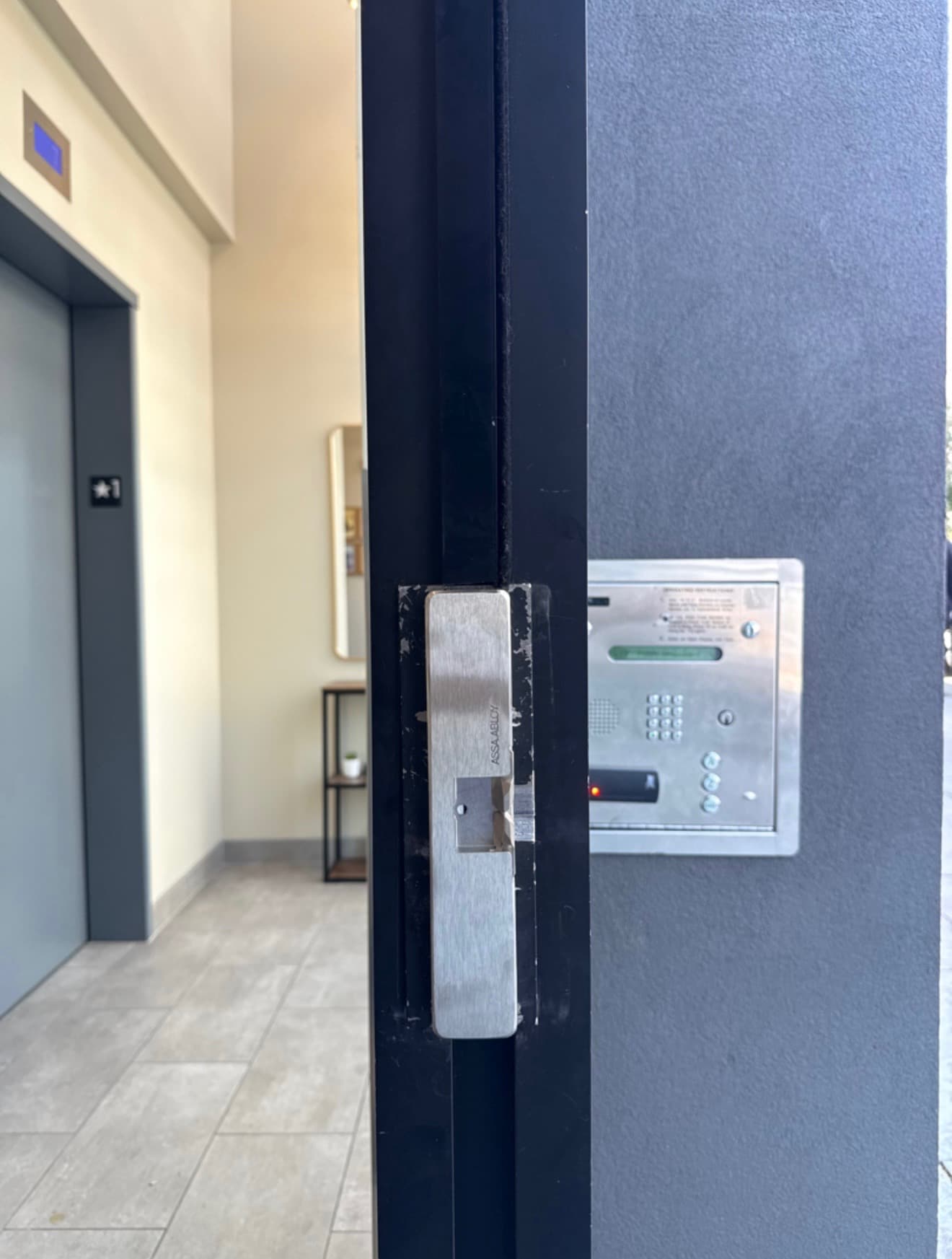
Key takeaways
- Treat the door, frame, hanging hardware, closer, latch, strike, trim, and any electrified hardware as one opening.
- Describe the symptom and operating conditions before naming the replacement part.
- A lock cannot compensate for a sagging door, and a stronger closer should not be used to overpower binding or misalignment.
- Match hardware to the door material, frame preparation, opening size, traffic, exposure, security needs, and required function.
- Fire-rated, egress, and accessible openings need project-specific review under adopted requirements and the authority having jurisdiction.
- For multi-door work, inventory every opening and standardize by function rather than assuming one hardware set fits the property.
Opening anatomy
Every part affects the next part in the chain.
Commercial hardware is easiest to understand by the job each layer performs. The exact components differ on an aluminum storefront door, hollow-metal service door, wood office door, glass entry, or exterior gate, but the functional chain remains similar.
| Layer | Typical components | What to verify |
|---|---|---|
| Opening structure | Door, frame, anchors, reinforcements, threshold, glazing, and gasketing | Material, condition, clearances, preparation, movement, corrosion, damage, and suitability for the hardware |
| Hanging hardware | Butt hinges, pivots, concealed hinges, or continuous hinges | Door support, wear, fastening, alignment, swing, load, and compatibility with the door and frame |
| Door control | Surface closer, concealed closer, floor closer, stops, holders, or automatic operator | Closing behavior, opening force, mounting, arm geometry, leakage, abuse, wind, and required function |
| Latching and locking | Cylindrical lock, mortise lock, deadlatch, exit device, flush bolts, strike, or electric release hardware | Positive latching, secure engagement, handing, function, preparation, keying, release behavior, and listed use where applicable |
| Operating trim | Levers, knobs, paddles, push plates, pull handles, exit trim, and cylinders | Secure mounting, comfortable operation, return action, clearance, accessibility, and compatibility with the lock or device |
| Monitoring and power | Door contacts, electric strikes, electrified locks, power transfer, request-to-exit devices, and wiring | Mechanical operation first, then power, command, wiring, release, monitoring, and fail-state behavior |
Component guide
Know the job of the major hardware groups.
Hinges, pivots, and continuous hinges
These components connect the door to the frame and carry its load through the swing. Wear, loose fastening, unsuitable capacity, damaged reinforcement, or frame movement can produce sag, rubbing, uneven gaps, and latch misalignment.
Door closers and control hardware
A closer returns the door after use and manages portions of its movement. The correct closer, mounting, arm, spring range, and control features depend on the door, frame, use, exposure, and required performance. A closer is not a structural correction for a door that binds.
Locks, latches, strikes, and cylinders
The lock or latch provides the securing function, the strike receives it, and the cylinder accepts the authorized key where keyed operation is used. Each must match the door preparation, frame, handing, function, and keying plan.
Handles, levers, pulls, paddles, and trim
The part users call a door handle may be operating trim connected to a latch, fixed pull hardware used with another locking method, or exterior trim for an exit device. Naming the function prevents the wrong assembly from being ordered.
Exit devices and vertical rods
Panic and fire exit hardware release from the egress side through a crossbar or touchpad. Rim, mortise, surface vertical-rod, concealed vertical-rod, and less-bottom-rod configurations are different systems with different door and frame preparations.
Electrified opening hardware
Electric strikes, electrified locks, latch retraction, power transfers, door contacts, and access-control wiring add power and control to the physical opening. The door must still swing, align, close, latch, release, and secure mechanically as intended.
Problem routing
Start with what the door does—not the part someone suspects.
| Observed symptom | Possible layers | Useful service description |
|---|---|---|
| Door drags or rubs | Hinges or pivots, door sag, frame movement, threshold, closer geometry, or damaged door | Where it rubs, when it began, whether the condition changes during the day, and whether the door was struck |
| Door closes but will not latch | Hinge-side alignment, closer behavior, latch, strike, lock body, gasketing, air pressure, or electrified release hardware | Whether it latches with a gentle push, whether the latch reaches the strike, and whether access control is involved |
| Door slams or closes too slowly | Closer leakage, settings, mounting, arm, spring selection, temperature, wind, or another binding condition | Which part of the swing is affected and whether the closer is leaking or loose |
| Lever or handle is loose | Trim fastening, spindle, return mechanism, latch or lock body, door preparation, or use damage | Whether the trim moves without retracting the latch and whether both sides are affected |
| Panic bar sticks or rods do not latch | Exit device, strikes, rod adjustment, door alignment, dogging state, trim, closer, or door/frame preparation | Whether pressing the device releases freely and which latch point fails to engage |
| Reader grants access but door stays locked | Controller command, relay, power, wiring, electric lock, latch pressure, strike alignment, or physical door condition | Reader response, sound at the lock, affected credentials, and whether mechanical operation works |
Application fit
The same symptom can require different hardware on different openings.
| Opening | Typical considerations | Common scope risk |
|---|---|---|
| Aluminum storefront | Narrow stiles, pivots, concealed or surface closer, deadlatch or exit device, pull or paddle trim, and glass | Ordering hardware that does not match the narrow-stile preparation or existing pivot/closer system |
| Hollow-metal door and frame | Reinforcements, hinge type, mortise or cylindrical preparation, closer mounting, exit hardware, rating label, and frame anchors | Treating a damaged reinforcement or shifted frame as a replaceable-hardware-only problem |
| Wood commercial door | Core construction, edge condition, reinforcements, through-bolting needs, hinge loading, lock preparation, and exposure | Fastening into an unsuitable or damaged section of the door |
| Glass or narrow-rail entry | Patch fittings, rails, pivots, floor or overhead closers, pulls, locks, clearances, and specialized glass preparation | Changing fittings without confirming the glass, patch, floor, and frame system |
| Exterior pedestrian gate | Gate construction, post alignment, hinges, closer, latch, strike, weather, drainage, wiring, and pedestrian use | Using indoor assumptions for an exposed opening that moves or corrodes differently |
Scope decision
Repair the failed layer; replace when the assembly no longer supports a dependable result.
Commercial hardware is often repairable, but replacement becomes the responsible path when condition, compatibility, preparation, or support prevents a durable repair.
Repair
Repair fits an isolated, identifiable condition when the door and frame remain sound, the hardware is suitable, parts are available, fastening and preparation can support the work, and the result can be tested through the full operating cycle.
Targeted retrofit
A retrofit fits when useful layers can remain but a closer, hinge system, lock function, exit device, trim set, strike, or electrified component should change. Compatibility and the final opening function must be documented.
Door, frame, or assembly replacement
Broader replacement deserves consideration when the door or frame is damaged, reinforcements no longer hold hardware, preparation has been repeatedly modified, corrosion is extensive, clearances cannot be maintained, or the existing assembly cannot support the required function.
Property operations
Use an opening-level inspection instead of waiting for lockouts.
Traffic, impact, weather, loose fasteners, wear, building movement, and later construction can gradually change a door. A recurring visual and operational check helps property teams notice that change before the opening stops securing.
- Confirm the door swings without scraping, unusual resistance, or uncontrolled movement.
- Watch the complete closing cycle and confirm the latch engages without someone pulling or pushing the door into place.
- Look for loose, missing, or damaged visible hardware and new marks at the head, jamb, threshold, or strike.
- Note closer leakage, a loose cover or arm, and any sudden change in speed or closing behavior.
- Check that levers, pulls, paddles, and exit-device touchpads remain secure and return normally.
- Report doors that are propped open, field-modified, difficult to operate, or unable to latch—especially on required egress or rated openings.
- Keep the opening number, hardware record, keying information, service history, and access-control relationship together.
Project constraints
Security, accessibility, egress, and fire protection must resolve at the same opening.
Door hardware decisions are not based on security alone. Operating hardware, opening force, closing speed, maneuvering clearance, unlatching, egress, fire protection, and any electrified locking sequence can all affect the scope.
The 2010 ADA Standards include provisions for operable parts, door hardware, closing speed, and opening force. California requirements, local amendments, the adopted building and fire codes, the occupancy, and the actual opening can add or change obligations. Fire-rated assemblies also depend on compatible labeled components and approved field work.
This guide is a planning resource, not a determination for a particular door. The responsible design team and authority having jurisdiction determine the applicable requirements and acceptance path.
Portfolio planning
For multiple doors, standardize the decision process before the products.
- Assign a unique opening number and record location, use, door material, frame, handing, swing, and observed condition.
- Document hinges or pivots, closer, lock or exit device, trim, strike, cylinder or keyway, and any electrified hardware.
- Group openings by function: public entry, tenant or resident entry, staff-only, service, stair, amenity, utility, gate, or emergency use.
- Identify fire labels, egress roles, accessible-route conditions, automatic operators, and connected access-control equipment.
- Separate immediate repairs from standardization opportunities and full-assembly replacement needs.
- Define approved hardware families by actual opening condition; keep alternates and exceptions visible.
- Require testing, keying records, closeout documentation, and a service path for every completed phase.
Common questions
Commercial door-hardware questions property teams ask
Is a door that will not latch always a lock problem?
No. The cause may be the hinges or pivots, closer, door or frame alignment, latch, strike, gasketing, threshold, air pressure, or electrified release hardware. The complete opening should be checked before the lock is replaced.
Can existing commercial hardware be reused during a door replacement?
Sometimes. Reuse depends on condition, function, dimensions, handing, preparation, compatibility, listing requirements, and whether the manufacturer supports the intended application. Each retained component should be identified in the scope.
Should every door in a building use identical hardware?
Not necessarily. Standardization helps service and inventory, but hardware still has to fit each opening's material, size, traffic, exposure, security, egress, accessibility, fire-protection, and access-control needs.
Who should receive a service call when access control and mechanical hardware overlap?
Route the call by symptom but include both contexts. If a reader grants access while the latch remains loaded, or a door no longer closes into an electric strike, diagnosis must cover the access command and the physical opening together.
Sources and further reading
These sources back up the general guidance. Your building and the people who approve the work decide the details for your doors.
- U.S. Department of Justice: 2010 ADA Standards for Accessible Design, Section 404
- Builders Hardware Manufacturers Association: Guide to Builders Hardware Terminology
- Builders Hardware Manufacturers Association: Hardware Highlights: ANSI/BHMA Standards
- Steel Door Institute: Maintenance of Steel Door and Frame Assemblies
- California Building Standards Commission: Current California Building Standards Codes