
Key takeaways
- Confirm that the existing door closes, latches, and secures consistently before adding electronic access.
- Choose the locking or release method after inspecting the door, frame, and existing hardware.
- Verify existing cable, conduit, power, and controller capacity before promising reuse.
- Plan the reader, credential, request-to-exit, door-position, and management workflow together.
- Treat fire-rated doors, exit hardware, delayed-egress conditions, and other code-sensitive openings as review items, not generic retrofits.
- Write the final scope door by door so the property knows what stays, what changes, and who owns each connection.
Retrofit principle
Start with the opening, not the reader.
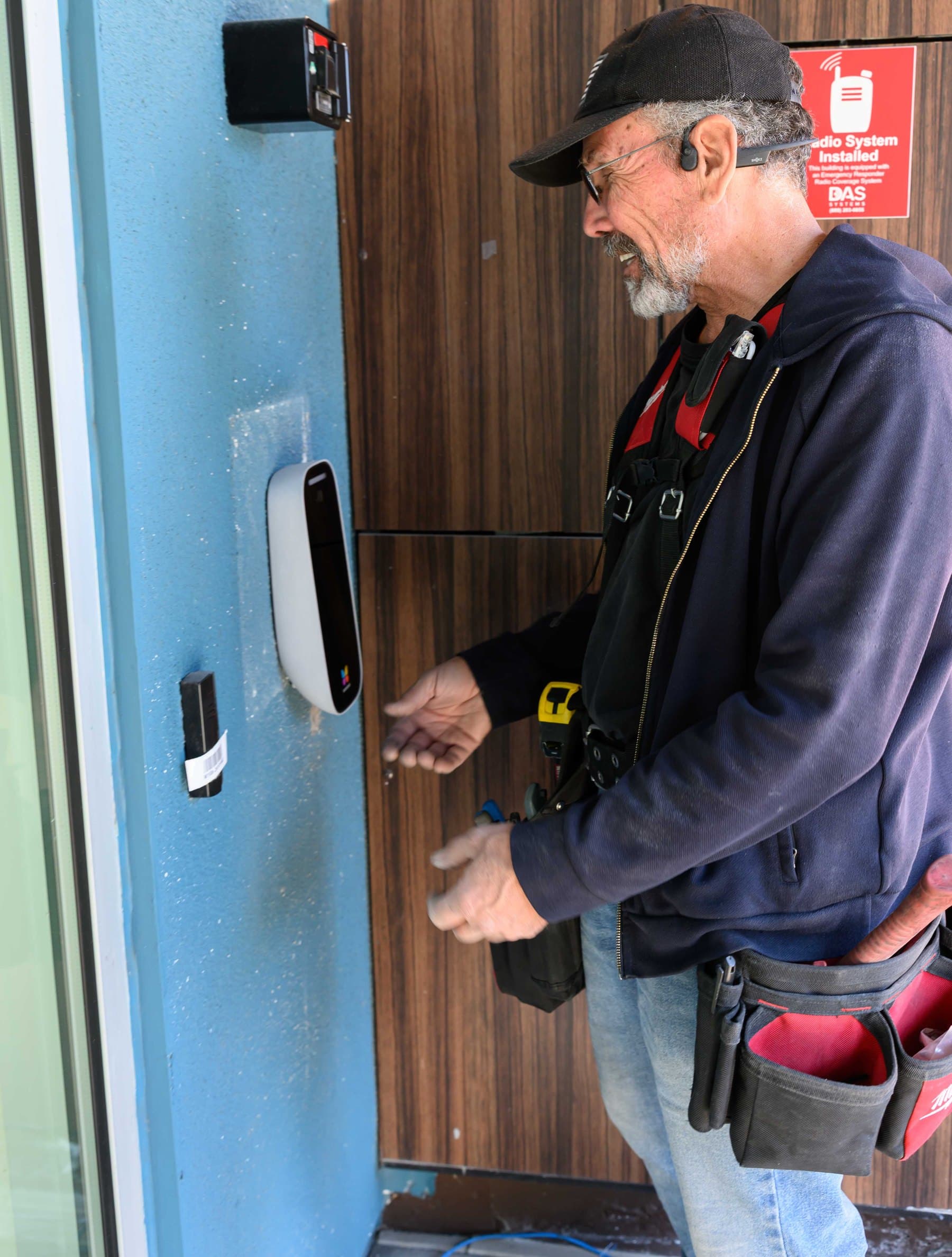
Adding a card reader sounds like a device request. In practice, the reader is only the visible part of a connected access path.
When a credential is accepted, the system still needs a controller, power, wiring, and compatible locking hardware to release the opening. The door then has to open, close, latch, and return to a secure state. Exit behavior and any required monitoring also have to work as intended.
A responsible retrofit answers two questions: can the existing opening support reliable controlled access, and which parts of the existing door and system are suitable to keep? Field inspection and system review provide those answers.
Opening survey
Inspect the door, frame, lock, and exit hardware first.
The retrofit strategy depends on what currently secures the opening and how the door behaves through a complete cycle.
Door and frame condition
Check whether the door swings freely, closes without dragging, latches consistently, and remains aligned. Review frame condition, hinges, closer behavior, weather exposure, traffic, and whether the opening is a single door, pair, storefront, or gate.
Existing lock and exit hardware
Identify cylindrical or mortise locks, narrow-stile storefront hardware, rim or vertical-rod exit devices, electric strikes, maglocks, electrified locks, deadlatches, hook bolts, and other relevant commercial hardware. Confirm condition, function, handing, latch behavior, and egress operation.
Closing and latching
Observe the opening repeatedly. Alignment, latch pressure, closer adjustment, hinge wear, frame movement, and traffic conditions can determine whether electrified release works consistently.
Hardware decision
Match the locking method to the actual opening.
Common retrofit paths are not interchangeable. The door construction, existing hardware, power, cable routing, traffic, egress, and local review all affect the decision.
Electric strike
A compatible electric strike releases an existing latch or supported exit hardware at the frame. Frame preparation, latch alignment, preload, power, and the exact hardware pairing matter.
Electrified lever or lockset
Powered hardware in the door can control secure-side entry while preserving the required egress-side function. Door preparation, lock function, controller compatibility, and a supported wired or wireless path must be verified.
Electrified exit hardware
A supported exit-device application can connect access control to an existing or replacement panic or fire exit hardware assembly. The exact device, opening, listing, and egress conditions require project-specific review.
Magnetic lock
A maglock can fit an opening when the door, frame, mounting, continuous power, release devices, connected alarm conditions, and approved egress arrangement support electromagnetic locking.
System path
Verify the reader, controller, power, and cable route.
Credential and reader
Define cards, fobs, mobile credentials, keypads, or a supported mix. Confirm reader compatibility, mounting location, weather exposure, approach path, accessibility, and the user groups that will rely on it.
Controller and capacity
For an existing system, confirm the platform, administrator access, supported field devices, available capacity, inputs and outputs, software or licensing implications, schedules, and current supportability.
Power and equipment location
Identify the power supply, controller, and equipment locations. Confirm that the selected devices, cable distances, field conditions, and service access can be supported.
Cable and conduit
Identify, test, and document existing cable before reuse. Review cable type, route, condition, labeling, accessible pathways, exterior exposure, and how power or communication crosses from the frame into the door when needed.
Opening behavior
State how people exit and how connected systems release the door.
The proposal should make normal access, egress, monitoring, schedules, and connected release paths understandable.
Fail-safe and fail-secure describe the secure-side state of particular electrified hardware when power is removed. Those terms do not, by themselves, determine whether the egress side is properly designed.
- Mechanical free egress through the lock or exit device where that is the approved design
- Request-to-exit hardware or sensing where applicable
- Door-position monitoring and door-held or forced-door behavior where needed
- Manual release and alarm interfaces required by the approved locking arrangement
- Scheduled unlock, staff override, and property-management workflows
- Video intercom, reception, gate, garage, elevator, camera, network, or automatic-operator connections
- The intended state during power loss and relevant building-system activation
Scope decisions
What can remain in an existing-door retrofit?
Reuse is a condition-based decision. The scope should name the retained components and the verification required before they are accepted.
| Component | Reuse may fit when | Change may be needed when |
|---|---|---|
| Door and frame | The opening is stable, closes correctly, and supports the proposed hardware | It drags, sags, binds, fails to latch, is damaged, or cannot accept the required preparation |
| Lock or exit hardware | It is compatible, serviceable, and functions correctly with the release method | It is worn, incompatible, incorrectly functioning, or unsuitable for the intended access and egress behavior |
| Electrified hardware | The device, mounting, power, function, and listing remain suitable | It is damaged, unsupported, incorrectly matched, or part of an unsuitable locking arrangement |
| Reader and controller | The credential technology, interfaces, capacity, and software support the plan | The system cannot support the selected credentials, field devices, administration, or future direction |
| Power and wiring | Condition, output, route, cable type, labeling, capacity, and testing support the equipment | The infrastructure is undersized, damaged, unidentified, inaccessible, or incompatible |
Field conditions
Common surprises that change an existing-door scope
The reader works, but the door does not release
The fault may be farther down the path: controller output, relay behavior, power, wiring, locking hardware, latch pressure, alignment, closer behavior, or the physical door.
The door releases but does not secure again
The door may not close fully, the latch may miss the strike, the closer may not complete the cycle, the lock may remain in the wrong state, or a schedule or request-to-exit condition may be involved.
The opening contains more hardware than expected
Door pairs, exit devices, coordinators, power transfers, automatic operators, alarm contacts, and other connected hardware can change preparation, wiring, testing, and responsibility.
The simple door is code-sensitive
Fire-rated openings, required egress doors, delayed-egress systems, panic or fire exit hardware, and certain occupancy conditions need careful professional and authority review.
Proposal checklist
A one-door proposal should still describe the complete opening.
The same checks apply when you add several doors at once. List the shared parts once (controller, power supply, network connection, and where the equipment lives) and the door work under each door. To decide which doors to include, see which doors need access control. For typical pricing, see access control cost per door. A door that has never had access control is priced as a new install, about $3,000–$7,000, even though the door itself stays.
Existing condition
Record the door and frame, lock or exit hardware, closer, reader, controller, power, cable, current access behavior, egress behavior, and observed problems.
New or modified work
State the credential, reader, controller connection, locking hardware, request-to-exit, door position, power supply, cable route, door preparation, permissions, schedules, and system interfaces as applicable.
Coordination
Assign affected trades, building contacts, design review, permits, inspections, occupied-building access, finish work, and any owner-provided items.
Commissioning and handoff
Define credential testing, secure-side access, egress-side operation, closing and latching, connected-system behavior, administrator access, documentation, training, and support.
Authority review
Treat life-safety requirements as part of the design.
Requirements for electrified locking depend on the opening, occupancy, adopted code, local amendments, fire-alarm and sprinkler conditions, and the authority having jurisdiction. An approved arrangement may require specific release behavior, listed hardware, signage, emergency lighting, alarm connections, or other features.
This guide does not determine compliance for a particular door. Fire-rated doors and hardware should use listed, compatible components where required. The fire marshal or other authority having jurisdiction determines compliance.
Common questions
Existing-door retrofit questions
Can access control be added without replacing the door?
Often, yes. The existing door and frame can remain when their condition and preparation support the selected hardware and required opening behavior. Inspection is necessary before that promise is made.
Can the existing lock remain?
Sometimes. A compatible, serviceable lock or exit device may work with an electric strike or another approved electrified approach. Hardware condition, function, and the complete opening design decide whether it should stay.
Can existing wiring be reused?
Sometimes. The cable type, condition, route, labeling, communication method, power requirements, and test results must support the selected equipment.
Can the retrofit happen in phases?
Often, yes. A phased project should identify controller capacity, credential transition, shared infrastructure, priority openings, temporary operating conditions, and the final system direction before the first phase begins.
Sources and further reading
These sources back up the general guidance. Your building and the people who approve the work decide the details for your doors.
- Security Industry Association: The Basics of Physical Access Control
- Security Industry Association: Implementing OSDP Access Control Checklist
- Allegion: Door Hardware 101: Mechanical and Electrified Hardware
- California Building Standards Commission: Current California Building Standards Codes
- California Building Standards Commission: 2025 California Code Changes: Chapters 9 and 10