
Key takeaways
- Each 8200 and 10X Line model number includes a function number, and the function tables below give what each listed function does.
- The 8200 catalog prints Grade 1 for operation and security "with all standard trims"; large and small format interchangeable core cylinders (LFIC and SFIC) do not meet Security Grade 1.
- Each 80 Series device type in the table below, from rim to concealed vertical rod, has its own number, catalog page, grade line and UL line.
- On several 80 Series device pages, SARGENT lists hex key dogging, which holds the push rail down with the latch retracted, as standard on "non fired rated devices".
Identify
Which SARGENT lock or exit device do I have?
Start with how the lock sits in the door. A mortise lock's body sits in a pocket cut into the door's edge, a cylindrical lock fits through a round hole bored through the door, and an exit device is a push bar across the door. The 7800 Series is the knob trim version of the 8200, and the catalog says 8200 lockbodies are dimensionally the same except for the through-bolt locations.
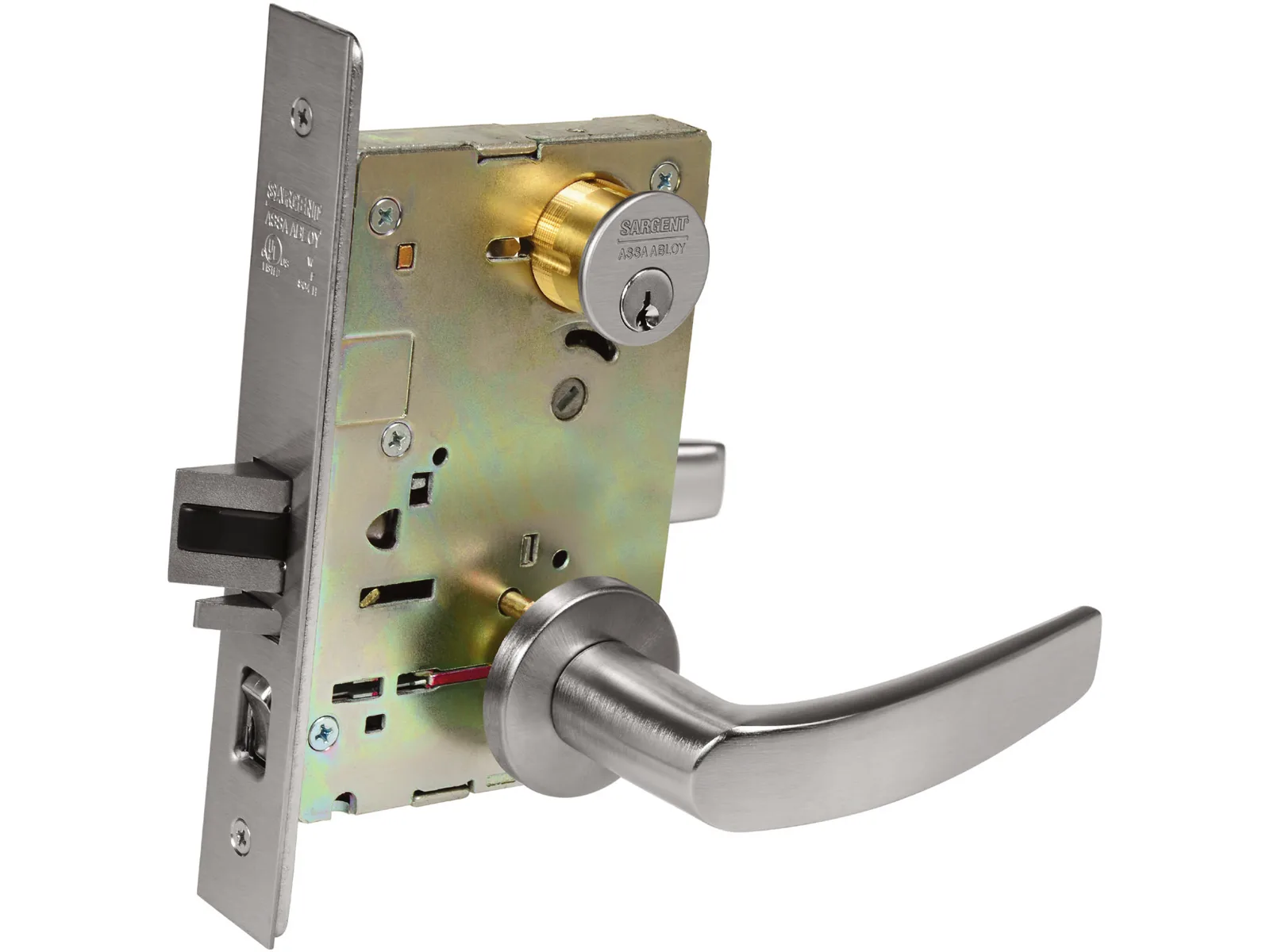
For how a mortise lock is built and how functions work on any brand, see the general commercial mortise lock guide.
| Line | What it is | Other lines on the same SARGENT page |
|---|---|---|
| 8200 Series | Lever mortise lock; the 7800 Series is the knob trim version | 7800, 7900, 9200 and M-9200 Series |
| 10X Line | Cylindrical lever lock, listed under bored locks | 11 Line, 7 Line, 6500 Series, 8X Line, 6 Line and DL Series |
| 80 Series | Rim, mortise lock and vertical rod exit devices | PE80, 90, 30, 20 and 5300 Series |
Source SARGENT's mortise lock, bored lock and exit device product pages, and its 7800/8200 Series, 10X Line and 80 Series catalogs.
Fit and ratings
Will an 8200 or 10X lock fit my door, and what is it rated for?
The backset is how far the lock sits in from the door edge, and the stile is the door's vertical side band. On door thickness, each catalog and its product page read differently; the table gives both and this page doesn't pick one.
The 8200 catalog's grade line reads "Certified to ANSI/BHMA A156.13 Series 1000 Operational Grade 1 and Security Grade 1 with all standard trims." The next line reads "Note: LFIC (Removable) Cylinders and SFIC Cylinders do not meet Security Grade 1 requirements." Its cylinder pages add: "When using Interchangeable Core Cylinders, the ANSI/BHMA Cylinder Grade determines the grade of the lock, even if the lock is certified ANSI/BHMA Grade 1 with a standard cylinder".
The 8200 fire listing line reads: "UL and cUL Listed to US and Canadian safety standards for A label 4 x 10 single and 8 x 10 double (3 hour fire door) and lesser class doors, stamped letter F and UL symbol on armored front indicate listing. Electrified functions are UL294 listed access control accessories."
The 10X Line catalog's grade and UL lines read "Certified ANSI/BHMA A156.2 (2022) Series 4000 — Grade 1" and "UL/cUL listed to US and Canadian safety standards for 3 hour doors up to 4' x 10' (double doors require 41- option)".
Both catalogs say any retrofit or other field modification to a fire rated opening can potentially impact the fire rating of the opening.
| Detail | 8200 Series mortise lock | 10X Line cylindrical lock |
|---|---|---|
| Backset | 2-3/4" (70mm) only | 2-3/4" (70mm) standard; 2-3/8" (60mm), 3-3/4" (95mm) and 5" (127mm) as the 20-, 23- and 25- options |
| Door thickness, catalog | 1-3/4" (44mm) standard; the features page says offered for 1-3/8" (35mm) to 6" (152mm) | 1-3/4" (44mm) adjusts to 2" (51mm) standard; 1-3/8" (35mm) with the 1- option; over 2" up to 2-1/4" (57mm) with the 31- option |
| Thicker doors, catalog | As above | Over 2-1/4" (57mm) up to 6" (152mm): "available by special application, contact Technical Product Support" |
| Door thickness, product page | 1 3/4" minimum and 1 3/4" maximum | 1 3/8" minimum, 2" maximum |
| Door prep | ANSI/SDI A250.14 modified per template 7057 | ANSI/SDI A250.14 |
| Minimum stile | 4-1/2" (114mm); 4-3/4" (121mm) for electrical function locks | 4-1/2" (114mm) |
| Handing | Hand specified on the order; easily field reversible | Non-handed |
| Bolts | Stainless steel latchbolt, 3/4" (19mm) projection; one-piece hardened stainless steel deadbolt, 1" (25mm) projection | Stainless steel latchbolt, 1/2" (13mm) throw; brass 3/4" (19mm) throw deadlocking fire latch for pairs of doors as the 41- option |
| Case, front or strike | 12 gauge wrought steel case; outside front plate 8" (203mm) x 1-1/4" (31mm) | 808 curved lip ANSI 4-7/8" strike, standard |
| Standard cylinder | Brass, size #41 (1-1/8"); #46 (1-3/4") with freewheeling trim; LA keyway; two nickel silver keys | Brass, 6-pin, LA keyway |
| Keying | Masterkeyed or grand masterkeyed; construction keying available | Master keyed or grand master keyed; construction key systems available |
Source The specification, certification and cylinder pages of SARGENT's 7800/8200 Series and 10X Line catalogs, and the specification lists on the 8200 Series and 10X Line product pages.
8200 functions
What does an 8200 function number mean?
An 8200 model number is the series plus a two-digit function, so an 8205 is the 8200 Series in the 05 function. Trim means the lever and its rose or escutcheon.
The catalog calls the Storeroom, Office, Classroom, Classroom Security and Exit Latch functions one multi-function 8200/7800 lockbody, which will accommodate the 04, 05 and 37 functions without additional parts, the 38 function by adding an additional cylinder, and the 06, 13, 31 and 36 functions by adding a Trim One Side Kit.
The 31 Utility, 36 Closet, 17 Asylum or Institutional and 24 Room Door functions carry the caution "not recommended for use on any door used for life safety egress", and the same caution heads the deadbolt-only page.
Eight lever designs (A, B, E, F, J, L, P and W) are standard on the 8200 Series only; the J, L and P have lever returns within 1/2" (13mm) or less of door face. Studio Collection levers, Coastal Series levers and freewheeling (FE) trim, where the outside lever swings freely in the locked mode, have their own pages.
The cylinder pages list SARGENT's Degree, Signature, XC, Keso and Keso F1 key systems, and large and small format interchangeable core options.
| Function | SARGENT's type name | ANSI No. | Key and thumbturn | Trim | Auxiliary deadlatch |
|---|---|---|---|---|---|
| 8204 | Storeroom or Closet | F07 | Key outside retracts latchbolt. | Trim outside locked at all times. Trim inside always retracts latchbolt. | Yes |
| 8205 | Office or Entry | F04 | Key outside retracts latchbolt, also locks and unlocks outside trim. Thumbturn inside locks and unlocks outside trim. | Trim inside always retracts latchbolt, trim outside remains locked. | Yes |
| 8237 | Classroom | F05 | Key outside retracts latchbolt, also locks and unlocks outside trim. | Trim inside always retracts latchbolt. | Yes |
| 8215 | Passage or Closet | F01 | — | Trim from either side retracts latchbolt at all times. | Not listed |
| 8265 | Privacy Bath/Bedroom | F22 | Thumbturn locks and unlocks trim outside. | Trim outside retracts latchbolt except when locked by thumbturn. Trim inside retracts latchbolt and unlocks outside trim. Closing the door will unlock outside trim. | Not listed |
| 8216 | Apartment, Exit or Public Restroom | F09 | Key outside retracts latchbolt. Key inside is required to lock and unlock trim outside. | Trim inside always retracts latchbolt. | Yes |
| 8238 | Classroom Security Intruder Latchbolt | F32 | Key from either side locks and unlocks outside trim. Key from either side retracts latchbolt. | Trim outside retracts latchbolt, except when locked. Trim inside always retracts latchbolt. | Yes |
| 8213 | Exit Latch | F31 | — | No outside trim or cylinder. Trim inside retracts latchbolt. | Yes |
Source The function pages, lever and rose pages and cylinder options pages of SARGENT's 7800/8200 Series Mortise Locks catalog.
10X functions
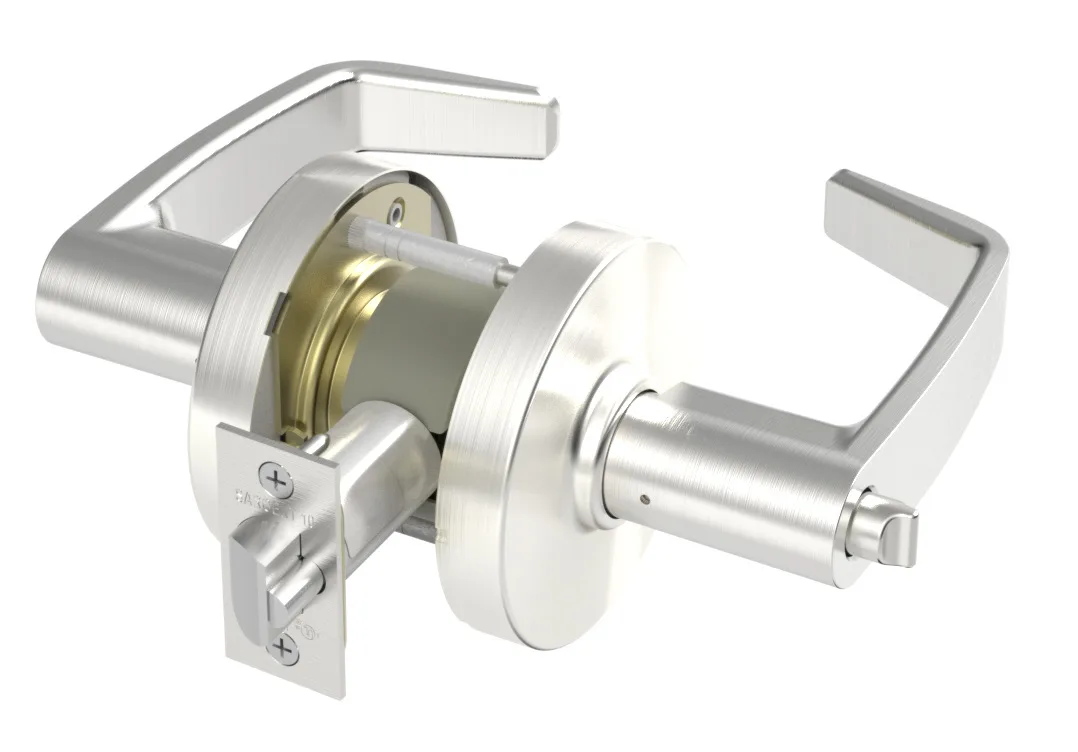
10X Line functions, levers and cylinders
A 10X Line function is written as the line name, a G or U, and a two-digit function, such as 10XG05.
The levers are the B, L and P in solid cast zinc and four decorative levers (MD, MB, ND and MW), on the G or L rose. The rigid lever is standard and freewheeling levers are available, and there are pages for behavioral health (BHW) trim and visual status indicator (VSL) trim.
The cylinder pages list fixed core cylinders in conventional, Signature, XC, Keso and Degree versions, plus large and small format interchangeable cores.
| Function | SARGENT's type name | ANSI No. | Latch | Locking and release |
|---|---|---|---|---|
| 10XG04 | Storeroom or Closet | F86 | Deadlocking latch. Latch by lever inside or key outside. | Outside lever locked at all times. |
| 10XG05 | Entrance or Office | F109 | Deadlocking latch. Latch by either lever unless outside lever is locked by push/turn button in inside lever. | Push button released by key outside or lever inside. Turn button must be released manually. Key retracts latch when outside lever is locked. |
| 10XG37 | Classroom | F84 | Deadlocking latch. Latch by either lever unless outside lever is locked by key. Inside lever always operative. | Key in outside lever locks or unlocks outside lever and retracts latch. |
| 10XU15 | Passage | F75 | Latch by either lever. | — |
| 10XU65 | Privacy/Bathroom | F76A | Latch by either lever unless outside lever is locked by push button in inside lever. | Turning inside lever or closing door releases button. |
| 10XG13 | Exit | F89 | Deadlocking latch. Latch by inside lever. | Outside lever locked at all times. |
| 10XG17 | Utility, Asylum or Institutional | F87 | Deadlocking latch. Latch by key either side. | Both levers locked at all times. Use only on rooms with more than one exit. |
| 10XG38 | Classroom Security Intruder | F110 | Deadlocking latch. Latch by either lever unless outside lever is locked by key. Inside lever always operable. | Key in either lever locks or unlocks outside lever. |
Source The function, lever, trim and cylinder pages of SARGENT's 10X Line Cylindrical Lever Lock catalog.
Electrified locks
Electrified 8200 and 10X locks: fail safe and fail secure
Both locks come in electrified versions, which their listing lines call access control accessories; the table gives what power does to the levers on each, in the catalog's words.
The 8200 catalog marks the 8273 with a caution: not recommended for use on any door used for life safety egress. Its EcoFlex section describes the lock as field configurable to fail-safe or fail-secure.
Of the 8200 electromechanical locks, the catalog says: "They meet ANSI/BHMA A156.13 Grade 1 requirements, are UL listed on fire doors, and satisfy industry standards for operating temperature, shock and fire hazard." The 10X Line's UL294 line reads "Listed as an Access Control Accessory (10XG70 & 10XG71)".
The 8200 electrified functions are available with a latchbolt monitor (LX-), request to exit (RX-) and motorized electric latch retraction (MELR, 56-), where the latchbolt retracts in 1/2 of a second with applied power and removing power allows the latch to project again. On the 10X Line, a request to exit switch that monitors the inside lever is the RX- option.
| Function | Lock | SARGENT's label | Catalog description | Power |
|---|---|---|---|---|
| 8270 | 8200 Series | Fail Safe | Power ON, locks outside lever. Key outside retracts latchbolt; lever inside always retracts latchbolt. | 12-24VDC regulated; .015 Amp continuous, 1/2 Amp peak; maximum two locks per 1 Amp power supply |
| 8271 | 8200 Series | Fail Secure | Power ON, unlocks outside lever. Key outside retracts latchbolt; lever inside always retracts latchbolt. | 12-24VDC regulated; .015 Amp continuous, 1/2 Amp peak; maximum two locks per 1 Amp power supply |
| 8272 | 8200 Series | Fail Safe | Power ON, locks both levers. Key on either side retracts latchbolt; both levers can only be locked and unlocked electronically. | 12-24VDC regulated; .015 Amp continuous, 1/2 Amp peak; maximum two locks per 1 Amp power supply |
| 8273 | 8200 Series | Fail Secure | Power ON, unlocks both levers. Key on either side retracts latchbolt; both levers can only be locked and unlocked electronically. | 12-24VDC regulated; .015 Amp continuous, 1/2 Amp peak; maximum two locks per 1 Amp power supply |
| 10XG70 | 10X Line | Fail Safe | Power off/unlocks outside lever. Inside lever always free. | 12VDC or 24VDC (operating range 10.2VDC to 26.4VDC); 10mA continuous, 500mA peak |
| 10XG71 | 10X Line | Fail Secure | Power on/unlocks outside lever. Inside lever always free. | 12VDC or 24VDC (operating range 10.2VDC to 26.4VDC); 10mA continuous, 500mA peak |
| 56- (MELR) | 8200 Series | Motorized electric latch retraction | Listed as 56-8204, 56-8215, 56-8217, 56-8270, 56-8271, 56-8272 and 56-8273; operates independently from fail safe and fail secure functionality. | 24VDC; operating current 700mA, hold current 50mA |
Source The electromechanical and motorized electric latch retraction pages of SARGENT's 7800/8200 Series catalog, and the electrified functions and certification pages of its 10X Line catalog.
80 Series
80 Series exit devices by number
Each 80 Series device type has its own number and catalog page. Rim devices and the 8900 latch at one point. Vertical rod devices have rods on the door's surface or concealed inside it, and the table gives each one's latching.
On the concealed vertical rod pages, the NB- prefix is the version with less bottom rod. The 8700 can not be used less bottom rod, and its page points to the NB8700 for that.
Fire exit hardware takes a 12- prefix, which the options page defines as "UL Fire Label Exit hardware", and the catalog's chart of maximum door openings for fire doors lists the devices with that prefix.
Rail length follows door width. The 8800 page lists an E rail for 24" to 32" doors, F for 33" to 36", J for 37" to 42" and G for 43" to 48".
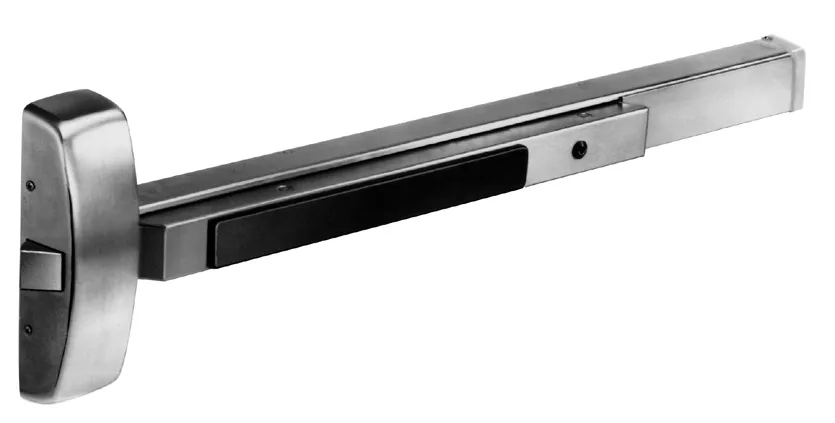
| Device | SARGENT's page title | Catalog describes it as | Grade line | UL line |
|---|---|---|---|---|
| 8800 | Rim Exit Device | Single point rim latching device | ANSI/BHMA A156.3 - Grade 1 | UL10C (Fire) and UL305 (Panic) Listed |
| 8900 | Mortise Lock Exit Device | Concealed single point guarded latching | ANSI/BHMA A156.3 - Grade 1 | UL10C (Fire) and UL305 (Panic) Listed |
| 8700 | Surface Vertical Rod Exit Device | Two point latching (top and bottom) | ANSI/BHMA A156.3 - Grade 1 | UL10C (Fire) and UL305 (Panic) Listed |
| NB-8700 | Top Latch Surface Vertical Rod Exit Device | Single point top latching, no bottom strike | ANSI/BHMA A156.3 - Grade 1 | UL10C (Fire) and UL305 (Panic) Listed |
| MD8600 and NB-MD8600 | Concealed Vertical Rod Exit Device for Metal Doors | Standard width stile applications on hollow metal doors | Devices are ANSI A156.3 - Grade 1 | UL Fire and Panic listed |
| AD8600 and NB-AD8600 | Concealed Vertical Rod Exit Device for Aluminum Doors | Standard width stile applications on aluminum doors | Devices are ANSI/BHMA A156.3 - Grade 1 | UL305 (Panic) listed only |
| WD8600 and NB-WD8600 | Concealed Vertical Rod Exit Device for Wood Doors | Standard width stile applications on wood doors | Devices are ANSI/BHMA A156.3 - Grade 1 | UL10C (Fire) and UL305 (Panic) listed |
| 8500 | Narrow Design Rim Exit Device | Narrow stile applications; single point rim latching device | Devices are ANSI/BHMA A156.3 - Grade 1 | UL10C (Fire) and UL305 (Panic) listed |
| 8300 | Narrow Design Mortise Lock Exit Device | Standard width stiles with a narrow design look | Devices are ANSI/BHMA A156.3 - Grade 1 | UL10C (Fire) and UL305 (Panic) listed |
| MD8400 and NB-MD8400 | Narrow Stile Concealed Vertical Rod Exit Device for Metal Doors | Narrow stile applications (e.g., full glass doors) | Devices are ANSI/BHMA A156.3 - Grade 1 | UL10C (Fire) and UL305 (Panic) listed |
| AD8400 and NB-AD8400 | Narrow Stile Concealed Vertical Rod Exit Device for Aluminum Doors | Narrow stile aluminum door applications (e.g., full glass doors) | Devices are ANSI/BHMA A156.3 - Grade 1 | UL305 (Panic) listed |
Source The device pages, how-to-order page and options page of SARGENT's 80 Series Exit Device catalog.
80 Series trim
8800 functions and outside trim
On the 8800, the outside lever trim is the 700 Series ET trim, ordered as a device number such as 8813 x ET_ with the lever design after the ET designation (for example ETL). The lever designs are the A, B, E, F, J, L, P and W, plus Coastal Series and Studio Collection levers.
The 73 and 74 functions have no cylinder override, and the 75 and 76 have cylinder override, where the key retracts the latch mechanically. For all four the voltage must be specified as 12VDC or 24VDC, and the actuator draw is 400mA inrush and 15mA continuous at 12VDC or 24VDC.
| SARGENT function | ANSI function | Catalog description | Ordered as |
|---|---|---|---|
| 04 | 03 | Night Latch, Key Retracts Latch | 8804 x ET_ |
| 06 | 09 | Key unlocks Trim, Trim retracts latch/Trim relocks when key is removed | 8806 x ET_ |
| 10 | 01 | No outside operation (No Cylinder) | 8810 |
| 10 | 02 | No outside operation (No Cylinder). ET Control is used as Pull Only | 8810 x ET_ |
| 13 | 08 | Key Outside Unlocks/locks Trim | 8813 x ET_ |
| 15 | 14 | Passage Only (No cylinder) | 8815 x ET_ |
| 16 | 10 | Key Outside Retracts Latch; Key Inside Unlocks/Locks O/S Trim | 8816 x ET_ |
| 73 | Not listed | Electrified ET Trim - Fail Safe. Power Off, Unlocks Lever (No Cylinder) | 8873 x ET_ |
| 74 | Not listed | Electrified ET Trim - Fail Secure. Power Off, Locks Lever (No Cylinder) | 8874 x ET_ |
| 75 | Not listed | Electrified ET Trim - Fail Safe. Power Off, Unlocks Lever, Key Retracts Latch | 8875 x ET_ |
| 76 | Not listed | Electrified ET Trim - Fail Secure. Power Off, Locks Lever, Key Retracts Latch | 8876 x ET_ |
Source The 8800 device page and the electrified ET trim page of SARGENT's 80 Series Exit Device catalog.
Dogging and options
Dogging and electric options on 80 Series devices
Dogging holds an exit device's push rail down with the latch retracted. The table lists the 80 Series dogging and electric options by order prefix.
The electric latch retraction page notes "HK- and 16- are not available for Fire Rated Doors", and of that option the catalog says: "The device can be dogged continuously on fire-rated devices that are tied into the building’s fire detection system."
Of electric dogging, the catalog says that when the device is de-energized or power is interrupted, the latch(es) will extend, and that manual hex key dogging is provided on non-fire rated devices.
The delayed egress compliance list includes the line "Conforms to NFPA 101 Special Locking Arrangements" and its operation list has the note "30 second delay available with written permission of Authority having Jurisdiction".
| Option | What it is | Power | Catalog notes |
|---|---|---|---|
| Hex key dogging | Dogging by hex key | — | "Hex key dogging standard on non fired rated devices", on the 8800, 8900, 8700, NB-8700 and MD8600 pages |
| 16- | Cylinder dogging: a 41 mortise cylinder in the rail insert "locks the rail in retracted position" | — | Available for all 80 Series devices except Fire Rated, FM8700 and some electrical options; not available with 12-, 59- or AL- |
| 12- | "UL Fire Label Exit hardware" | — | "not available with 16- & HK-" |
| LD- | "Less dogging for non fire rated devices" | — | — |
| AL- | Alarm | — | — |
| 53- | Latchbolt monitor | — | — |
| 54- | Outside lever monitoring | — | — |
| 55- | Request-to-exit signal | — | — |
| 56- | Electric latch retraction, by motor | 24VDC regulated and filtered; .6A during retraction, .25A maintained in the dogged hold position | Available for all 80 Series exit devices except the FM8700 |
| 58- | Electric dogging | 24VDC; .2 amp | When energized and the push rail is depressed, it continuously holds the push rail down and the latches retracted |
| 59- | Electroguard self contained delayed egress | — | Stays secure for fifteen seconds after the push pad is depressed; disarms for immediate egress when the fire alarm system is activated (if connected) |
Source The device pages, options page, cylinder dogging page and electric latch retraction, electric dogging and delayed egress pages of SARGENT's 80 Series Exit Device catalog.
Service
Service for SARGENT locks and exit devices
Elwin Security installs, repairs and replaces SARGENT mortise locks, cylindrical locks and exit devices as part of its commercial locksmith service for commercial and multifamily properties in the San Francisco Bay Area. Calls are answered 8:00 AM-8:00 PM daily at (408) 539-0535.
FAQ
SARGENT lock questions
Which SARGENT 8200 functions are fail safe and which are fail secure?
The catalog labels the 8270 and 8272 Fail Safe. It labels the 8271 and 8273 Fail Secure. On the 8270, power on locks the outside lever, and on the 8271 power on unlocks it.
What is the difference between a SARGENT 8800 and an 8900?
The 8800 is the 80 Series rim exit device, which the catalog describes as a single point rim latching device. The 8900 is the mortise lock exit device, with concealed single point guarded latching.
Does a fire-rated SARGENT 80 Series device have dogging?
Hex key dogging is listed as standard on "non fired rated devices", and the fire label option is not available with cylinder dogging or HK-. Of electric latch retraction, the catalog says: "The device can be dogged continuously on fire-rated devices that are tied into the building’s fire detection system."
Sources and further reading
These sources back up the general guidance. Your building and the people who approve the work decide the details for your doors.
- SARGENT Manufacturing Company (ASSA ABLOY): 7800/8200 Series Mortise Locks Product Catalog (90115 11/26)
- SARGENT Manufacturing Company (ASSA ABLOY): 10X Line Cylindrical Lever Lock Product Catalog (90890 02/26)
- SARGENT Manufacturing Company (ASSA ABLOY): 80 Series Exit Device Product Catalog (90641 10/26)
- SARGENT: 8200 Series product page
- SARGENT: 10X Line product page
- SARGENT: Exit devices product listing