
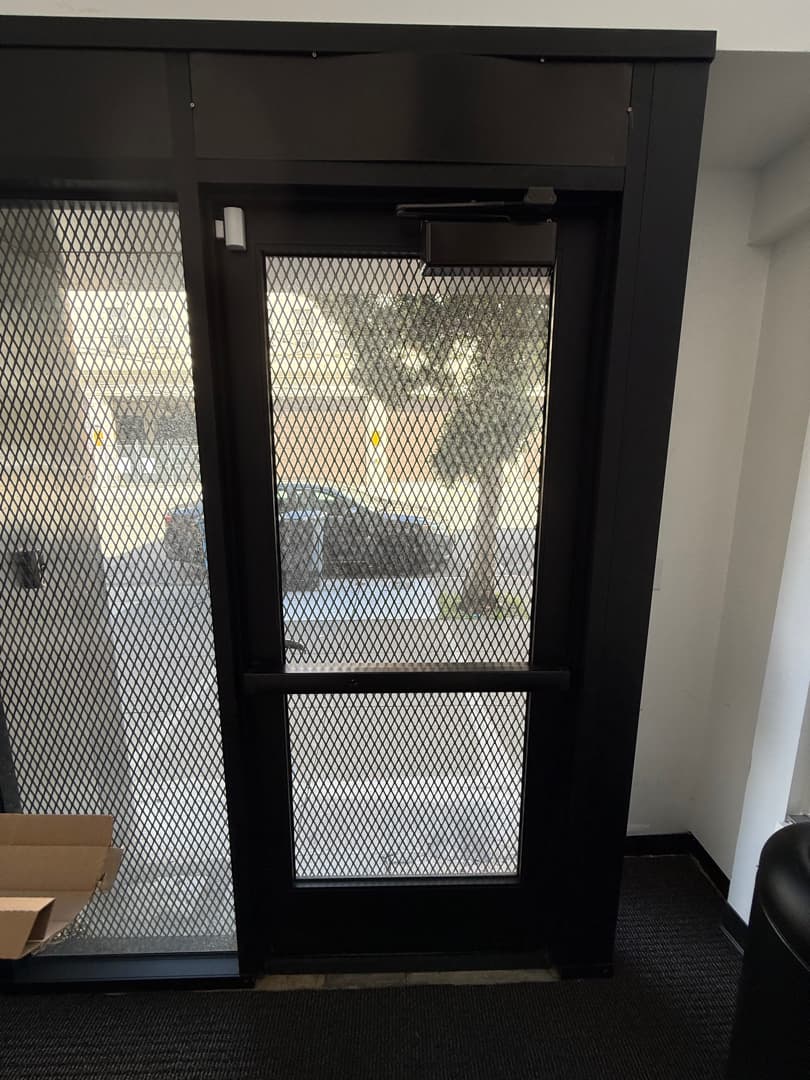
Fire, egress, and accessibility requirements for an opening are decided by the authority having jurisdiction (AHJ) and the project's adopted codes; this guide is general information.
Key takeaways
- A156.19 covers single, simultaneous pair, and dual egress swing door operators, and activation of the doors it describes requires a knowing act.
- Power, actuator type, fire alarm input, and electric strike timing are planned before the unit is ordered.
- Owners run daily safety checks; AAADM recommends an inspection after installation and annually thereafter.
- Do not self-adjust a door that fails its checks; call qualified service.
Definition
What a low-energy operator is
BHMA's A156.19 summary says the standard sets requirements for single, simultaneous pair, and dual egress swing door operators.
The defining idea is the knowing act. BHMA says activation of these doors requires a knowing act; dormakaba lists keypads, card readers, wireless transmitters and key switches.
Dormakaba's manual describes a low-energy door as one whose power mechanism does not generate more kinetic energy than A156.19 specifies. Dormakaba's manual says the door should open at a slow smooth pace (4 or more seconds) and stop without impact.
Comparison
Low-energy, power assist, and full-energy doors
LCN says its low-energy operator does not require guard rails or safety mats. That statement describes LCN's product, and the AHJ and project requirements still govern the opening in front of you.
| Category | BHMA standard | How a cycle starts | Where it fits |
|---|---|---|---|
| Low-energy swing operator | A156.19 | A knowing act; dormakaba lists keypads, card readers, wireless transmitters, key switches | |
| Power assist swing operator | A156.19 (same standard) | Confirm the model's documented mode with the manufacturer | |
| Full-energy automatic door | A156.10 | Opens automatically when approached by pedestrians | |
| Low-energy sliding or folding door | A156.38 | Sliding and folding openings, not swing doors |
Operator types
Electromechanical or electrohydraulic
Norton Rixson's low-energy brochure offers two types of operator, electromechanical and electrohydraulic.
LCN's 4630CS and 4640CS describe a fail-safe operator that acts as a standard door closer in a power outage. Norton lists an optional built-in battery back-up on one model so the door can keep operating during a power failure.
Read the weight rating for the exact model against the actual door, not the catalog family. The AHJ decides what the opening must do in a power failure.
Power and controls
Power, actuators, and fire alarm input
LCN's install sheet says the operator requires 120VAC supplied to the operator.
LCN says high-security card readers or keypads may also be used as actuators. LCN's install sheet says the setting allows time for electric latching hardware to release before the door starts to open.
LCN's 4600CS accepts a fire alarm input that deactivates the unit when the fire alarm is triggered. How an operator is tied to the fire alarm, and what the door must do afterward, is decided by the AHJ and the project's adopted codes, not by this guide.
- Confirm the actuator: push plate, reader, keypad, or push on the door.
- Confirm the power source and whether it is already at the door.
- Confirm whether a strike or other electrified lock releases the latch.
- Confirm any fire alarm connection with the AHJ before wiring.
Force, signs, and daily checks
Force, signage, and daily checks
BHMA's A156.19-2026 summary says the force required to prevent a stopped door from opening or closing shall not exceed 15 lbf (67 N), measured 1 inch (25 mm) from the latch edge of the door at any point during opening or closing. LCN's install sheet says a force gauge is needed to verify the force requirements. The AHJ decides acceptance of the finished opening.
Dormakaba's manual includes the text AUTOMATIC CAUTION DOOR.
Dormakaba's manual says the door will remain at full open position for not less than 5 seconds. Its AAADM label says the door should open at a slow smooth pace of 4 or more seconds and stop without impact.
Service
Who adjusts, repairs, and replaces them
Adjusting speed, opening force, hold-open time, or strike delay changes how the door behaves around people, so it belongs with qualified service using the model's own instructions.
Elwin installs, repairs, replaces, supports, configures, and works with commercial door hardware, closers, exit devices, and low-voltage door hardware. For California accessibility dimensions and force limits, see the existing guide on California door accessibility requirements rather than relying on an operator spec sheet.
A site walk is the next step: power, reader, strike, and fire alarm connections get checked in one visit.
FAQ
Questions and answers
What is a low-energy door operator?
It is a powered unit that opens a swing door after a knowing act and is limited in the energy it can deliver under ANSI/BHMA A156.19. Dormakaba lists keypads, card readers, wireless transmitters and key switches as controlled access devices.
How is it different from an automatic door?
BHMA A156.10 covers power operated doors for pedestrian use which open automatically when approached by pedestrians, or by a knowing act. A low-energy operator waits for a deliberate request.
Can a card reader or keypad open one?
LCN says card readers or keypads may be used as actuators. The access control system, reader, and any electric strike need to be planned together.
What happens when the power goes out?
It depends on the model. LCN describes a fail-safe operator that acts as a standard door closer in a power outage, and Norton lists an optional battery back-up on one model.
How often does it need inspection?
AAADM says owners check doors daily and recommends an inspection after installation and annually thereafter by an AAADM certified inspector.
Can I adjust the door myself?
Dormakaba's manual says do not attempt to repair or adjust the door. Call qualified service, and let the AHJ decide acceptance of the opening.
Sources and further reading
These sources back up the general guidance. Your building and the people who approve the work decide the details for your doors.
- Builders Hardware Manufacturers Association: ANSI/BHMA A156.19 Power Assist and Low Energy Power Operated Doors
- Builders Hardware Manufacturers Association: ANSI/BHMA A156.10-2024 Power Operated Pedestrian Doors
- Builders Hardware Manufacturers Association: ANSI/BHMA A156.38 Low Energy Powered Operated Sliding and Folding Doors
- Allegion (LCN): LCN 4630CS/4640CS Electric Auto-Equalizer Series Installation Instructions
- dormakaba USA Inc.: ED50/ED100/ED250 Overhead Concealed Owner's Manual DL4616-011
- ASSA ABLOY (Norton Rixson): Low Energy Door Operators brochure
- AAADM: American Association of Automatic Door Manufacturers
- AAADM: Inspection benefits