
Key takeaways
- Readers usually go on the man doors next to the roll-up doors. Your crew uses those doors all day, and they are simple to control.
- A roll-up door can go on access control only through its motor operator, and only if the operator has the right interface and safety devices. We flag every roll-up at the site walk.
- Set fob hours by shift, and give contractors and drivers access that ends on its own instead of a staff fob.
- The office-to-warehouse door and the tool crib are where most owners see the payoff.
- A yard gate can run on the same app as your doors.
- Budget about $3,000–$7,000 per door for a new install, or $1,500–$3,500 per door for a retrofit. Software is a subscription quoted per job, and installs usually take 2–4 weeks to schedule.
Door list
Which doors in a warehouse need card readers?
San Jose and Santa Clara business parks are full of the same layout: a small office up front, a warehouse or shop floor behind it, one or two roll-up doors, and a steel man door next to each roll-up. Whether you run a distributor, a contractor's yard, a machine shop or an assembly line, the doors that need a reader are usually the same handful.
You don't need a reader on every door. Put readers where the answer to "who should get through here?" changes, and leave the rest on a key or a simple lock.
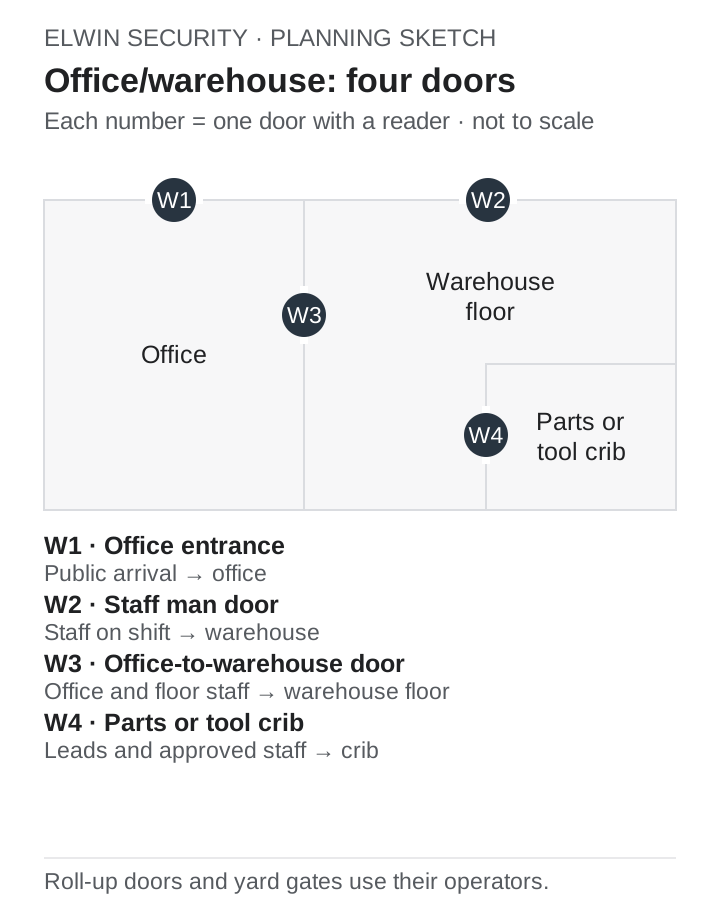
| Door | Who gets in | Usual setup |
|---|---|---|
| W1 · Front office door | Office staff; visitors by appointment | Often an aluminum storefront door. A reader and electric strike, or an unlock schedule during office hours. |
| W2 · Man door by the roll-up | Warehouse or shop staff on their shift | The door your crew really uses. Steel door, exit device inside, a reader outside and a closer that latches every time. |
| W3 · Office-to-warehouse door | Office staff and floor staff who need the office | Keeps visitors and drivers in the office and the floor crew out of payroll and petty cash. |
| W4 · Parts or tool crib | Leads and the people who sign out tools or parts | Often a chain-link cage with a gate. Needs a gate-rated strike or lock box and a short user list. |
| Roll-up door | Opened by staff or from the app for deliveries | Only through its motor operator, with the right interface and safety devices. See below. |
| Yard gate | Staff vehicles, drivers on a delivery window | Through the gate operator, or a reader on a pedestrian gate beside it. |
Roll-up doors
Can a roll-up door go on access control?
Yes, but only through its operator, and only with the right interface. That is why readers usually go on the man door next to the roll-up instead. Your crew walks through the man door dozens of times a day; the roll-up opens for trucks and forklifts.
A motorized roll-up has an operator, the motor box above the door, with its own control inputs. An access-control system can send an open signal to that operator through a relay, so a fob, the app or a schedule can raise the door. Closing is where it gets serious. A door that closes on its own or on a timer needs monitored safety devices such as photo eyes or a sensing edge, and the operator has to support them. Newer commercial operators, like LiftMaster's Logic 5.0 line, have timer-to-close and app connections built in. Older ones may not.
A manual chain-hoist roll-up can't go on access control without adding an operator. Lock it from the inside with a slide bolt or padlock and control the man door instead.
We flag every roll-up at the site walk and tell you whether the operator can take an access-control input. Usually your door company handles the operator and its safety devices, and we connect the access control to it.
People and schedules
Set access by shift, and keep contractors and drivers short.
Shifts are the easy win. Your morning crew's fobs can work on the man door from 5:30 a.m. to 3 p.m., the swing shift from 2 p.m. to 11 p.m., and supervisors can get wider hours. If your cleaning crew starts at 10 p.m. and finishes at 2 a.m., make sure the schedule crosses midnight correctly. That is a common setup mistake.
Your contractors come and go: the HVAC tech, the forklift service company, an electrician for a week. Give them a phone credential with an end date and only the doors they need, or have someone meet them. Don't hand out a staff fob and hope it comes back.
Your drivers shouldn't get staff fobs either. Have them ring at the man door or the dock, or have someone open the roll-up from the app when the truck pulls in. Door logs show whose fob opened the door, not who walked in behind them, so don't use them as a timesheet or a headcount.
Kisi is the platform we install most often. It handles shift schedules, temporary access links for vendors and contractors, and phone or fob credentials from one app. See Kisi access control installation. Elwin also works with PDK, Brivo, Verkada, SALTO and Paxton. If you are moving off keys or a shared keypad code, the keys and shared PINs guide covers the switchover.
Inside the unit
The office door and the tool crib are where the payoff is.
The office-to-warehouse door keeps visitors, drivers and contractors in the office, and keeps the floor out of laptops, payroll files and petty cash. It is also the door that gets propped open, because people walk back and forth all day. Two fixes work: a closer that pulls it shut plus a held-open alert, or leave it unlocked during office hours and let it lock on a schedule after everyone leaves.
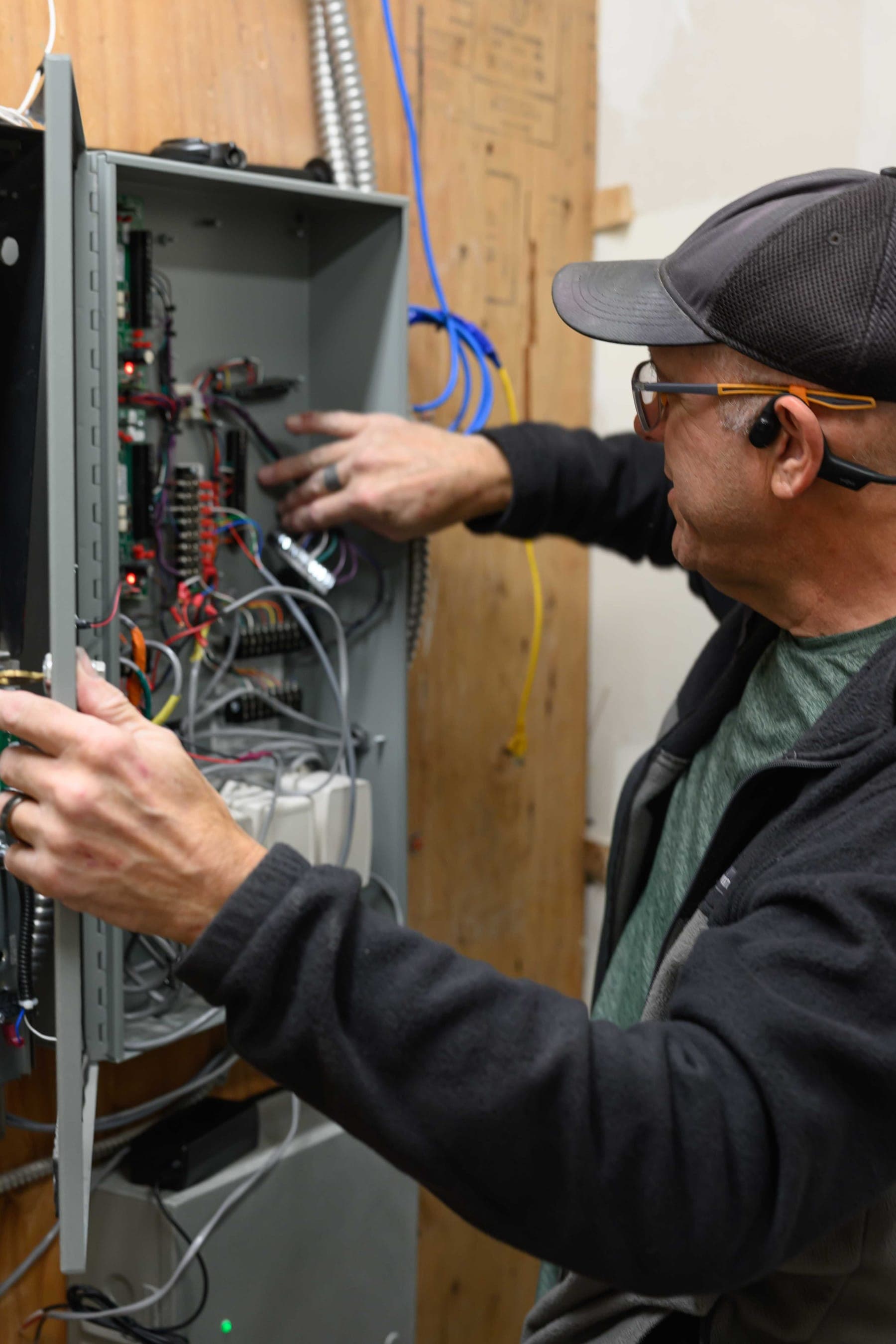
The parts or tool crib is usually a chain-link cage or a small room. A reader there tells you whose fob opened it at 7:12 p.m. on a Saturday. It won't tell you what left the crib, so keep your sign-out sheet or put a camera on it. A cage gate needs gate hardware, like the lock box in the photo above, not a door strike.
A fob on the shop door decides who gets in. It doesn't replace machine guards, lockout procedures or forklift training.
Outside
Your yard gate can run on the same app.
If your unit has a fenced yard for trucks, trailers or equipment, a motorized slide or swing gate can open from a reader on a post, a keypad, the app or a schedule, through an input on the gate operator. A pedestrian gate next to it can take a reader and an electric strike or lock box, the same way a door does.
Gate operators have their own safety rules (UL 325) and their own service company. If the gate belongs to the business park, the landlord or association decides what goes on it. Ask before we add anything.
See gate access control systems for how we connect gates, and industrial and warehouse security systems for doors, gates and cameras planned together.
Budget and hardware
How much does warehouse access control cost?
Plan on about $3,000–$7,000 per door for a new install, or $1,500–$3,500 per door to retrofit a door that already has access control. For the four doors in the sketch (front office, man door, office-to-warehouse and tool crib), that works out to roughly $12,000–$28,000 as a new install, before software. Roll-up and yard gate connections are priced after we see the operator.
Your warehouse pushes cost in its own ways. Wire runs across an open warehouse ceiling are long and often need a lift. Exterior man doors need outdoor-rated readers. Steel man doors usually take a Von Duprin exit device with an HES electric strike or electric latch retraction, an LCN closer, and Schlage locks on the interior doors.
Software is a subscription that depends on the platform and is quoted with the job. Installs usually take 2–4 weeks to schedule, faster with an expedite fee. Exit doors must always open from the inside without a key, a fob or special knowledge, and your fire marshal or the authority having jurisdiction (AHJ) decides compliance.
The access control cost per door guide breaks the number down. For long cable runs and power, see electrified locks and power transfer.
Before we visit
What to have ready for the site walk
Elwin is based in Santa Clara, and we walk office/warehouse units and shops across Santa Clara, San Jose, Sunnyvale, Milpitas and Fremont. Walk it with whoever opens up in the morning.
- Your door list: front office, man doors, the office-to-warehouse door, the crib, roll-ups and any yard gate.
- Your shift times, and when cleaners, contractors and drivers usually show up.
- The make of your roll-up door and gate operators if you know it, and who services them.
- Any door that sticks, doesn't latch or gets propped open now.
- Your landlord or business park contact, and any old access system or keypads already on the walls.
Warehouse questions
Common questions from warehouse and shop owners
Can a roll-up door be opened with a key fob or phone?
Yes, if it has a motorized operator that can take an access-control input. The door also needs working safety devices if it will close on its own. Manual chain-hoist doors need an operator added first.
Should delivery drivers get their own fob?
Usually no. Have drivers ring at the man door or dock, or open the roll-up from the app when they arrive. If a regular driver needs early access, give them a phone credential limited to one door and a time window.
Can different shifts have different access hours?
Yes. Most cloud platforms, including Kisi, let you set door hours by group, so each shift's fobs only work during that shift. Check that any overnight schedule crosses midnight the way you expect.
How much does it cost to put access control on a warehouse door?
About $3,000–$7,000 per door for a new install, depending on the door, the hardware and how far the cable has to run, or $1,500–$3,500 per door to retrofit a door that already has access control. Software is a separate subscription that depends on the platform and is quoted with the job.
Do we need a reader on every door in the warehouse?
No. Most office/warehouse units need readers on the front office door, the man doors, the office-to-warehouse door and the tool crib. Other doors can stay on a key or lock from the inside.
Sources and further reading
These references support the general technical guidance. The right answer for a specific opening still depends on the property and the authorities responsible for the project.