
Key takeaways
- The series is two detectors, the light gray DS160 and the black DS161, both listed with a sounder.
- Input power is 12 to 30 VDC or VAC, and the two relay contact sets are rated for 1 A each at 30 VDC or VAC max for resistive loads.
- It mounts on a wall or ceiling no more than 15 ft (4.6 m) above the floor, and Bosch's data sheet gives its coverage as 2.4 m x 3 m (8 ft x 10 ft), which varies with mounting height.
- Relay time runs from 0.5 sec, the default, to 64 sec, and DIP switch 3 selects Fail Safe or Fail Secure relay mode.
- Bosch says panic hardware must be used with this or any other egress device.
Identify
Which Bosch DS160 do I have?
The two detectors are the light gray DS160 and the black DS161. Bosch describes the series as a passive-infrared (PIR) detector for request-to-exit (REX) interior applications: it senses the change in infrared energy when a person passes through its field of view. For how request-to-exit devices work on any brand, see the general guide to request-to-exit sensors and buttons.
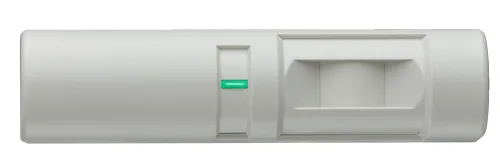
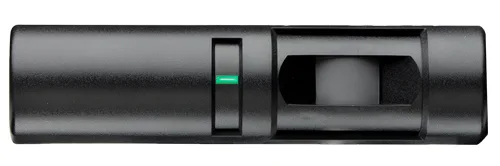
| Model | Housing | What Bosch lists |
|---|---|---|
| DS160 | Light gray | "Request-to-exit sensor, sounder". Optional trim plate TP160, light gray, listed for the DS150 and DS160. |
| DS161 | Black | "Request-to-exit sensor, black, sounder". Optional trim plate TP161, black, listed for the DS151 and DS161. |
| DS150i, DS151i | Light gray, black | A separate DS150i Series, not covered here, with its own data sheet and guide. Relay latch time adjustable to 60 sec. |
Source Bosch's DS160 Series data sheet, DS160/DS161 installation guide and DS150i Series data sheet. Keenfinity Group's site says its Radionix portfolio features Bosch detectors, and Radionix lists these request-to-exit detectors on its Bosch specialty detectors and sensors page.
Egress and listing
What Bosch says about egress, panic hardware and listing
Bosch says: "Panic hardware must be used with this or any other egress device."
A notice in the guide reads: The NFPA 101 Life Safety Code requires secured doors to have a "manual release device that shall result in direct interruption of power to the lock - independent of the access control system electronics". That is Bosch's notice, not the code text. The regulatory notes add that the sensor "was not investigated by UL for special locking arrangements in accordance with NFPA 101."
The notes say the sensor "is UL Listed as an access control device under the UL 294 Standard" and "is not intended to be configured to function as a stand-alone access control system." They add: "Connection to listed (ALVY and/or ALVY7) compatible control units and locking devices shall be required."
Bosch intends it as an access control request-to-exit device only, not for security function, so it should not be connected to a burglar alarm system; it also "shall not be connected directly to a keypad for access control function."
Source The notices and regulatory notes in Bosch's DS160/DS161 installation guide.
Mounting
Where does it mount and what does it cover?
The sensor mounts on a wall or ceiling, no more than 15 ft (4.6 m) above the floor. The mounting figure shows three locations: above the door, on the ceiling, and above double doors.
Coverage is 2.4 m x 3 m (8 ft x 10 ft), with patterns drawn for a detector at 2.3 m (7.5 ft). It grows with mounting height and varies with lens angle and with wall or ceiling mounting.
On a wall with the lens pointed straight down, some detection zones point toward the wall and miss movement. The lens sits in a rotating barrel with a lock-down screw; above a door, rotating it moves the pattern off the wall.
Three supplied masking wedges each cover approximately 25% of the pattern; up to three can limit detection to a very small area, such as around a doorknob or crash bar.
With the optional trim plate, the base and trim plate mount onto a single gang electrical box.
Source Bosch's DS160/DS161 installation guide and DS160 Series data sheet.
Power
How is it powered, and what are the terminals?
Input power is 12 to 30 VDC or VAC, and the terminal strip takes 26-14 AWG (wire gauge) wire.
The data sheet lists current as 8 mA nominal standby and 39 mA at 12 VDC in alarm. The installation guide's tables add a figure with the sounder on: in Fail Safe Mode, alarm and sounder is 65 mA at 12 VDC and 147 mA at 30 VAC. In Fail Secure Mode it is 73 mA at 12 VDC and 164 mA at 30 VAC.
Operating temperature is -20°F to +120°F (-29°C to +49°C). For UL and ULC Listed installations the guide gives +32°F to +120°F (0°C to +49°C), with humidity of 0-95% non-condensing.
| Terminal | What it connects to |
|---|---|
| - | The negative side of the power supply |
| + | The positive side of the power supply. The voltage must be between 12-30 Volts DC or AC |
| R | Sequential Logic Input (SLI), the keycard input, or remote control of the sounder. The contact must be Normally Closed (NC) |
| D | Door contacts for the detector to monitor. If used, they must be Normally Closed (NC) door contacts, not shared with any alarm systems |
| T | Normally Closed (NC) tamper contacts |
Source Bosch's DS160/DS161 installation guide (specifications, Table 1 and the current tables) and DS160 Series data sheet.
Relay outputs
How do the two relays switch?
The output is two Form C contact sets: in each, a common terminal (C) connects to either a normally open (NO) or normally closed (NC) terminal. Each is rated for 1 A at 30 VDC or VAC max for resistive loads, and DIP switch 3 changes their normal positions.
The basic connection drawing shows Switch 3 ON (Failsafe Mode) and labels the supply as a 12-30 Volt DC power supply.
One contact set is specially protected from EMF (voltage) spikes caused by inductive loads and needs no additional spike protection; the drawing marks it as the first NO, C and NC group.
The other set is best used for non-inductive loads. For an inductive load that is not spike-protected, such as a magnetic door lock, the guide calls for a bridge rectifier (such as a KBL01) or a diode (such as a 1N4007), and warns that failure to spike-protect can shorten the life of the relay contacts.
A notice adds that "UL listed magnetic locks typically are already EMF spike-protected" and do not need the rectifier or diode.
| State | Fail Safe (Switch 3 On) | Fail Secure (Switch 3 Off) |
|---|---|---|
| Power off | C closed to NO | C closed to NO |
| Normal (no motion) | C closed to NC | C closed to NO |
| Motion detected | C closed to NO | C closed to NC |
Source Bosch's DS160/DS161 installation guide (relay output section, Figures 8 and 9).
Settings
What each DIP switch setting is
Ten DIP switches, small on-off slide switches numbered 1 through 10, set how the sensor behaves.
Bosch adds that with switch 2 ON, the relay only drops out when there is no more motion and the timer expires. Its OFF entry also says that if the motion continues, the timer restarts.
For Fail Secure, the guide says: "In the secure mode, the REX shall be installed in a manner that does not impair the intended operation of panic hardware used in conjunction with the REX detector." Bosch also states: "The Fail Secure Mode must be authorized by your Local Authority Having Jurisdiction (AHJ)."
| Switches | Position | What the setting is |
|---|---|---|
| 1 | ON | LED operates normally when motion is detected |
| 1 | OFF | LED is turned off |
| 2 | ON | Timer reset mode: the relay timer starts when the detector sees motion and restarts if there is additional motion |
| 2 | OFF | The relay drops out when the timer runs out, even if the motion continues |
| 3 | ON | Fail Safe Mode |
| 3 | OFF | Fail Secure Mode |
| 4, 5, 6 | OFF, OFF, OFF | Relay time 0.5 sec (default) |
| 4, 5, 6 | OFF, OFF, ON | 1 sec |
| 4, 5, 6 | OFF, ON, OFF | 2 sec |
| 4, 5, 6 | OFF, ON, ON | 4 sec |
| 4, 5, 6 | ON, OFF, OFF | 8 sec |
| 4, 5, 6 | ON, OFF, ON | 16 sec |
| 4, 5, 6 | ON, ON, OFF | 32 sec |
| 4, 5, 6 | ON, ON, ON | 64 sec |
| 7 | ON | High sensitivity (REX Mode) |
| 7 | OFF | Low sensitivity (security sensor) |
| 8, 9, 10 | All ON | Door Secure Mode is enabled |
| 8, 9, 10 | All OFF | Door Secure Mode is disabled |
| 9, 10 | OFF, OFF | Terminal R function: Keycard Input |
| 9, 10 | OFF, ON | Terminal R function: Direct Sounder Enable |
| 9, 10 | ON, OFF | Terminal R function: Sequential Logic Input |
| 9, 10 | ON, ON | Terminal R function: Monitor Door Contacts |
Source Bosch's DS160/DS161 installation guide (Section 4.0, Figure 18 and Tables 2 and 3).
Inputs
What the Terminal R and door contact inputs do
Switches 9 and 10 set what a closed contact on Terminal R does. Both door contact options, through Terminal D, need a relay time of 16 sec or longer.
Sequential Logic Input (SLI).
The detector activates on motion only while Terminal R is open, or for 10 sec after it closes; later movement is ignored. Bosch's example uses a second detector placed before this one, and the data sheet says this eliminates the possibility that an object slid through or underneath the door will activate the detector.
Keycard Input.
Normally used with a keycard reader outside the door or building: an input to Terminal R activates the detector and holds the relay while it is closed, and the internal sounder does not activate. With switch 2 on, the suggested setting, toggling the input again restarts the timer.
Direct Sounder Enable.
The internal sounder stays on while the external contacts, such as a door controller or door contacts, stay open. It does not affect the relay or timer and does not remove power from the magnetic lock.
Terminal R as an external disable input.
An external device such as an access control or burglar alarm system can disable the sensor through Terminal R, 10 sec after the contact closes.
Monitor Door Contacts.
If the door is held open and the relay timer is in the last 10 seconds of the latch time, the sounder turns on. It also sounds if the door opens without the detector or keycard input activating first, and stays on until the door closes or someone moves in view.
Door Secure Mode (switches 8, 9 and 10 all ON).
If the detector activates but the door does not open, the relay drops out after 10 sec; if the door opens and closes, after 2 sec, which Bosch says prevents unauthorized people from entering. With the R input, the guide lists switch 2 ON (resettable mode).
Source Bosch's DS160/DS161 installation guide (remote input and door monitor sections) and DS160 Series data sheet.
Sounder and LED
The sounder, the LED and the tamper switch
The sounder has a Volume Control, and Bosch's documents differ on its maximum: up to 70 dB at a distance of 10 ft (3 m) in the installation guide, and fully adjustable to 85 dB in the 2024 data sheet.
The one activation LED, when enabled, flashes on and off at first power-up, and Bosch says the sensor is ready to be used once the flashing stops.
The component drawing also shows a tamper switch, and the T terminals are normally closed (NC) tamper contacts.
Source Bosch's DS160/DS161 installation guide and DS160 Series data sheet.
Service
Help with a Bosch DS160 or DS161
Elwin Security installs, repairs and replaces request-to-exit sensors, including the Bosch DS160 and DS161, as part of its electric strike, maglock and door release hardware service for commercial and multifamily properties in the San Francisco Bay Area. Calls are answered 8:00 AM-8:00 PM daily at (408) 539-0535.
FAQ
Bosch DS160 questions
What is the difference between the Bosch DS160 and DS161?
Bosch lists the DS160 Detector as light gray and the DS161 Detector as black, both as request-to-exit sensors with a sounder.
What voltage does a Bosch DS160 need?
Input power is 12 to 30 VDC or VAC. The data sheet lists current as 8 mA nominal standby and 39 mA at 12 VDC in alarm.
How high can a Bosch DS160 be mounted?
No more than 15 ft (4.6 m) above the floor, on a wall or ceiling. Higher mounting gives a larger coverage area.
Can a Bosch DS160 release a magnetic lock?
In Bosch's basic connection with a power supply and a magnetic lock, power is removed from the lock when the sensor sees motion. Bosch also says it is not designed as a primary means of exit for emergency egress applications.
What relay time does the Bosch DS160 door monitor need?
Bosch says the latch time must be 16 seconds or greater for the door monitor sounder to work correctly.
Sources and further reading
These sources back up the general guidance. Your building and the people who approve the work decide the details for your doors.
- Bosch Security Systems: DS160/DS161 Installation Guide, High Performance Request-to-Exit Sensors (F01U252567-01, 9/11)
- Bosch Security Systems: DS160 Series High Performance Request-to-exit Detectors data sheet (V20, June 11, 2024)
- Bosch Security Systems: DS150i Series Request-to-exit Detectors data sheet (V19, November 16, 2023)
- Bosch Security Systems: DS150i/DS151i Installation Guide, Request-to-Exit PIR Detectors (F01U252565-01, 9/11)
- Radionix (Keenfinity Group): Bosch specialty detectors and sensors (request-to-exit detectors)
- Keenfinity Group: Intrusion and Access: Radionix Intrusion Alarm