
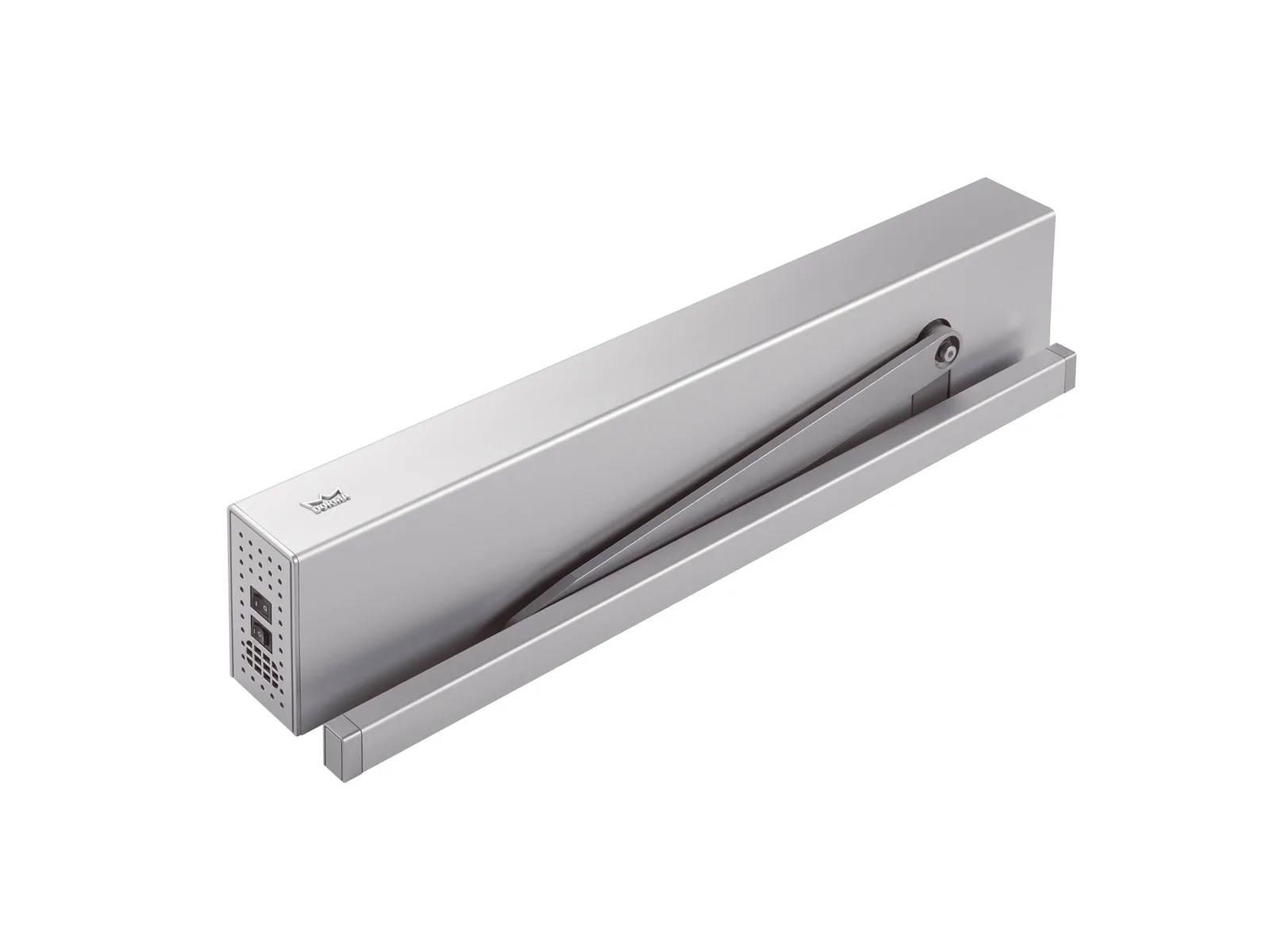
Key takeaways
- Pull mounting puts the operator on the swing (hinge) side, the side the door opens toward; push mounting puts it on the approach (non-hinge) side.
- For the ED100LE, dormakaba's documents differ: its setup manual marks the full energy setting "Not used", while its fact sheet says it can be configured for either standard with additional equipment required.
- dormakaba's product pages for five of the six models say the operator closes and latches on power loss.
- The setup manuals list a fire protection upgrade card for these operators, and three dormakaba documents name different fire test standards for the ED100.
Models
Which dormakaba operators does this page cover, and are they low or full energy?
dormakaba's setup manuals define a low energy power operated door as one that opens "upon receipt of a knowing act activating signal" and "does not generate more kinetic energy than specified in ANSI 156.19". Low energy is the mode covered by ANSI/BHMA A156.19, the "Standard for Power Assist and Low Energy Power Operated Swinging Doors." Full energy is the mode covered by ANSI/BHMA A156.10, the standard for power operated pedestrian doors.
dormakaba files the six operators under two headings in its US catalog and documents them in three sets of manuals. The three swing door operator catalog models share installation manuals for two housing versions, which dormakaba calls fine cover and narrow header.
The table quotes each document on each model's energy mode, including where they differ for the ED100LE and the ED250, and lists the catalog's other swing door products, which this page doesn't cover.
For how low-energy operators work in general, see the guide to low-energy door operators.
| Model | dormakaba catalog heading | Manuals | What dormakaba's documents say about energy mode |
|---|---|---|---|
| ED50LE | Low Energy Swing Door Operators | ED50LE installation manual; ED50LE/ED100LE setup manual | Setup manual: ED50LE and ED100LE operators "are configured to meet requirements of a low energy application per ANSI/BHMA A156.19, Standard for Power Assist and Low Energy Power Operated Swinging Doors." F2: "Not used". |
| ED100LE | Low Energy Swing Door Operators | ED100LE installation manual; ED50LE/ED100LE setup manual | Setup manual (06/2026): the same statement as the ED50LE; F2: "Not used". Fact sheet (02/25): the ED100LE "can be configured to meet ANSI/BHMA A156.19" or "ANSI/BHMA A156.10" with "additional equipment required". |
| ED900 | Low Energy Swing Door Operators | ED900 installation manual; ED900 setup manual | Installation manual: the ED900 "is supplied only as a low energy operator", with a reduced power motor and a brake that is used during door hold open time. Setup manual: F2 "Not used". Product page: "certified as a low energy operator to ANSI/BHMA Grade 1". |
| ED50 | Swing Door Operators (ED50/100/250 Surface Applied) | ED50/100/250 fine cover and narrow header installation manuals, setup manual and owner's manual | Fact sheet: the operator "is set to low energy (A156.19) conformance from the factory." Setup manual: the ED50 is available only as a low energy operator. |
| ED100 | Swing Door Operators (ED50/100/250 Surface Applied) | ED50/100/250 fine cover and narrow header installation manuals, setup manual and owner's manual | Fact sheet: the operator "is set to low energy (A156.19) conformance from the factory", and "Upon installation, the ED100 can be configured to meet ANSI/BHMA A156.19 ... or ANSI/BHMA A156.10 ... (*additional equipment required)." Setup manual: F2 0 (default) is low energy and 2 is full energy. |
| ED250 | Swing Door Operators (ED50/100/250 Surface Applied) | ED50/100/250 fine cover and narrow header installation manuals, setup manual and owner's manual | Fact sheet: the operator "is set to low energy (A156.19) conformance from the factory", and the same configuration sentence as the ED100, with ED250. Setup manual: the ED100 and ED250 default is low energy; F2 0 (default) is low energy and 2 is full energy. Product page: "The ED250 full power operator is designed for demanding applications". Brochure: "ED250 Power operated pedestrian operator". |
| ED20LE EasyAssist | Low Energy Swing Door Operators | Not covered on this page | Not covered on this page |
| ED50/100/250 OHC (overhead concealed) | Swing Door Operators | Not covered on this page | Not covered on this page |
| ED-IG in-ground operator | Swing Door Operators | Not covered on this page | Not covered on this page |
| ED400-IG to ED250-IG retrofit kits | Swing Door Operators | Not covered on this page | Not covered on this page |
Source dormakaba's two US catalog pages for low energy swing door operators and swing door operators, the product pages, the setup manuals, the ED900 installation manual, the ED50, ED100, ED250 and ED100LE fact sheets and the brochure.
Door size
How heavy and how wide a door can each model run?
The installation manuals give a maximum door weight for each model, in tables headed "Prevailing conditions at opening must be considered". For three models, other dormakaba documents give different weights, and the last column gives each with its document.
| Model | Maximum door weight | Door width | Other figures in dormakaba's documents |
|---|---|---|---|
| ED50LE | 220 lb, exterior and interior applications | 28" to 48" | None |
| ED100LE | 220 lb exterior applications; 600 lb interior applications | 28" to 48" | Specifications later in the same manual: 220 lb, "depending on door width and application". Product page: maximum recommended door weight 400 lb; doors up to 600 lb under limited conditions. |
| ED900 | 220 lb at 48" door width | 28" to 48" | None |
| ED50 | 220 lb, exterior and interior applications | 28" to 48" | None |
| ED100 | Low energy: 220 lb exterior, 600 lb interior. Full energy: 220 lb | 28" - 55" in the fine cover manual; 28" - 48" in the narrow header and setup manuals; "Up to 48” (1219 mm) wide" in the brochure | Fine cover manual specifications: 250 lb in full energy and 600 lb in low energy, "depending on specific door application". Fact sheet: 600 lb in low energy; for full energy (ANSI A156.10) applications with door weights above 200 lb, contact Technical Support. |
| ED250 | Low energy: 600 lb exterior, 800 lb interior. Full energy: 320 lb | 28" - 63" in the manuals, which also list "Door width fire protection" as 28" to 55"; 28" minimum and 52" maximum in the fact sheet; "Up to 48” (1219 mm) wide" in the brochure | Fine cover manual specifications: 320 lb in full energy and 700 lb in low energy, "depending on specific door application". Fact sheet: 800 lb in low energy; for full energy (ANSI A156.10) applications with door weights above 200 lbs, contact Technical Support. |
Source The door weight tables and specifications in each model's installation manual, with the ED100LE product page, the fact sheets, the setup manual and the brochure where named.
Mounting and arms
Which side of the door does it mount on, and which arm fits?
The setup manuals list the installation type as a setting called AS. The table gives its values, then the arms dormakaba lists for each reveal depth: the distance the door face sits back from the face of the wall the operator is mounted on.
| Models | Installation type or arm | Wall side or reveal depth | Where dormakaba lists it |
|---|---|---|---|
| All six | Pull (AS 0, factory setting): pull arm with CPD lever | Swing (hinge) side | All three setup manuals |
| All six | Push (AS 1): standard push arm or deep push arm | Approach (non-hinge) side | All three setup manuals |
| See last column | Pull as push (AS 2): pull arm with CPD lever | Approach (non-hinge) side | ED50/ED100/ED250 manual: ED100/ED250 only. ED50LE/ED100LE manual: "Pull as push (ED100LE only)". ED900 manual: no model note |
| ED250 | Push (AS 5), ANSI size 6, door width ≥ 55" (1400 mm); arm not listed | Approach (non-hinge) side | ED50/ED100/ED250 setup manual only; not in the ED50LE/ED100LE (values 0, 1 and 2) or ED900 lists |
| ED900 | J8, standard push arm | Reveal 0 - 8" | Arm configurations in the ED900 installation manual |
| ED900 | J12, deep reveal push arm | Reveal 8" - 12" | Arm configurations in the ED900 installation manual |
| ED900 | T275, deep reveal arm and track | Reveal 1" - 2 3/4" | Arm configurations in the ED900 installation manual |
| ED900 | Standard push arm | Reveal 0 to 8 3/4" | Operating specifications in the same manual |
| ED900 | Deep push arm | Reveal 8" minimum to 11 13/16" | Operating specifications in the same manual |
| ED50LE, ED100LE | Pull arm with CPD lever | Reveal 0 to 2 1/4" | ED50LE and ED100LE installation manuals |
| ED50LE, ED100LE | Standard push arm | Reveal 0 to 11 13/16" | ED50LE and ED100LE installation manuals |
| ED100, ED250 | Push arm | Reveal 0 - 8 3/4" | Section 3.2 of the fine cover installation manual |
| ED100, ED250 | Deep push arm | Reveal 8 3/4" - 19 1/2" | Section 3.2 of the fine cover installation manual |
| ED100, ED250 | Standard pull arm | Reveal ± 1 3/16" | Section 3.2 of the fine cover installation manual |
| ED100, ED250 | Deep pull arm | Reveal 1 3/16" - 2 3/8" | Section 3.2 of the fine cover installation manual |
| ED100, ED250 | Deep reveal pull arm | Reveal 2 3/8" - 9 3/4" | Section 3.2 of the fine cover installation manual |
| ED100, ED250 | Standard push arm | Reveal 0 to 9-3/4" | ED100 and ED250 fact sheets |
| ED100, ED250 | Deep push arm | Reveal 8" minimum to 19-3/4" | ED100 and ED250 fact sheets |
Interior or exterior use
Every installation manual on this page carries a notice that the operator "must be installed on an interior building surface." The ED900 is used exclusively for opening and closing interior swing doors, and its manual covers single door installations. For the ED100LE, dormakaba's documents differ: its product page says the operator is "For interior or exterior use in medium to heavy duty settings", while its installation manual carries that notice and its door weight table is headed "Exterior applications" and "Interior applications". The ED50LE and ED100LE installation manuals also have a section on exterior door installation with a notice headed "Exterior door use," and the weight tables in the ED50LE and swing door operator manuals are headed "Exterior and interior applications".
Source The installation notices and arm and reveal depth specifications in each installation manual, the installation type tables in the three setup manuals, the ED100 and ED250 fact sheets and the ED100LE product page.
Power
What power does it need, and what happens when the power goes off?
All six run on 115-volt AC power from a dedicated branch circuit, one that feeds only the operator, protected at 15 A maximum.
For the ED100LE, ED100 and ED250, the setup manuals say the 24 Vdc, 1.5 A accessory supply is 36 watts with overcurrent protection, and that an external power supply must be used if additional power is required.
The product pages for the swing door operator catalog models and for the ED50LE and ED100LE list closing and latching on power loss, with an adjustable closing speed on loss of power.
The closing speed on power loss is a setting on a power fail closing speed potentiometer. A note beside it, addressed to the installer, says a minimum 5 second closing time is required to meet the requirements of A117.1, Accessible and Usable Buildings and Facilities, Section 404.2.7, and the 2010 ADA Standards for Accessible Design, Section 404.2.8. Error message E 73 (System error 3, braking circuit) is displayed if the door closes in less than three seconds.
| Item | What dormakaba lists | Models |
|---|---|---|
| Power supply | 115 Vac ±10%, 50/60 Hz, 6.6 A maximum | ED50LE, ED100LE, ED900, ED50, ED100, ED250 |
| Branch circuit protection (provided by others) | 15 A maximum, dedicated branch circuit | ED50LE, ED100LE, ED900, ED50, ED100, ED250 |
| Power wiring: black, white, bare copper (ground) | 12 AWG maximum | ED50LE, ED100LE, ED900, ED50, ED100, ED250 |
| Maximum power consumption | 120 watts | ED50LE, ED100LE, ED50 |
| Maximum power consumption | 120 watt | ED900 |
| Maximum power input | 120 watt | ED100 |
| Maximum power input | 240 watt | ED250 |
| Power supply for accessories | 24 Vdc ± 5%, 1.5 A | ED100LE, ED100, ED250 |
| Power supply for accessories | Manuals: external power supply required. Product page: an onboard power supply delivering 1.5 A at 24 VDC | ED50LE |
| Power supply for accessories | Setup manual: an external power supply must be used for accessories. Product page: an onboard power supply delivering 1.5 A at 24 VDC | ED900 |
| Power supply for accessories | Manuals: separate or external power supply required. Fact sheet: internal power supply, 24 volts DC ± 5%, 1.5 A | ED50 |
| Protection class | NEMA 1 | ED50LE, ED100LE, ED900, ED50, ED100, ED250 |
| Ambient temperature | 5 to 122 °F | ED50LE, ED100LE, ED900, ED50, ED100, ED250 |
| Suitable for dry rooms only | Relative air humidity: 93% maximum, non-condensing | ED50LE, ED100LE, ED900, ED50, ED100, ED250 |
Source The technical data in each installation manual, the accessory power and power fail closing speed sections of the three setup manuals, and the product pages and ED50 fact sheet where named.
Activation and locks
What opens the door, and how does it work with a lock?
The operator opens the door on a signal from an activator. The setup manuals name the typical activators as pushbuttons and key switches, access control systems, telephone systems and intercoms. The manual for the swing door operator catalog models adds sensor automatic activators under A156.10, the full energy standard.
The typical locking devices are electric strike plates (an electrically released catch in the door frame), electromagnetic locks and electric locks. A locking device must comply with five points: 24 Vdc ± 5% when powered from the operator, 48 Vdc/Vac maximum from an external power supply, a maximum load of 1 A on the locking device relay contact, a minimum 30% duty factor for an electric strike plate and a 100% duty factor for a motor lock.
| Terminal | Function | What the technical data lists |
|---|---|---|
| X4 | Activation inputs | Interior, exterior; N.O. contact |
| X5 | Safety sensors | Swing, approach sides |
| X10 (57, 57a) | Night-bank (intercom system) | 8-24 Vdc/Vac +5% |
| X1 (35, 3) | Night-bank (key switch) | d2 parameter; contact type N.O. or N.C. |
| X6 (4, 4a) | Deactivation of drive function | d1 parameter; contact type N.O. or N.C. |
| X3 (43, 3) | Locking device feedback | Motor lock |
| X7 (97, 98, 99) | Door status output | Sr parameter: door closed, door open, or door closed, locked; Com, N.O., N.C. contacts |
Source The activator and locking device lists in the three setup manuals, and the terminal data in the ED100LE, ED900 and ED50, ED100 and ED250 fine cover installation manuals.
Settings
What settings do the manuals list for the installer?
This section describes the settings dormakaba lists for the installer, not how to change them. The operator has a 4 button keypad and 2 digit display for door parameter values, and the setup manuals warn: "Hazard to mechanical processes by use of control settings, elements, or procedures not documented in this manual!"
The table gives the low energy speed, force and hold-open settings, each of which the manual sets beside an A156.19 requirement. Note 1 in that table reads: "Speed may be slower after learning cycle completed."
| Parameter | Function | Factory setting | Range |
|---|---|---|---|
| So | Swing door opening speed | 17°/s (Note 1) | 8°/s - 27°/s; 27°/s max. L.E. mode |
| bc | Back check: checking or slowing down of door speed before door being fully opened | 10° | 5° - 40° |
| Sc | Swing door closing speed, automatic mode | 17°/s (Note 1) | 8°/s - 27°/s; 27°/s max. L.E. mode |
| dd | Hold open time | 5 s | 5 s - 30 s |
| Fo | Static force on door closing edge in opening direction | 13.5 lbf [60 N] | 4.5 lbf [20 N] - 15 lbf [67 N] |
| Fc | Static force on door closing edge in closing direction | 13.5 lbf [60 N] | 4.5 lbf [20 N] - 15 lbf [67 N] |
Push & Go (PG)
The setup manuals describe Push & Go as off at its factory setting of 0. At 1 it is on: automatic opening starts when the door is manually moved 4° out of the closed position.
Source The parameter descriptions in the three setup manuals, and the low energy door measurements in the ED50, ED100 and ED250 fine cover installation manual.
Fire doors
What matters on a fire door?
The setup manuals list a fire protection upgrade card for these operators, and the table gives its part number by model. The entry for the card's parameter, F1, says that following activation the "drive may be used as a electrically controlled hold-open system according to EN 14637, Building hardware-Electrically controlled hold-open systems for fire/smoke door assemblies, or similar standards." The manual for the swing door operator catalog models adds that the full energy function (F2) is automatically activated on the ED100 and ED250.
The troubleshooting charts say the hold-open system (information code ln 11, "Hold-open system triggered") can be triggered automatically by a smoke detector or building interface system, manually by a manual release button, or by manually moving the door, and that "The system must be reactivated by a deliberate action."
The product pages for the three low-energy catalog models each describe "a blow-open feature for smoke ventilation (per National Fire Protection Association (NFPA) code 92B)". A note in the ED900 installation manual reads: "Insure operator door configuration is qualified for use on the respective smoke or fire rated door."
For the ED100, three dormakaba documents name different fire test standards, and the table quotes each.
| Item | Models | What dormakaba lists |
|---|---|---|
| Fire protection upgrade card | ED50LE, ED100LE, ED900, ED50, ED100 | Part DX3461-003 |
| Fire protection upgrade card | ED250 | Part DX3461-004 |
| ED50/100/250 product page | ED100 | The systems "meet all of the stringent requirements of ANSI 156.10, ANSI 156.19, and UL325, as well as NFPA 252 90-minute fire rating when used with rated doors and hardware." |
| ED100 fact sheet | ED100 | Names "ANSI 156.10, ANSI 156.19, UL325 and UL 10B" |
| Brochure | ED100 | The ED100 systems "are UL 10C rated" |
Source The upgrade card tables, parameter lists and troubleshooting charts in the three setup manuals, the ED900 installation manual, and the product pages, ED100 fact sheet and brochure where quoted.
Signs and troubleshooting
What signs, daily checks and red light codes do the manuals describe?
The installation manuals say signage and warnings for low energy doors are specified in ANSI/BHMA A156.19, and list three decals: "AUTOMATIC CAUTION DOOR", "ACTIVATE SWITCH TO OPERATE", and "PUSH TO OPERATE" with "PULL TO OPERATE". They also describe a safety information label for low energy swinging doors from AAADM, the American Association of Automatic Door Manufacturers, with safety checks to be performed daily.
The owner's manual for the swing door operator catalog models says it is the owner's responsibility to inspect the operation of the door system on a daily basis. Its warning reads: "Should the door fail to operate as prescribed in the Safety information checklist or at any other time for any reason, do not attempt to repair or adjust the ED50/ED100/ED250 swing door system!"
A red LED beside the operator power switch displays blinking codes. Each of the three setup manuals has its own table of them; the one below is from the manual for the swing door operator catalog models.
| Red LED status | Display | Description |
|---|---|---|
| Steady flashing | Not listed | Control unit has detected error, emergency mode activated. |
| On steady | ln 11 | Hold-open device triggered. |
| Flashing 2 times | E 02 | Locking device error. |
| Flashing 4 times | E 04 | Safety sensor test error. |
| Flashing 5 times | E 25 | SVP PR DCW module test negative. |
| Not listed | E26 | ED50 braking error. |
| Flashing 5 times | E 51, E 52, E 53 | Incremental encoder error. |
| Flashing 6 times | E 62 | Double door operation, 2nd system has incompatible firmware version. |
| Flashing 6 times | E 63 | Double door operation, 2nd system has incompatible fire protection setting. |
| Flashing 7 times | E 71 | System error 1 (test), second shutdown option. |
| Flashing 7 times | E 72 | System error 2 (test), current measuring circuit. |
| Flashing 7 times | E 73 | System error 3 (test), braking circuit |
| Flashing 12 times | E 12 | EEPROM error |
| Flashing 13 times | E 13 | Motor overcurrent |
| Flashing 15 times | E 15 | Faulty learning cycle |
Source The signage sections of the ED50LE, ED100LE, ED900 and ED50, ED100 and ED250 fine cover installation manuals, the red LED status code tables in the three setup manuals and the ED50, ED100 and ED250 fine cover owner's manual.
Questions about dormakaba ED Series operators
Questions and answers
Is the dormakaba ED100 a low-energy or a full-energy operator?
dormakaba's ED100 fact sheet says the operator "is set to low energy (A156.19) conformance from the factory" and can be configured upon installation to meet the low-energy or the full-energy standard, with additional equipment required.
How heavy a door can a dormakaba low-energy operator open?
The installation manuals list 220 lb for three of the models, 600 lb for interior doors on two more, and 800 lb for interior doors on the ED250, each at a maximum door width of 48 inches; other dormakaba documents give different figures for three models.
Can I adjust the speed or force on a dormakaba door operator?
Speed, force and hold-open time are among the settings dormakaba's setup manuals list for the installer. If a door seems too fast, too forceful or open too long, the next step is a service call, not a changed setting.
Service
Installation and service on dormakaba operators
Elwin Security installs, repairs and replaces door closers and low-energy door operators, including the dormakaba ED Series, as part of its commercial door closer and exit device service for commercial and multifamily properties in the San Francisco Bay Area. Calls are answered 8:00 AM-8:00 PM daily at (408) 539-0535.
Sources and further reading
These sources back up the general guidance. Your building and the people who approve the work decide the details for your doors.
- dormakaba: Low Energy Swing Door Operators (US catalog page)
- dormakaba: ED50LE product page
- dormakaba: ED100LE product page
- dormakaba: ED900 product page
- dormakaba: Swing Door Operators (US catalog page)
- dormakaba: ED50/100/250 Surface Applied product page
- dormakaba USA, Inc.: ED50LE Low energy swing door operator with fine cover Installation Manual (DL4616-002, 06/2026)
- dormakaba USA, Inc.: ED100LE Low energy swing door operator with fine cover Installation Manual (DL4616-001, 06/2026)
- dormakaba USA, Inc.: ED50LE/ED100LE Setup and troubleshooting instructions (DL4617-001, 06/2026)
- dormakaba USA, Inc.: ED900 Low energy swing door operator with fine cover Installation Manual (08125370, 06/2026)
- dormakaba USA, Inc.: ED900 Setup and Troubleshooting Manual (08125380, 06/2026)
- dormakaba USA, Inc.: ED50/100/250 Surface applied swing door operator with fine cover Installation Manual (DL4616-004, 04/2026)
- dormakaba USA, Inc.: ED50/100/250 Swing door operator with narrow header Installation Manual (DL4616-005, 04/2026)
- dormakaba USA, Inc.: ED50/100/250 Swing door operators Setup and Troubleshooting Instructions (DL4617-002, 04/2026)
- dormakaba USA, Inc.: ED50/100/250 Surface applied swing door operator with fine cover Owner's Manual (DL4616-006, 05/2026)
- dormakaba USA Inc.: ED50 Low energy operator fact sheet (ENS_1071, 11/2024)
- dormakaba USA Inc.: ED100 Low energy/power operated pedestrian operator fact sheet (ENS_1105, 10/2025)
- dormakaba USA Inc.: ED250 Low energy/power operated pedestrian operator fact sheet (ENS_1106, 03/2026)
- dormakaba USA Inc.: ED100LE Low energy swing door operator fact sheet (DHW_1732, 02/25)
- dormakaba USA Inc.: Automatic swing door solutions product brochure (ENS_1231, 10/2025)