
Key takeaways
- The 4630 mounts on the pull side with a track arm, the 4640 on the push side with a regular arm; both allow 90° of power opening on doors up to 225 lbs.
- The operator needs 120VAC; its built-in 12VDC and 24VDC supply, rated for 1 amp combined, can power actuators, electric strikes or magnetic locks.
- With the power out, or when nobody actuates it, the operator works as a full door closer.
- A fire alarm input makes the operator close the door immediately and stops all power door functions until the alarm contacts are deactivated.
Which LCN operator do I have?
LCN's product page describes the 4630 as the pull-side model with a single lever track arm, and the 4640 as the push-side model with a double lever regular arm. The photos in the next section show each.
A CS version adds a concealed on/off power switch, and its cylinder assembly has no hold open switch. The installation instructions use slightly different model numbers, shown in the table.
LCN's catalog says all its automatic operators are low-energy (LE) operators, which require a knowing act (a deliberate action, such as using an actuator) for operation. This page covers the 4630 and 4640 and their CS versions only.
For how low-energy operators work on any brand, see the general guide to low-energy door operators.
| Model or series | What it is | Name in LCN's installation instructions |
|---|---|---|
| 4630 | Top jamb, pull side, single lever track arm | 4631 |
| 4640 | Top jamb, push side, double lever regular arm | 4642 |
| 4630CS | 4630 with a concealed on/off power switch; no hold open switch | 4631CS |
| 4640CS | 4640 with a concealed on/off power switch; no hold open switch | 4642CS |
| 4810, 4820 and 4840 Series | Pneumatic LCN operators | Not covered on this page |
| 6400 COMPACT Series | Another LCN automatic operator | Not covered on this page |
| Senior Swing 9500IQ and 2800IQ Series | Other LCN automatic operators | Not covered on this page |
| 9130, 9140 and 9150 Series | Other LCN automatic operators | Not covered on this page |
Source LCN's 4630 / 4640 product page, its Automatic Operators catalog, its index of installation instructions and the two installation booklets.
Will it fit my door?
Both operators mount on the top jamb, the top of the door frame. On an interior door, mounting on either side allows 90° of power opening; on an exterior door, the operator mounts on the inside only.
The instructions give a minimum door width of 36 inches for both the 4631 and the 4642.
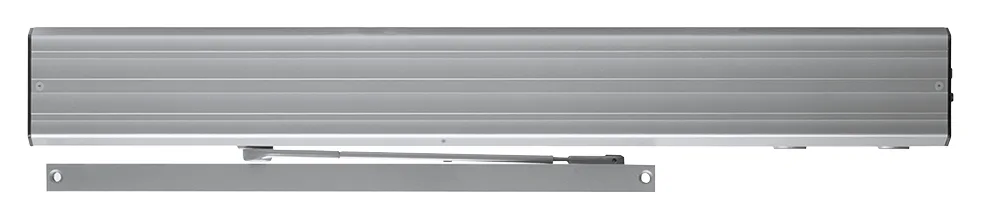
The 4640 template lists the overall operator size as 33 1/2" x 4 3/8" x 5 3/16". It says to consult the factory if the door is hung on pivots or wide-throw hinges, and recommends reinforcing hollow metal doors and frames per ANSI/SDI-100.
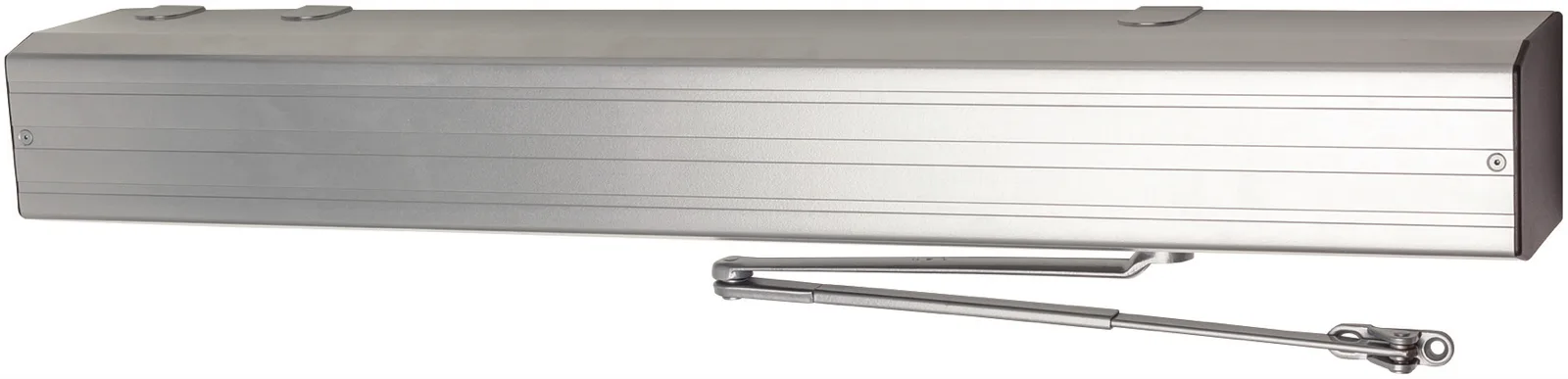
| Detail | 4630 | 4640 |
|---|---|---|
| Mounting | Top jamb (pull side) | Top jamb (push side) |
| Arms | Standard single lever arm and track | Regular arm (REGARM), standard; long arm (LONG), optional |
| Maximum opening | Templating allows 90° power opening and 170° manual opening | Templating allows 90° power opening and 100° manual opening |
| Size | Adjustable spring size 1-4 | Adjustable spring size 2-5 |
| Door weight | Up to 225 lbs | Up to 225 lbs |
| Handing | Non-handed | Non-handed |
| Reveal | Should not exceed 1/8" (3 mm) | 4-1/2" (114 mm) allows up to 90° power opening and 100° manual opening |
| Reveal with long arm | None listed | 8" (203 mm) allows the same, with the optional long rod and shoe, 4640-79LR, replacing the standard rod and shoe |
| Top rail | Minimum 1-1/8" (29 mm) | Minimum 1-3/4" (44 mm); flush ceiling installation requires 3-3/4" (95 mm) minimum |
| Head frame | Minimum 2" (51 mm) | Minimum 1-3/4" (44 mm) |
| Butt hinges | Should not exceed 5" (127 mm) in width | Should not exceed 5" (127 mm) in width |
| Auxiliary stop | Recommended | Recommended |
Source LCN's 4630 / 4640 product page, the mounting details in its Automatic Operators catalog and the templates in the installation instructions.
How is it powered?
The operator runs on 120VAC brought to the unit, and its built-in low-voltage supply can power actuators, electric strikes or magnetic locks.
LCN's documents differ on its AC current; the table gives each figure with its document.
The instructions say high voltage connections should be made by a qualified professional, and that electrical power must be disconnected during the installation.
| Item | What LCN's documents give |
|---|---|
| Input power | 120VAC supplied to the operator (instructions); 120V AC at 1.5 amperes (catalog) |
| Maximum AC current load | 1.5 amps (4630CS/4640CS instructions); 1 amp (4630/4640 instructions) |
| Built-in DC supply | 12VDC and 24VDC, rated for 1 amp combined current load |
| High voltage input protection | One amp slow blow fuse (catalog) |
| Low voltage output protection | Self-resetting fuses (catalog) |
| Wiring | Surface or concealed |
| Conduit connections | Separate for Class 1 (high voltage) and Class 2 (low voltage) wiring |
Source The electrical sections of LCN's two installation booklets and the field wiring and circuit protection notes in its Automatic Operators catalog.
What opens it, and what stops it?
An actuator is the switch or reader that tells the operator to open. The wiring diagrams show any normally open dry contact actuator, a plain switch contact with no power of its own.
The 4630CS/4640CS instructions say the series is compatible with all LCN 8310 series actuators and scanners, and that high-security card readers or keypads may also be used as actuators.
LCN's catalog says to consult the factory when using actuators supplied by others, such as card readers. It adds that, generally, two-way traffic needs an actuator on both the interior and exterior side of the door.
When an actuator triggers it, the controller checks the optional swing-side safety sensor, and an active sensor cancels the opening. If the door meets an obstruction that exceeds the present opening force setting, the controller pauses one second and tries again (LCN calls this the second chance feature). Opening then resumes until the door reaches its power opening range or a second obstruction is sensed.
An active push-side safety sensor holds the door open until the sensor clears; then the door closer assembly controls the closing.
| Function | Terminal |
|---|---|
| Actuator - normal input (N.O.) | 16 & 17 or 18 & 19 |
| Actuator - sequential input (N.O.) | 8 & 19 |
| Actuator - alternate action (N.O.) | 15 & 17 |
| Actuator - continuous (N.O.) | 6 & 17 |
| Sequential output | 9 |
| Stop side safety (N.O.) | 19 & 20 |
| Swing side safety (N.O.) | 19 & 21 |
| Fire alarm contact (N.C.) | 13 & 14 (fire shunt) |
| Auxiliary relay contacts (5 amp max) | 10 common, 11 N.O., 12 N.C. |
| E.S. relay contacts (5 amp max) | 22 common, 23 N.O., 24 N.C. |
| 12V DC and 24V DC negative | 2, 4, 13, 17 & 19 |
| 12V DC positive | 5 & 7 |
| 24V DC positive | 1 & 3 |
Source The wiring diagrams, connection table and basic operation description in LCN's installation instructions, and the actuator and drive notes in its Automatic Operators catalog.
What LCN says about ANSI/BHMA A156.19
LCN's installation instructions say the 4600 series Auto-Equalizer "is designed to meet" a list of codes and standards that begins with ANSI A156.19, section 2.1. The catalog words it differently: "Tested and certified under ANSI Standard A156.19 (Refer to Section 2.1 and consult factory for details)."
The instructions also caution that "closer and controller adjustments might be necessary to meet ANSI A156.19 requirements," and that a force gauge is needed to verify the force requirements.
The catalog lists these points for its electric Auto Equalizer systems, and its product selection guide presents them as ANSI/BHMA A156.19 requirements.
- Opening time to back check no faster than 3 seconds.
- Opening time 4 seconds or more to fully open.
- Must remain fully open for at least 5 seconds.
- Closing time from 90° to 10° no faster than 3 seconds.
- Less than 15 pounds-force to stop door's motion.
- Kinetic energy must not exceed 1.25 lbf-ft.
The door closer assembly controls the closing cycle. The instructions give a closing force of not more than 15 lbs, measured one inch from the door edge, to comply with ANSI A156.19.
Table 3 below gives the maximum door opening speeds ANSI 156.19 specifies for low-energy operators; the instructions give 5 seconds as the 4630 and 4640 maximum opening speed to 90°.
The instructions also say the low energy operator does not require guard rails or safety mats.
The instructions call for one caution / automatic door decal on each side of the door, near the latch area, to meet ANSI A156.19-2007 code requirements. It must be located at 50" (+/- 12") from the floor to the center line of the sign, visible without interference from door trim or auxiliary door hardware.
The parts list shows the door decal as part -155G, and the catalog says each actuator is packaged with a decal for the controlled door.
| Maximum door weight | 36" door | 42" door | 48" door |
|---|---|---|---|
| 100 lbs. | 3.0 sec | 3.5 sec | 4.0 sec |
| 125 lbs. | 3.5 sec | 4.0 sec | 4.5 sec |
| 150 lbs. | 3.5 sec | 4.0 sec | 4.5 sec |
| 200 lbs. | 4.0 sec | 4.5 sec | 5.5 sec |
Source LCN's installation instructions (features, important notes, Table 3 and the decal section) and the electric Auto Equalizer, product selection and actuator pages of its Automatic Operators catalog.
Settings the installation instructions name
The controller's speed, force and timing settings are preset before shipment and are for the installer, who verifies the door with a force gauge. If an operator's speed, force or hold-open time seems wrong, the next step is a service call, not a changed setting.
The time display shows a numeric value for each timing setting, with 16 equal to approximately 5 seconds.
The catalog says the factory settings are always retained in memory and can be recalled to replace the field settings. On the 4630, it gives a maximum hold open time of up to approximately five minutes.
| Setting | What it is | Range and default |
|---|---|---|
| Opening speed | How fast the door opens. Opening speed must be within ANSI A156.19 specifications. | Catalog: limited to a minimum of 3 seconds to back check (approx. 70°) |
| Opening force | The force the door exerts when opening (15 lbs. max). | Catalog: maximum of 15 lb-f to stop door swing |
| Hold open time | How long the door stays open after reaching the 90° position. | 0 to 999, default 16. Must be at least 5 seconds of hold open time. |
| 90° slow down time | Time from start of door movement to a transition at approximately 70°, when door opening speed is reduced. | 0 to 26, default 9 |
| One shot input | Off: hold open delay starts on the last activation input signal. On: it starts on the first and ignores all others. | ON/OFF, default OFF |
| Exterior mode | Off: door stops and hold open timer starts at the first restriction. On: door pauses 1 second at the first restriction (wind), then retries. | ON/OFF, default ON |
| E.S. delay | Time between activation signal and door movement, so electric latching hardware can release first. Meant only for doors with electric latching hardware. | 0 to 16, default 0 |
| E.S. 3 second power | Off: E.S. relay is powered the entire time the door is open. On: powered for only 3 seconds after activation, then releases. | ON/OFF, default ON |
| Sequential delay | Time from first door activation to second door activation. Meant only for sequential door applications. | 0 to 100, default 0 |
| Alternate action time | How long the door remains open after an alternate action input. Meant only for alternate action door applications. | 0 to 3. Default 0 = no time out; 1 = 10 minute, 2 = 20 minute, 3 = 30 minute time out. |
| Lockout time | How long a safety scanner input is ignored during door closing. Meant only where safety scanners are used. | 0 to 66, default 20 |
Source The controller settings pages of LCN's two installation booklets, and the digital control box table, program memory notes and 4630 mounting details in its Automatic Operators catalog.
With the power off or the fire alarm on
LCN's instructions list this among the features: "Fail safe operator acts as a standard door closer in event of power outage." The catalog adds that if not actuated, the Auto Equalizer functions as a full featured door closer, with the heavy duty 4040XP closer always operable.
An on/off switch turns the operator on and off without disconnecting power; the catalog lists easily accessible on/off and continuous hold open switches on the 4630 and 4640.
The non-CS booklet describes the hold open switch as an option to keep the door in the hold open position, and adds "(fire signal will override)."
The instructions list the operator as UL listed for use on labeled (fire-rated) doors. The catalog's standards, listings and approvals for its electrohydraulic systems read:
- UL listed for Fire Door Operator (GUJY) and Door Operator System (FDDR) file R18222.
- Listed for positive pressure plus UL 10B and UL 10C.
- UL 10 C Listed for Fire Rated Door Operators with Automatic Closers, File No. (GUJY).
The operator will accept a fire alarm input to deactivate the unit when the fire alarm is triggered. If fire alarm contacts are activated at any time during the opening cycle or while in hold open, the operator will override any function and close the door immediately. All power door functions are stopped until the fire alarm contacts are deactivated.
For LCN's hold-open arms and electrically released holders, see LCN hold-open closers. For fire door labels and ratings, see fire-rated door requirements.
Source The features, switch descriptions, fire alarm note and codes and standards list in LCN's installation instructions, and the standards, listings and approvals in its Automatic Operators catalog.
Indicator lights and error codes
At power-up the controller performs a self diagnostics and shows an error code if an error is present; with no error, the display is blank. In normal operation the Power and Safety Clear indicators are lit.
LCN's catalog says the LEDs allow direct observation of input power, fire alarm input, normal trigger input, sequential trigger input, hold open/alternate action input, lockout timer, and the safety sensor clear and active inputs.
| Code | Meaning in LCN's instructions |
|---|---|
| E01 | Non-functional microprocessor |
| E02 | No 12V and 24V power supplies |
| E03 | Motor / clutch not plugged in or open coil |
| E04 | Continuous activation signal upon power up or when leaving programming mode. With NORMAL/SEQ. lit, the instructions point to a mis-wired or stuck actuator switch. |
Source The diagnostics and error code pages of LCN's installation instructions and the LED list in its Automatic Operators catalog.
Service for an LCN operator
Elwin Security installs, repairs and replaces LCN low-energy door operators as part of its commercial door closer and exit device service for commercial and multifamily properties in the San Francisco Bay Area. Calls are answered 8:00 AM-8:00 PM daily at (408) 539-0535.
Questions about LCN operators
LCN 4630 and 4640 questions
What is the difference between the LCN 4630 and 4640?
The 4630 mounts on the pull side with a single lever arm and track; the 4640 mounts on the push side with a regular arm. The 4630 allows 170° of manual opening and the 4640 allows 100°.
What power does an LCN 4640 need?
120VAC supplied to the operator, at 1.5 amps in the catalog and the 4630CS/4640CS instructions, 1 amp in the 4630/4640 instructions. Its on-board supply provides 12V and 24V DC at 1.0 ampere maximum combined load.
Does an LCN 4630 or 4640 connect to the fire alarm?
Yes. It accepts a fire alarm input that deactivates the unit and closes the door immediately when the fire alarm contacts are activated.
What does E04 mean on an LCN 4630 or 4640 controller?
A continuous activation signal upon power up or when leaving programming mode. If the NORMAL/SEQ. indicator is lit, LCN's instructions point to a mis-wired or stuck actuator switch.
Sources and further reading
These sources back up the general guidance. Your building and the people who approve the work decide the details for your doors.
- LCN (Allegion): Automatic Operators Catalog Section (009510, Rev. 08/26)
- LCN (Allegion): 4630CS/4640CS Electric Auto-Equalizer Series Installation Instructions (29268, Rev. 05/19)
- LCN (Allegion): 4630/4640 Series Electric Auto-Equalizer Installation Instructions (28101, Rev. 01/19)
- LCN (Allegion): 4630 / 4640 Auto Equalizer Series Operators product page
- LCN (Allegion): Door Controls General Information Catalog (009514, Rev. 05/26)
- LCN (Allegion): Installation Instructions/Templates Index (Rev. 03/26)