
Key takeaways
- Aiphone documents IX and IXG as one series. The IXG models are the multi-tenant stations: a directory entrance station, a tenant station and a guard station.
- The stations require a PoE connection for communication and power. The IX-DV, IX-DVF and IX-SSA can also use a 24-volt DC supply; the IX-EA, IX-DVM and IX-SS-2G list PoE only.
- On the IX door stations covered here, the relay is rated 24 volts AC or DC at 1 amp (resistive load); the IXG entrance station's two relays are rated 3 amps and 500 milliamps.
- A door station can call up to 20 stations in a single group, and an answering station's address book holds up to 500 stations.
- Registering the IXG phone app takes an IXGW gateway and an IXG cloud server administrative account; calling a registered phone number needs an IXGW-TGW with an active SIM plan.
Identify
Which Aiphone IX or IXG station do I have?
The table lists the stations this page covers, with the name on each data sheet.
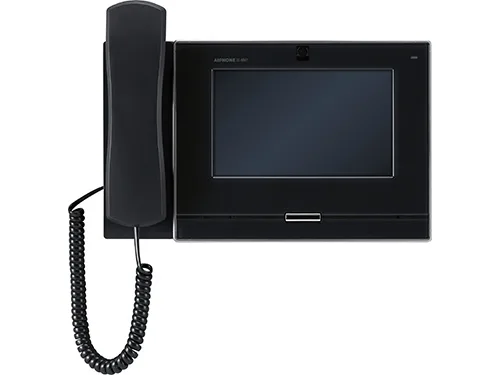
Inside, a video answering station on a desk stand or the wall is an IX-MV7; the IX-MV7-HB adds a handset. The audio-only IX-RS is a sub station.
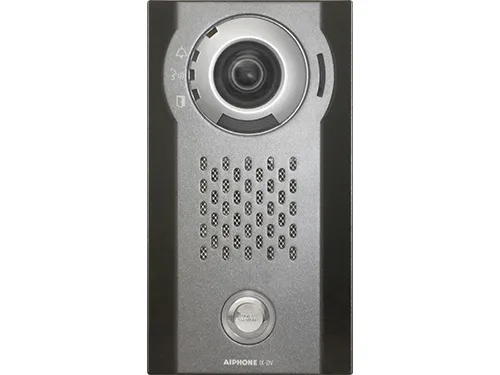
At the entrance, mounting tells the door stations apart: the IX-DV and IX-EA mount on the wall surface, the IX-DVF and IX-SSA are flush mounted (set into the wall), and the IX-DVM fits a mullion, a narrow upright frame member. The IX-SSA and IX-SS-2G are audio only.
A door station with two buttons (standard call and emergency call), raised lettering and braille signage is an emergency call station.
An entrance panel with a 7-inch directory screen, used to call a tenant or enter an access code, is the IXG-DM7-HIDA entrance station. The IXG-2C7 is Aiphone's video tenant station and the IXG-MK its video guard station.
Aiphone lists more, including the IX-SOFT software answering station and IX-DVF and IX-SSA variants with their own data sheets; this page doesn't cover them.
For how a controller, power supply and lock work together on any brand of system, see the general guide to how commercial access control works.
| Model | Aiphone's name | Video or audio | Mounting | Notes |
|---|---|---|---|---|
| IX-MV7-B, IX-MV7-W | IP Video Answering Station | Video | Included desk stand, or mounted to a wall | |
| IX-MV7-HB | IP Video Answering Station (with handset) | Video | Included desk stand, or mounted to a wall | |
| IX-RS-B, IX-RS-W | IP Audio Room Sub Station | Audio | Surface mount | |
| IX-DV | IP Video Door Station | Video | Surface mount | Product page: vandal resistant and weather resistant, with an aluminum die cast cover |
| IX-DVF | IP Video Door Station | Video | Flush mounted with included back box, or surface mount with the SBX-IDVF stainless steel box (product page) | |
| IX-DVM | IP Video Door Station | Video | Mullion mount | Built-in touchless call sensor, which incorporates a Class 1 laser |
| IX-EA | IP Video Door Station | Video | Surface mount | |
| IX-SS-2G | IP Audio Door Station | Audio | Flush mounted with a locally available 2-gang box, 2-1/2 inches deep or greater, or surface mount with the SBX-2G/A box (product page) | |
| IX-SSA | IP Audio Door Station | Audio | Flush mounted with included back box, or surface mount with the SBX-IDVF stainless steel box (product page) | |
| IX-DVF-2RA | IP Video Emergency Call Station | Video | Flush mount | Two buttons, raised lettering, braille |
| IX-SSA-2RA | IP Audio Emergency Call Station | Audio | Flush mount | Two buttons, raised lettering, braille |
| IXG-DM7-HIDA | IP Video Entrance Station | Video | Flush mount with IXG-DM7-BOX or surface mount with SBX-IXGDM7 | HID card reader: 26-bit Wiegand formats only (data sheet); Prox or iCLASS 26- and 37-bit, Aiphone 40-bit, Corporate 1000 35- and 48-bit (product page) |
| IXG-2C7 | IP Video Tenant Station | Video | Wall-mount | |
| IXG-MK | IP Video Guard Station | Video | Wall or desk mount (stand included) |
Source Each station's data sheet and product page, and Aiphone's IX | IXG Series Network Security Summary.
IX and IXG
How do IX and IXG stations fit together, and how big can a system get?
Aiphone describes the IX | IXG Series as a peer-to-peer network video intercom system, allowing unlimited expansion: the stations call one another over the network.
IX stations such as the IX-MV7 and IX-DV are, in Aiphone's words, compatible with all IX | IXG series devices. Aiphone's multi-tenant programming guide is for sites with an IXG-DM7-HIDA entrance station; a site without one uses the standard guide instead.
In a multi-tenant system, stations are divided into units, groups of stations that serve a particular purpose. The table gives each kind of unit and the limits Aiphone states.
| Limit or unit | What Aiphone states |
|---|---|
| Stations one door station calls | Up to 20 stations in a single group when its call button is pressed; its contact inputs can call up to 20 stations |
| Answering station address book | Up to 500 stations; it can receive calls from an unlimited number of stations, including stations not in its address book |
| Incoming calls at once | Up to 20 on an answering station, shown on a call queue list |
| Stations called at the same time | Up to 50 with Unicast, the default for outbound calls; up to 500 with Multicast, which requires extra configuration on the site's network |
| Residential Unit | Eight total IXG-2C7 or IX-RS-* answering stations, eight IXG mobile apps, two door stations and one registered phone number |
| Entrance Station Unit | Ten IXG-DM7-HID(A) entrance stations |
| Directory names | Up to 9,999 names/numbers stored in the IXG-DM7-HIDA |
| IXGW-TGW gateways | Up to 99 per system; eight simultaneous calls per adaptor; up to 9,999 IXG mobile apps; up to eight apps per tenant station |
Source Aiphone's Call Capacity and Station Features knowledge base articles, its Network Security Summary, its IX | IXG Series Multi-Tenant Programming Quick Start Guide, the IX-MV7-B and IX-DV product pages, and the IXG-DM7-HIDA and IXGW-TGW data sheets.
Power and network
How is it powered and connected?
Aiphone's Network Security Summary says IX | IXG Series stations require a PoE connection for communication and power: one network cable carries both. The IX-DV, IX-DVF, IX-SSA and the two emergency call stations can also run from a 24-volt DC supply, Aiphone's PS-2420UL.
For the IX-DVF, IX-EA and IX-DVM, the technical specifications say a PoE-compatible switch must be used as the switch (hub) for station connection.
The IX-DV, IX-DVF and IX-SSA can pass PoE on to another device (PoE passthrough), which requires 802.3at Type 2 PoE+, a higher-power standard; the installation manual says an IEEE 802.3at compatible PoE switch must then power the intercom unit. Used together with a PoE switch, the PS-2420 can provide back-up power if the PoE power supply fails.
For the installer, the multi-tenant guide says each station requires an IP address and subnet mask, and any IXGW gateway adaptors also require a default gateway and a DNS server, assigned statically or by DHCP reservation.
| Model | Power source | Operating temperature | Protection |
|---|---|---|---|
| IX-MV7-B, IX-MV7-W, IX-MV7-HB, IX-RS-B, IX-RS-W | PoE (IEEE 802.3af class 0) | 32° to 104°F | Not listed |
| IX-DV | PoE (IEEE 802.3af class 0) or 24V DC (PS-2420UL) | -40° to 140°F | IP54, IK08 |
| IX-DVF, IX-DVF-2RA | PoE (IEEE 802.3af class 0) or 24V DC (PS-2420UL) | -40° to 140°F | IP65, IK08 |
| IX-DVM | PoE (IEEE 802.3af class 0) | -40° to 140°F | IP54, IK07 |
| IX-EA | PoE (IEEE 802.3af class 0) | -40° to 140°F (data sheet); 14° to 140°F (product page); -10 to +60°C, +14 to +140°F (technical specification) | IP54 |
| IX-SS-2G | PoE (IEEE 802.3af class 0) | -40° to 140°F | IP65 (data sheet and product page); IK10 (data sheet); IK08 (product page and technical specification) |
| IX-SSA, IX-SSA-2RA | PoE (IEEE 802.3af class 0) or 24V DC (PS-2420UL) | -40° to 140°F | IP65, IK08 |
| IXG-DM7-HIDA | PoE (IEEE 802.3af Class 0) | -22° to 140°F | IP65, IK08 |
| IXG-2C7 | PoE (IEEE 802.3af class 0) | 32° to 104°F | Not listed |
| IXG-MK | PoE (802.3af) | 32° to 104°F | Not listed |
| IXGW-TGW | PoE | 14° to 122°F | Not listed |
Source Each station's data sheet, the IX-EA, IX-SS-2G and IXG-MK product pages, the IX-DVF, IX-EA, IX-DVM and IX-SS-2G technical specifications, the IX Series Door Stations Installation Manual, and the Multi-Tenant Quick Start Guide.
Door release
How does it release the door?
IX | IXG Series door stations have built-in door release relays, switches that can be programmed to trigger during door release. Aiphone calls the output a Form C dry contact: a switch that supplies no power of its own, with a normally open (N/O) and a normally closed (N/C) side.
The IX-MV7-B data sheet says door release will only unlock the entrance that is associated with the connected door station.
For the installer, Aiphone's IX-MV7, IX-DV and IXW-MAA door release wiring diagram shows an 18 AWG, 2-conductor run from each IX-DV to a box labelled "Lock and Power or Access Panel (REX) Input" (REX is request to exit), plus a Cat-5e/6 network cable to the PoE switch.
| Model | Outputs | Output type | Contact rating |
|---|---|---|---|
| IX-DV | Two contact outputs, programmable to trigger during door release or based on the status of the station | Form C dry contact (N/O or N/C) | 24 VAC, 1 A or 24 VDC, 1 A (resistive load) |
| IX-EA | One contact output with the same description | Form C dry contact (N/O or N/C) | 24 VAC, 1 A or 24 VDC, 1 A (resistive load) |
| IX-DVM | One contact output that can be used for door release | Form C dry contact (N/O or N/C) | 24 VAC, 1 A or 24 VDC, 1 A (resistive load) |
| IX-DVF, IX-DVF-2RA, IX-SSA, IX-SSA-2RA, IX-SS-2G | - | Form C dry contact (N/O or N/C) | 24 VAC, 1 A or 24 VDC, 1 A (resistive load) |
| IXG-DM7-HIDA | Two programmable Form C dry contacts | Form C dry contact | 24V AC/DC; Relay 1: 3A; Relay 2: 500mA |
| IXW-MAA adaptor | Ten Form C relay outputs | Form C relay | 24V AC/DC 500mA |
Source Aiphone's installation manuals for the IX door stations, the IX-DV, IX-EA, IX-DVM, IX-MV7-B and IXG-DM7-HIDA data sheets, the IX block diagram for door release wiring, the IXW-MAA product page and the Multi-Tenant Quick Start Guide.
Mobile app
How do calls reach a phone?
Aiphone calls the IXGW-TGW a cloud gateway that connects door stations to the IXG mobile app, which lets tenants talk with visitors and open doors from anywhere; the app is compatible with iOS and Android devices.
The app is free to download. Registering apps takes an IXGW-(T)GW mobile app gateway and, first, an IXG cloud server administrative account. Each phone is registered to a single unit with a QR code, and each code can be used once.
Once activated, the gateway's included SIM card provides an LTE (cellular) connection: it allows a single phone number to be called per tenant and can be used as the primary network connection or as a backup failsafe. A registered phone number requires an active SIM plan, and the cloud gateway cellular data plan is managed on AiphoneCloud.
Source Aiphone's IXGW-TGW product page and data sheet, the Multi-Tenant Quick Start Guide and the AiphoneCloud page.
Programming tools
How is it programmed?
IX stations are set up with the IX Support Tool, software designed to batch configure all IX stations simultaneously, identifying each by its MAC address (its hardware network address). For IX | IXG systems, one of two methods must be chosen: IXG Support Tool on a local PC, or Remote Management through AiphoneCloud, from any location, for sites using an IXGW-TGW gateway.
For the installer, the IX guide says the IX Series is designed to function on managed networks, but the broadcast method used to find stations may not function properly there, and a second network connection, such as a VPN or WiFi connection, may prevent Support Tool from finding stations. Stations retain their programming for weeks without power, so a system can be configured off-site before installation.
This page does not reproduce programming steps. For what Aiphone lists when a station search fails, see the guide to apartment intercom troubleshooting by model.
Source Aiphone's IX Series Quick Start Programming Guide, its Network Security Summary and its Multi-Tenant Quick Start Guide.
Integration
Does it work with phone systems and video recorders?
Aiphone states three standards station by station: SIP, for internet phone calls; ONVIF Profile S, which video systems use to connect to cameras; and RTSP, for video streaming.
IX and IXG Series video door stations offer a secondary video stream that can be streamed to a compatible VMS (video management system) using ONVIF or RTSP. On the IX-DVF, IX-EA and IX-DVM, the door station's ONVIF video system can only be accessed by one 3rd party product at a time; multiple simultaneous connections are not possible.
| Model | SIP | ONVIF Profile S | RTSP |
|---|---|---|---|
| IX-DV | SIP compliant | Compliant | Capable of streaming video feeds through RTSP |
| IX-DVF, IX-EA, IX-DVM | SIP compliant | Compliant | Capable of streaming video through ONVIF and RTSP |
| IX-MV7-B | SIP compliant | Compliant | Not given here |
| IX-SSA, IX-SS-2G | Compliant with SIP | Not given here | Not given here |
| IX-RS-B | SIP compliant | Not given here | Not given here |
| IXG-MK | SIP compliant | Not given here | Not given here |
Source Each station's product page, Aiphone's General ONVIF and RTSP Registration note and the IX-DVF, IX-EA and IX-DVM technical specifications.
Discontinued
Is my station discontinued?
Aiphone's knowledge base keeps the IX-MV, the IX-DVF-P and the IXGW-GW gateway adaptor under legacy stations. Each of those pages says the station is discontinued and may no longer be supported, and that the instructions are provided to assist with operation and maintenance and to guide upgrade paths.
| Model | What Aiphone says |
|---|---|
| IXG-DM7-HID entrance station | Discontinued as of 5/31/2024 (product page); Aiphone names the IXG-DM7-HIDA as the replacement |
| IX-MV | Discontinued and may no longer be supported (legacy stations) |
| IX-DVF-P | Discontinued and may no longer be supported (legacy stations) |
| IXGW-GW gateway adaptor | Discontinued and may no longer be supported (legacy stations) |
Source Aiphone's IXG-DM7-HID product page, its Network Security Summary and the legacy-station pages in its knowledge base.
FAQ
Aiphone IX and IXG questions
What is the difference between Aiphone IX and IXG?
Aiphone documents them as one IX | IXG Series. The IXG models are the multi-tenant stations: the IXG-DM7-HIDA entrance station, the IXG-2C7 tenant station and the IXG-MK guard station.
What is the door release relay on an Aiphone IX-DV rated for?
Aiphone's door stations installation manual gives the IX-DV relay output as a Form C dry contact (N/O or N/C) rated 24 VAC, 1 A or 24 VDC, 1 A (resistive load). The station has two contact outputs.
Is the Aiphone IXG-DM7-HID discontinued?
Yes. Aiphone's product page says it has been discontinued as of 5/31/2024 and gives the IXG-DM7-HIDA as the replacement part. Aiphone's Network Security Summary lists the IXG-DM7-HIDA as the entrance station available.
Service
Help with an Aiphone IX or IXG system
Elwin Security installs, repairs, replaces and supports Aiphone IX and IXG intercom stations through its Aiphone intercom repair and replacement service for commercial and multifamily properties in the San Francisco Bay Area. Calls are answered 8:00 AM-8:00 PM daily at (408) 539-0535.
Sources and further reading
These sources back up the general guidance. Your building and the people who approve the work decide the details for your doors.
- Aiphone: Call Capacity (IX & IXG Support Tool), updated February 5, 2026
- Aiphone: IX | IXG Series Station Features, updated May 15, 2026
- Aiphone: IX | IXG Series Network Security Summary (09/26)
- Aiphone: IX | IXG Series Multi-Tenant Programming Quick Start Guide (08/25)
- Aiphone: IX Series Quick Start Programming Guide (IX Support Tool Version 10.0.0.0 or later)
- Aiphone: IX Series Door Stations Installation Manual (IX-DV, IX-DVF, IX-SSA and variants; issue date Dec. 2019)
- Aiphone: IX-EA Installation Manual
- Aiphone: IX-DVM Installation Manual
- Aiphone: IX-SS-2G Installation Manual
- Aiphone: IX-MV7, IX-DV, and IXW-MAA Door Release Wiring (IX Block Diagram)
- Aiphone: General ONVIF and RTSP Registration application note (11/2023)
- Aiphone: IX-MV7-B Data Sheet (02/26)
- Aiphone: IX-MV7-W Data Sheet (02/26)
- Aiphone: IX-MV7-HB Data Sheet (02/26)
- Aiphone: IX-RS-B Data Sheet (02/26)
- Aiphone: IX-RS-W Data Sheet (02/26)
- Aiphone: IX-DV Data Sheet (02/26)
- Aiphone: IX-DVF Data Sheet (02/26)
- Aiphone: IX-DVF Technical Specification
- Aiphone: IX-DVM Data Sheet (02/26)
- Aiphone: IX-DVM Technical Specification
- Aiphone: IX-EA Data Sheet (02/26)
- Aiphone: IX-EA Technical Specification
- Aiphone: IX-SS-2G Data Sheet (02/26)
- Aiphone: IX-SS-2G Technical Specification
- Aiphone: IX-SSA Data Sheet (02/26)
- Aiphone: IX-DVF-2RA Data Sheet (02/26)
- Aiphone: IX-SSA-2RA Data Sheet (02/26)
- Aiphone: IXG-DM7-HIDA Data Sheet (02/26)
- Aiphone: IXG-2C7 Data Sheet (02/26)
- Aiphone: IXG-2C7 Technical Specification
- Aiphone: IXG-MK Data Sheet (02/26)
- Aiphone: IXGW-TGW Data Sheet (02/26)
- Aiphone: IX-DV Data Sheet (knowledge base page listing IX and IXG door station data sheets)
- Aiphone: IXGW-GW Technical Specifications (legacy stations)
- Aiphone: IX-DVF-P Data Sheet (legacy stations)
- Aiphone: IX-MV Specifications (legacy stations)
- Aiphone: IX-MV7-B product page
- Aiphone: IX-RS-B product page
- Aiphone: IX-DV product page
- Aiphone: IX-DVF product page
- Aiphone: IX-DVM product page
- Aiphone: IX-EA product page
- Aiphone: IX-SS-2G product page
- Aiphone: IX-SSA product page
- Aiphone: IXG-DM7-HIDA product page
- Aiphone: IXG-DM7-HID product page (discontinued 5/31/2024)
- Aiphone: IXG-MK product page
- Aiphone: IXGW-TGW product page
- Aiphone: IXW-MAA product page
- Aiphone: AiphoneCloud