
Key takeaways
- DoorKing lists three 1812 models: the 1812 Classic, the 1812 Plus and the 1812 Access Plus. Only the Access Plus is marked as PC programmable.
- In telephone mode the house phone line passes through a by-pass board, which the Classic manual says is not optional.
- All three models have two relays, each able to control a normally open or normally closed device, with contacts rated at 3 amps at 30 VAC maximum.
- The Classic operates only on 24 VAC. The Plus and Access Plus manuals say those models operate only on 16.5 VAC and must not be powered from a 24-volt source.
Identify
Which DoorKing 1812 do I have?
DoorKing's literature names three models to choose from, and its model table labels them 1812 (Classic), 1812-P (Plus) and 1812-AP (Access Plus).
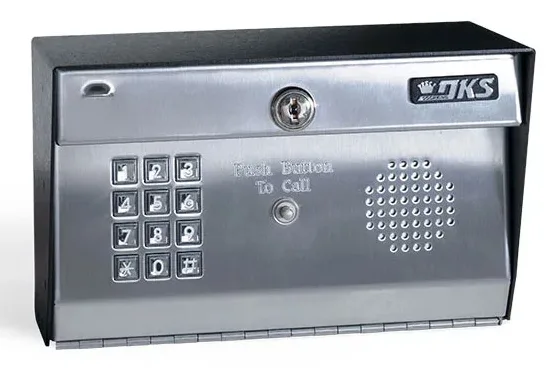
DoorKing calls the Plus an updated version of the Classic, with an upgraded processor, a new high fidelity digital voice circuit, better volume control and a lighted push-button. The Access Plus is IP addressable (it can join a computer network) and controls up to six additional access points using cards, transmitters or keypads.
From the front, the older brochure marks an LED lighted faceplate on the Classic and an LED lighted keypad on the Plus and Access Plus.
The literature gives the Classic an analog voice circuit; the 1812 Classic product page lists a hands free, full duplex digital audio circuit.
For a panel that is dead, will not ring the house or will not release the door, see apartment intercom troubleshooting by model.
| Feature | 1812 (Classic) | 1812-P (Plus) | 1812-AP (Access Plus) |
|---|---|---|---|
| Phone numbers | 3 | 27 | 27 |
| Directory names | N/A | N/A | N/A |
| Entry codes | 50 | 50 | 0 |
| Device codes | 0 | 0 | 100 |
| Relays | 2 | 2 | 2 |
| Inputs | 2 | 2 | 2 |
| Expansion | No | No | 6 Max |
| PC programmable | No | No | Yes |
| Temporary codes | 5 | 10 | 10 |
| Holiday schedule | No | No | Yes |
| Voice circuit | Analog | HD digital | HD digital |
| Dialing | 11-digit | 20-digit | 20-digit |
Source DoorKing's three 1812 product pages, its 1812 Series literature (2020) and its older 1812 Series brochure (2019).
Connection
Does it need its own phone line, or can it use a network?
The literature says the system connects directly to the homeowner's existing telephone line, with no additional monthly expenses for a separate telephone line.
In telephone mode, the incoming line passes through a by-pass board. The Classic manual says the board is not optional when using an incoming telephone line or internet, and that all telephone wires for the 1812 must pass through it.
In intercom mode, the Classic manual says only the PHONE OUT terminals are used, wired straight to a single telephone or an un-used C.O. port (an outside-line port) on a PBX or KSU business phone system. The Plus manual says its dial-out directory codes cannot be used in intercom mode.
For a cellular connection, DoorKing's cut sheet lists the 1800-080 interface for use with the 1812 and the 1800-081 for the 1812AP, on the AT&T 4G-LTE network where available.
On the Access Plus, an RJ-45 network jack on interface board 1972-010 connects it directly with a crossover cable, through a router on a local network, or over the internet with a static or dynamic IP address. The manual limits the Cat5 run to 325 feet (100 meters).
It also has a built-in modem for connecting to a PC, but of POTS (a plain analog phone line) DoorKing's older brochure says: "POTS is not recommended as DoorKing can no longer guarantee modem connections."
Source DoorKing's 1812 Series literature and brochure, the three 1812 installation/owner's manuals, and DoorKing's telephone entry cellular connection cut sheet (2026).
Relays
How does an 1812 control a door or gate?
Two internal relays allow the system to control a main entry gate plus a pedestrian access gate. Each can control a normally open or normally closed access control device, with contacts rated for 3 amps at 30 VAC maximum. The switch inputs can be used to activate relay 1 or relay 2.
The Classic manual's intercom-mode wiring diagram labels a magnetic lock on the normally closed contact and an electric strike on the normally open contact of relay 2, and says magnetic locks or electric strikes "must be powered from a separate UL Listed power transformer."
The Classic and Plus manuals list four relay functions available by telephone: momentary activation for the programmed strike time, hold open, deactivate, and hold 1 hour.
On the Access Plus, RS-485 terminals add up to six card readers, keypads and/or RF receivers, daisy-chained with a maximum wire run distance of 4000 feet and each on its own power source, not the 1812.
For vehicle gates, each of the three manuals states: "When used to control a vehicular gate with an automatic gate operator, the telephone entry system must be mounted a minimum of six (6) feet away from the gate and gate operator, or in such a way that a person cannot operate the entry system and/or touch the gate or gate operator at the same time."
| Terminal | 1812 Classic | 1812 Plus and Access Plus |
|---|---|---|
| 6 | External time clock input | Not used |
| 7 and 8 | Switch inputs: Emergency and/or Postal Entry Switch | Switch inputs: Emergency and/or Postal Entry Switch |
| 11, 12, 13 | Relay 1: normally open, normally closed, common | Relay 1: normally open, normally closed, common |
| 14, 15, 16 | Relay 2: normally open, normally closed, common | Relay 2: normally open, normally closed, common |
Source The quick guides, features lists and wiring pages of the three 1812 installation/owner's manuals.
Capacity
How many codes and phone numbers does each model hold?
Codes typed on the panel's keypad (or a secondary keypad) are entry codes in DoorKing's literature and access codes in its manuals; device codes come from five-digit RS-485 devices such as cards, transmitters or PINs.
The Classic stores up to 50 unique four-digit access codes; each relay gets 14 momentary activation codes, 1 flash code, 5 hold codes and 5 time zone codes.
The Plus takes up to 50 five-digit access codes, both "simple" codes, which operate on a 24/7 basis, and time zone restricted codes. Its product page adds 10 temporary entry codes with start and end dates.
DoorKing's older brochure lists 4-digit Plus entry codes; its newer literature, the Plus product page and the manual give five digits.
The Access Plus is stated two ways. The literature's model table lists 0 entry codes and 100 device codes, and the product page's summary reads "Not Used with Entry Codes", yet the same sheet's 1812-P and 1812-AP column lists 50 5-digit entry codes with time zone restrictions on some codes. The manual lists 100 card / transmitter / keypad codes (50 with phone numbers, 50 as access only), and the same manual and product page also describe up to 50 five-digit keypad access codes.
Source DoorKing's 1812 Series literature and brochure, the 1812 Plus and Access Plus product pages, and the three 1812 installation/owner's manuals.
Calls
What happens when a guest calls?
Calls from the access system are identified with a double ring, so homeowners know instantly if a call is coming from their door or gate.
In the Classic manual, call waiting sounds a short tone in the homeowner's handset when a guest pushes the button during a call. Do not disturb, within its time zone, stops both ringing and call forwarding. Call forwarding dials a preprogrammed number whenever enabled, or only within its time zone.
The literature lists 4 hold open time zones, which on the Classic work in pairs, two per relay. Answer machine bypass is listed for the 1812-P and 1812-AP in the 2020 literature, and for all models in the 2019 brochure.
Source DoorKing's 1812 Series literature and brochure, and the 1812 Classic installation/owner's manual.
Power
What power does it need?
The Plus and Access Plus manuals say powering the 1812 from a 24-volt source, such as a gate operator, causes damage that is not covered under DoorKing's warranty.
Those two manuals give 16.5 VAC as the only operating voltage, while their own power sections ("the supplied power transformer, 16 VAC, 20 VA (or U.L. listed equivalent)"), the literature and the two product pages give the transformer as 16 VAC.
On standards, the product pages print "Complies with UL 294; ETL Listed." The 2020 literature prints "Conforms To UL STD 294:2018 Ed 7".
| Item | 1812 Classic | 1812 Plus and Access Plus |
|---|---|---|
| Supply | 24 VAC only | 16.5 VAC only; not to be powered with 24 volt AC power |
| Supplied transformer (manual) | "the supplied power transformer, 24 VAC, 20 VA (or U.L. listed equivalent)" | 16 VAC, 20 VA (or U.L. listed equivalent) |
| Back-up battery | Two 12 volt .8 amp hour batteries, DoorKing P/N 1801-008, in series to terminals 9 and 10 | One 12 volt .8 amp hour gel cell battery to terminals 9 and 10; maximum input 14.5 volts DC |
| Power loss | Clock keeps time approximately 48 hours; all other programming remains intact | Clock keeps time approximately 48 hours; all other programming remains intact |
| Environmental range (literature and product pages) | 10°F to 145°F (-12°C to 62°C) | 10°F to 145°F (-12°C to 62°C) |
Source The three 1812 installation/owner's manuals, DoorKing's three 1812 product pages and its 1812 Series literature.
Mounting
How does it mount, and where?
The product pages list surface or flush mount for the Classic and add curved surface for the Plus and Access Plus; the stainless steel housing is surface mount only. The manuals and the older brochure also show wall mount for all three.
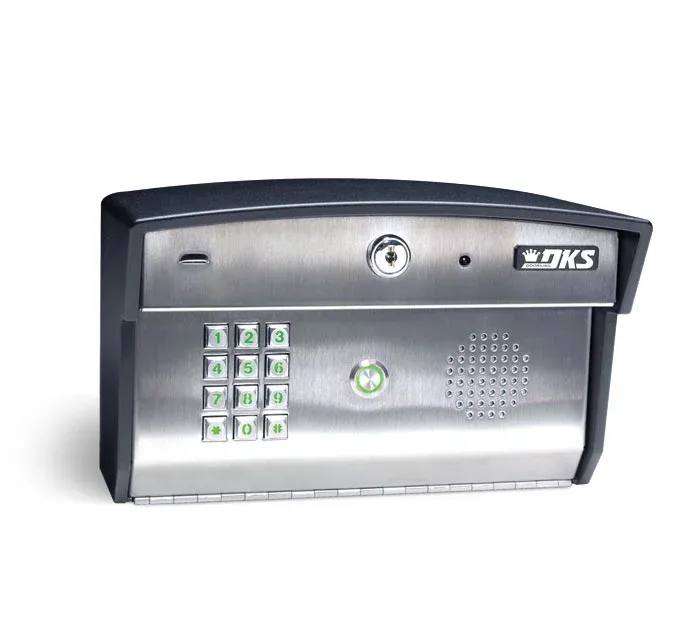
Surface mount units are designed for direct outdoor installations, though it is preferable to protect them from driven rain or snow whenever possible; flush mount units must be protected from direct exposure to the elements. Under no circumstances should the unit be mounted directly to a moving door or gate.
| Style | Product pages | Rev. 10/20 literature |
|---|---|---|
| Surface | 6.13"H x 10"W x 5.25"D | 6.13" x 10.00" x 5.25" |
| Curved surface | 7.38"H x 10.88"W x 6"D (Plus and Access Plus pages) | 6.75" x 11.00" x 6.25" |
| Flush | 9.13"H x 11.88"W x 4.5"D | 9.13" x 11.88" x 4.50" |
Source DoorKing's three 1812 product pages, its 1812 Series literature and brochure, and the three 1812 installation/owner's manuals.
Manuals
Which manual goes with my 1812?
DoorKing's tech support pages link one installation/owner's manual per model; each cover names the circuit board it applies to.
Each has a terminal quick guide, specifications and dimensions, then installation, programming, adjustments, operating instructions and maintenance, which holds the troubleshooting table, wiring schematic, accessories list and log sheets.
Each manual covers programming and the master code. This page does not reproduce programming steps, codes or the log sheets.
On the Access Plus, four items can only be programmed from a computer: Strike Out, holiday schedules, email notification and the transaction log.
| Model | Manual number | Circuit board named on the cover | Access Plus Account Manager software |
|---|---|---|---|
| 1812 Classic | 1812-065-E-3-20 | 1871-010 Revision S or higher | Cannot be used with this board |
| 1812 Plus | 1812-161-W-6-18 | 1971-010 Revision U or higher | Cannot be used with this board |
| 1812 Access Plus | 1812-162-D-6-19 | 1970-010 Revision U or higher | For this board only |
Source DoorKing's 1812 tech support pages, the three 1812 installation/owner's manuals and the 1812 Access Plus product page.
Service
Help with a DoorKing 1812
Elwin Security installs, repairs, replaces and supports DoorKing 1812 telephone intercom systems through its intercom repair service for commercial and multifamily properties in the San Francisco Bay Area. Calls are answered 8:00 AM-8:00 PM daily at (408) 539-0535.
FAQ
DoorKing 1812 questions
What is the difference between the DoorKing 1812 Classic, Plus and Access Plus?
DoorKing's literature gives the Classic 3 phone numbers, four-digit codes and a 24 VAC transformer, and the Plus 27 numbers, five-digit codes and a 16 VAC transformer. Only the Access Plus is marked PC programmable, with 6 more entry points and a holiday schedule.
Does a DoorKing 1812 need its own phone line?
No. DoorKing's literature says it connects directly to the homeowner's existing telephone line.
What are the relays on a DoorKing 1812 rated for?
All three DoorKing 1812 manuals rate the relay contacts for 3 amps at 30 VAC maximum.
Can a DoorKing 1812 Plus run on a 24-volt transformer?
No. The 1812 Plus manual says the Plus operates only on 16.5 VAC and is not to be powered with 24 volt AC power; a 24-volt source causes damage not covered under DoorKing's warranty. The Classic is the 24 VAC model.
Sources and further reading
These sources back up the general guidance. Your building and the people who approve the work decide the details for your doors.
- DoorKing: 1812 Classic product page
- DoorKing: 1812 Plus product page
- DoorKing: 1812 Access Plus product page
- DoorKing: 1812 Series Entry + Access Control Systems literature (Rev. 10/20)
- DoorKing: 1812 Series Telephone Intercom Residential Systems brochure (Rev. 3/19)
- DoorKing: Model 1812 Classic Installation/Owner's Manual (1812-065-E-3-20)
- DoorKing: Model 1812 Plus Installation/Owner's Manual (1812-161-W-6-18)
- DoorKing: Model 1812 Access Plus Installation/Owner's Manual (1812-162-D-6-19)
- DoorKing: Telephone Entry Cellular Connection cut sheet (Rev. 8/26)